The Subordinated Debt Strategy for Growth
National Business Capital's Joe Camberato discusses a capital stack strategy that includes sub debt
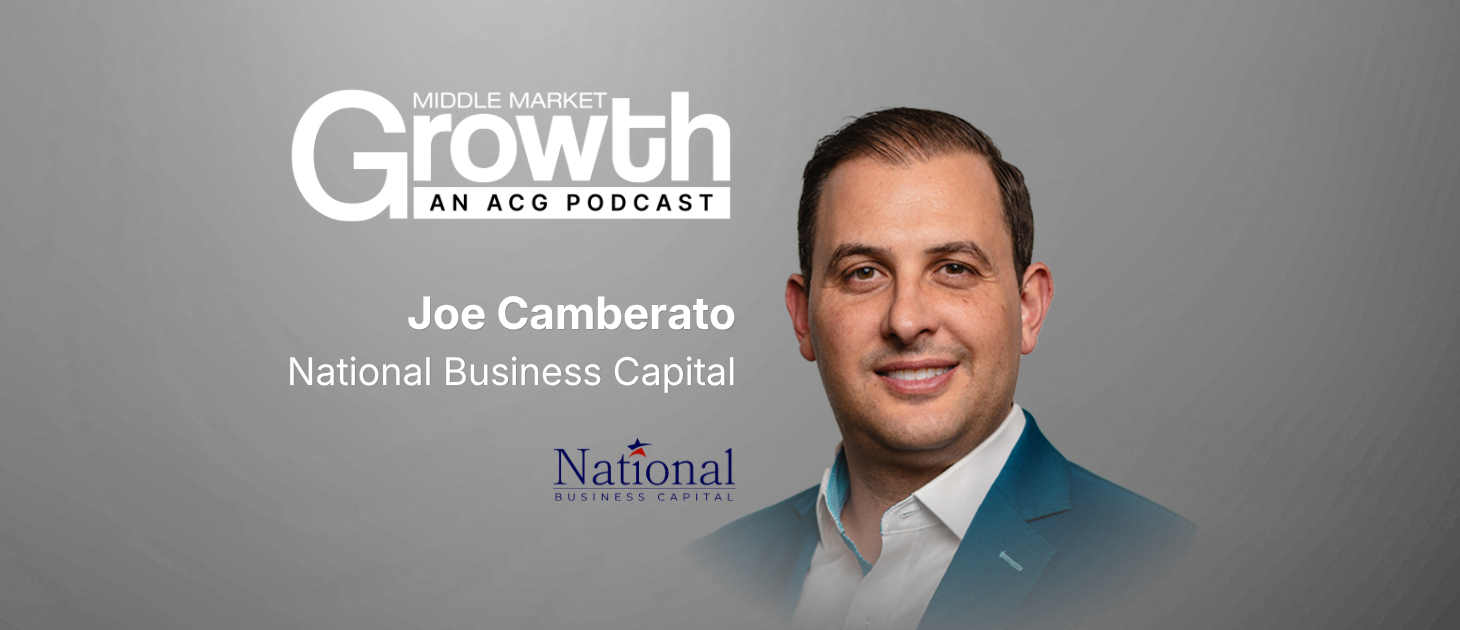
Subordinated debt can play an important role in the capital stack for businesses growing into the middle market—if used in the right circumstances. Joe Camberato, founder and CEO of National Business Capital, shares how he’s seeing small and midsized businesses use sub debt not as a lifeline for cash, but as fuel for expansion and exit-readiness.
This episode is brought to you by National Business Capital. Learn more at nationalbusinesscapital.com.
Middle Market Growth: Welcome to ACG’s Middle Market Growth podcast. I’m Carolyn Vallejo. The right growth strategy involves the right capital strategy, and capital needs can change as a small business grows into the middle market and potentially prepares for an exit. Here to dig into how businesses can use subordinated debt, or sub debt, to calibrate their capital for growth and a sale is Joe Camberato, founder and CEO of National Business Capital. Joe, welcome to the podcast.
Joe Camberato: Thanks for having me.
MMG: Can you tell us first a bit about National Business Capital and the work that you do there?
JC: Yes. I founded National Business Capital in 2007. We’ve grown into a market leader for growth capital and bridge capital. We’re non-asset focused, and we typically fund deals of up to about $10 million, $12 million or $15 million. We do really well with deals of $10 million to $15 million and under. We’ve really helped serve that lower-middle-market-to-larger-small-business end of the market. We’ve deployed more than $3 billion in capital.
MMG: And just for a little bit of fun, if you could pick any walkout song, what would it be?
JC: “Juicy” by The Notorious B.I.G.
MMG: Love it. That’s a good one. Why?
JC: That’s a great song. I was born in the ’80s, grew up in the ’90s and lived through that whole change in music. It was just a great time. It’s a great song.
MMG: Absolutely. Definitely.
JC: It was alive then. And “it was all a dream” at one point.
MMG: All right, well, let’s get down to it. We know now what National Business Capital does, and it’s clear you definitely have a boots-on-the-ground viewpoint for our topic of conversation today. So let’s start with that. What are you seeing on the ground in terms of how businesses today are seeking out sub debt?
JC: I think it’s a wild market. We’re still kind of getting out of COVID, so to speak, even though it’s been several years. All the free money has dried up, and I think you’ve got a mixed bag of deals and businesses out there. Especially when you talk to a lot of the ABL lenders and other lenders in the space, it’s definitely been a challenging market. It’s a challenging time to find a good deal, so you really have to be diligent. You have to move fast, you have to be able to underwrite quickly, and you have to look at a lot of deals. From a sub debt standpoint, and where we fit in, sub debt is not our only focus.
We also help with growth capital and working capital. Sometimes businesses come to us that are growing fast, don’t have a senior lender and aren’t really bankable—not because they’re a bad business, but because it just doesn’t make sense for a bank. Maybe they don’t have the assets, or maybe they don’t have the AR, the B2B AR or inventory. They’re selling direct to clients or working with consumers and not businesses. So we see a lot of those deals as well. In this market, a lot of banks and ABL lenders were very aggressive. As things have restabilized, people are trying to grow and take advantage of opportunities, and they’re going back to their bank or ABL lender and can’t get an increase.
That’s where we’ve come in, if we like the deal and if it makes sense. If they’ve got good cash flow and they want to buy inventory, have an opportunity to buy some equipment, maybe make an acquisition or pursue some other opportunity that’s popped up and they need to move fast on, maybe they just don’t have the availability from their ABL lender or don’t have the time to wait. We can be a really good fit. That’s where folks have come to us. It’s also where a lot of ABL lenders and banks have referred us business, and they love us because they get to keep their client happy, retain that client and prevent them from going out in the market, shopping around and losing a deal. If we help fuel that growth, it usually creates more AR and more inventory, which can potentially give them more availability on their line, which helps the ABL lender or the bank. It could be a win-win for everybody.
MMG: And just for our listeners, ABL means asset-based lending. I’m sure there are more strategic, more effective ways to use subordinated debt and less effective ways, of course. Could you maybe give us a few of the best practices for utilizing sub debt?
JC: The best way to utilize any type of debt is always for growth and not as a lifeline. So we don’t work on deals that need lifelines. Sometimes people come to us because they need payroll and have to bridge a gap because they’re wrapped up in a number of jobs and are waiting to get paid and want to start a new one. But sub debt makes sense when you have a real growth opportunity that will drive revenue and profit to the bottom line, and you usually need to act quickly. I’ll give you an example. We had a deal come to us from an ABL lender. They had a really great client, an awesome manufacturer with really great products. They had an opportunity to win a contract, but in order to do it, they had to build out a new facility.
That new facility was going to require equipment and machinery. They had to build some things out, hire new people and staff up. So it was a combination of equipment and working capital. That deal came to us. We were able to do some equipment financing and give them some sub debt for working capital to fuel their cash flow and get that factory going. Once that factory was up and running, they were able to land the contract and get a whole new factory up and running. They were able to add a whole new part of the business to their business. They were able to drive revenue and profit. In turn, that created AR and the ability to increase their line and continue to further fuel the growth of their business.
Another opportunistic area where we’ve been helping, and another area where sub debt is really well utilized, is in an acquisition where you have a senior lender in play, maybe some private equity, and we’ll just use easy numbers. Let’s say it’s a $10 million purchase of a business, and you’ve got $7 million from a senior lender, $2 million from private equity and there’s a $1 million gap. We’re coming in and filling that gap to get a deal closed. A lot of times in these M&A deals, there’s private equity and senior lenders, and there’s usually a gap of $1 million to $3 million or $1 million to $5 million. Typically, it’s somewhere in the $1 million to $3 million range. We come in as a mezzanine alternative without equity covenants, warrants and a crazy structure, and can really help get those deals closed. Those are other really effective ways.
MMG: I like that you’re highlighting how sub debt can be used to fuel—or even should be used to fuel—growth, not used as, I think you used the word, a lifeline. I want to talk about some of the maybe less effective or even riskier ways to take on this type of debt. What types of risks can borrowers face when it comes to sub debt, and what does that maybe look like?
JC: Ineffective ways, and I guess risky ways, are when things aren’t really going well in the business and you’re just trying to borrow your way through a challenging time. Sometimes you just need to do what you have to do, but I think when things aren’t working in a business, people naturally run out to borrow money and think money is going to solve all of their problems. The reality is, in a lot of those situations, you really have to look inward, put your ego to the side as a business owner or CEO, and uncover what’s going on in the business and clean things up. That might mean making necessary cuts, or sometimes you’re having cash flow challenges and it’s really a collection process.
It’s not even an issue with the business. You’re making profitable decisions, but you just have a horrible collections process, and that’s creating these huge cash flow gaps and holes in the business. We sometimes see companies that come to us, and you uncover through the process that they actually have a collections process issue. If they just nailed collecting their receivables one to two weeks faster, they would be in a whole different place with their business. We see a lot of that out there.
MMG: Registration is now open for ACG’s Aerospace and Defense Middle Market Leadership Forum on October 14 and 15 in Los Angeles. To learn more and register, visit acg.org/ad26. That’s acg.org/ad26. This leads me really well into my next question about how businesses are able to strategically use capital, or more specifically, use subordinated debt to help prepare them for acquisition. Can you tell me a little bit more about that?
JC: There are a lot of different use cases, but I was just talking with an awesome entrepreneur yesterday. He built out a really cool product. They are growing fast. They had to do some R&D, and when they deployed in their first year, it really wasn’t that strong. Then in the second year, they crushed it, and now they’re coming into a third year. When you look back at their last two years of financials, the first year really wasn’t good. The second year got better, and this year is really where it’s all going to come together. They’re just not bankable. They don’t have reviewed financials yet. They don’t have audited financials. They haven’t had time for that. They’re going to be very profitable this year. They’re already profitable year to date, and it’s a great business. We really like it. They’re going to be very profitable this year. They’re already profitable year to date, and it’s a great business. We really like it.
If they go to a bank, it’s going to take them at least 90 days to go through the process. It’s probably not going to make sense for a bank or ABL lender because they are selling direct to consumer. They’ve really figured it out. They understand marketing really well. They’re super smart people who come from big brand names, and they really get their business. They’re great operators, and we can see all that. There are ways that we’re able to validate all of that information without audited or reviewed financials. Even if a bank or ABL lender were able to do something, they don’t have the three to four months for underwriting because right now they need to nail their orders and get ready for the holiday season. That’s where they do a huge part of their business, and they’ve already crushed it year to date.
So we see that, we get that, and he’s a smart entrepreneur. He understands that the cost of capital is going to be more expensive going to a non-bank lender versus a bank or an ABL lender. But he doesn’t have the time. There’s no senior lender in place, and he needs anywhere from $5 million to $10 million to execute on his inventory purchase. He needs that lead time. That’s a deal that we like and are working through now, and that we’re most likely going to do. We’ll be able to underwrite that in the next one to two weeks and fund him within the next one to two weeks. It’s a whole different approach, but it’s a growing business, and he wants to use us to grow over the next 12 to 18 months.
Two things are going to happen. They’re starting to work on their audited financials with a big firm. They’re going to work on getting some sort of credit line or facility with a big bank. They’re also prepping themselves for a potential sale. So they’re getting the audited financials in place, and they’re either going to sell the business or move into some senior, long-term solution. But right now, they understand their business, profitability and margins, and they understand the power of speed and capital. They’re going to use us to grow into a senior solution or an exit of the business.
MMG: All right. Well, that’s excellent. Let’s move a little bit further down the pike. Let’s say a business is acquired. Can you tell me a little bit about how its capital strategy might need to change?
JC: I think if you acquire a business and use a senior lender, that usually makes the most sense. You’ll usually have a long duration to repay. But what happens is, you get into the business, you’ve used a senior lender and you’re probably tapped at that point. Then how are you going to grow the business? Do you have equity in the business? What does the business need to grow? If working capital is needed in order to fuel the growth, I think we’re seeing the best businesses understand that and have a capital mix of senior debt with junior debt. There’s a time and place, if you have to purchase equipment, to pull in an equipment finance lender. That’s all secured by the equipment and is typically separate from your senior lender or bank.
There are multiple different areas, and it all depends on the business, the industry and what’s needed to fuel that growth. I think pre-COVID and even a little bit into COVID, raising private equity was really appealing, and it’s what everyone was running to do. I remember when I started the company in 2007, no one talked about raising money or debt or anything. It was kind of taboo, and raising money was very private. Then all of a sudden, all of that became really cool. COVID happened, and then things really tightened up in private equity, and terms got really bad, so people started to consider debt because it made more sense. I think we’re in a time now where people are understanding the time and place for private equity and the time and place for debt.
It was the same with the story I just shared about the product and the high-growth business. That founder really understood that they did a private equity raise, but they’re using equity for things like R&D and hiring people, and they’re using debt to fuel their inventory and sales of product. I think, when you own a business, there’s a time and place to use different things. You talk to private equity professionals, and they say you should always raise private equity and never raise debt. You talk to debt professionals, and they say you should raise debt and shouldn’t raise private equity. I’m obviously on the debt side, but I have a much different view. There’s a time and place when you should be using a bank and a senior lender, or when you should use an ABL, or maybe you need to use a factor, or you’re buying equipment and should use an equipment lender.
Or you need some working capital or sub debt, and a bank doesn’t make sense, your ABL line doesn’t make sense, or none of that makes sense and you really should be raising private equity and then, at some point, maybe switch back to raising debt. So I think there’s just a time and a place for all these different things. When I look at some of the best companies that we work with, they really understand this and have a really good capital mix. They’ve got a really good senior lender, whether that’s a bank or ABL lender. They’ve worked with folks like us on the junior debt side or working capital side in sync with their senior lender. If they’re manufacturing, they’ve done that plus used an equipment lender to buy more equipment and not have to go back to the bank, and it’s just faster and easier.
Some of those companies have done all that and have some private equity in the mix. There’s just a time and place for all this. I think you have to understand when it makes sense. On the other side of that, I’ve seen people go out and raise equity, giving up a ton of equity in their business when they could have easily financed their growth and not had to give up equity. They just didn’t realize the options that were out there. So I think it’s really important, as a business owner or an advisor listening to this, that you really understand the capital stack, what options are out there today and how to use them all the right way in order to maximize value.
MMG: Absolutely. Your response, and quite frankly the whole conversation, has given a lot of insight, advice and guidance to business owners, operators and borrowers considering debt as a growth tool, as you mentioned. Before we close out today, do you have any final advice for business owners considering subordinated debt as a growth tool? What is some actionable advice that you would give them?
JC: A few things. One is that we all pay more money for convenience and speed, right? In your life, you’re paying for speed and convenience in a lot of things when you really think about all the things you do in your business life and personal life. It’s no different when it comes to sub debt, junior debt or working with a non-bank lender. You’re paying for speed and convenience and being able to execute and not miss out on opportunity. Obviously, the cost of capital is higher when you’re using sub debt, junior debt, working capital or a non-bank deal. But does that work for you and your business? Does that help you execute your plan faster? Does that help you not miss out on a deal and make more money for the year?
Does that help add to the market value of your business because of that growth? Those are the things that you have to ask yourself and put into your equation. At the end of the day, whether it’s a bank, an ABL lender or working with folks like us, we’re still in a high-rate environment, and it’s probably going to be that way for a little bit. So you have to remove the emotion around high interest rates and get really clear on your business, the growth plan for your business, the ROI and what that means for you. If it doesn’t make sense, then you shouldn’t do that deal. But if it does, you don’t want to stand around and be complacent because others are not, and everyone is having to move and grow fast. Also, sometimes opportunities present themselves, and sometimes they don’t for a while.
The other thing I’ll add, which I talk about with entrepreneurs and business owners all the time, is that when you own a business, you should look at it like that: You own your own private equity group or your own hedge fund. What I mean by that is your job as a business owner is to deploy capital smartly and make a return on that capital. That’s why a lot of, not all, but a lot of private equity professionals put the emotions to the side. It’s all about the numbers, and they focus on deploying capital and getting a return on their capital. So if you start to look through the lens of someone in private equity, it might change the way you look at your business.
It will help you put a lot of focus on ROI and on the numbers, and you might deploy capital better and grow a better business. A lot of entrepreneurs start their businesses because they were really good at something, and they grew a business around it. A lot of them have done an amazing job. I have a lot of respect for entrepreneurs. I started my business from zero, so I completely get it, and I have so much respect for people who grow companies. It’s not easy. But when you really change your view and look through the lens of a private equity group, really know your numbers, look at what’s working and what’s not working, and constantly improve, I think you’ll have much better outcomes.
MMG: Absolutely. Definitely some great advice there. All right, that is Joe Camberato, founder and CEO of National Business Capital. Joe, thank you so much for joining us today.
JC: My pleasure. Thanks for having me.
This transcript was prepared by a transcription service. This version may not be in its final form and may be updated.
The Middle Market Growth podcast is produced by the Association for Corporate Growth. To hear more interviews with middle-market influencers, subscribe on Apple Podcasts, Spotify or Soundcloud.