Growing Into the Middle Market: How Small Businesses Size Up
National Business Capital's Joe Camberato is back on the podcast to discuss scaling small businesses with a calibrated capital stack
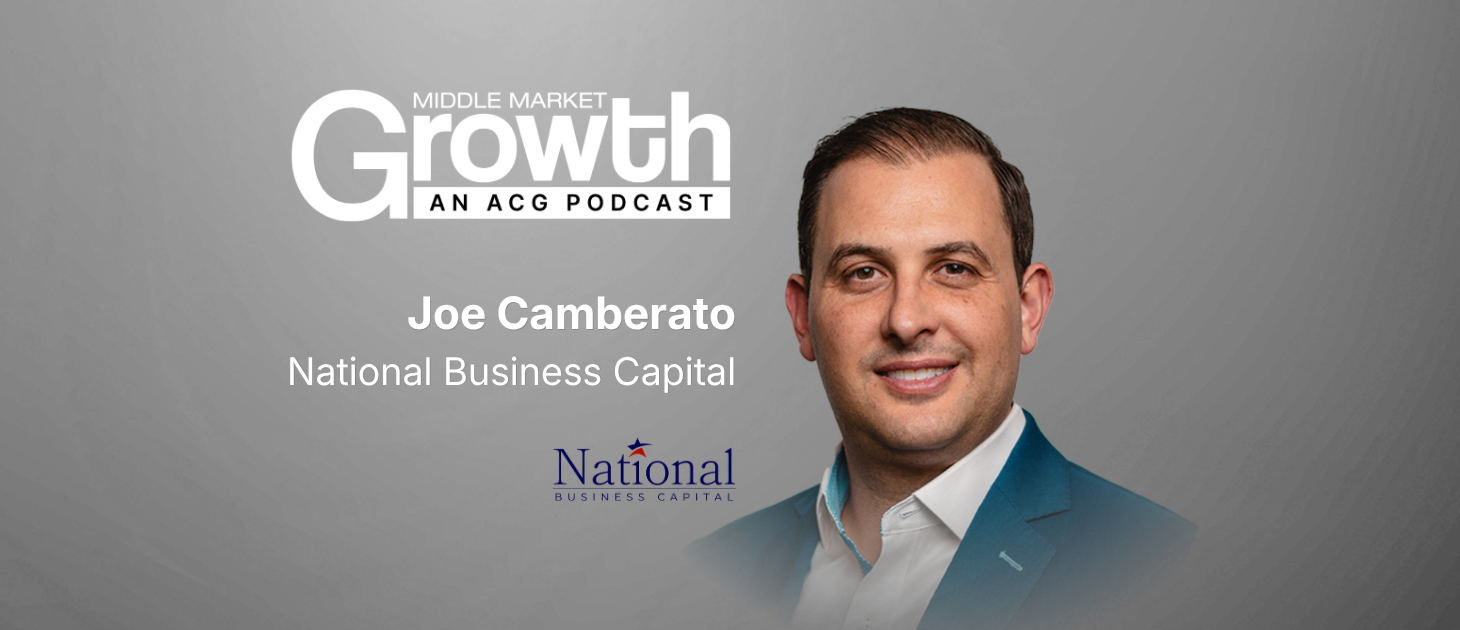
As small businesses grow into the middle market, their infrastructure, people, and capital needs can change rapidly. Joe Camberato, founder and CEO of National Business Capital, is back with the podcast to delve into what small businesses need to successfully scale in 2026 and the role creativity plays in a calibrated capital stack.
This episode is brought to you by National Business Capital. Learn more at nationalbusinesscapital.com.
Middle Market Growth: Welcome to ACG’s Middle Market Growth. I’m Carolyn Vallejo. Once small businesses achieve success and stability, they’re faced with a big decision: Do they want to stay small and nimble, or grow into the middle market? Back with us today to delve into that question and how the right capital stack can support growth is Joe Camberato, founder and CEO of National Business Capital. Joe, welcome back to the podcast.
Joe Camberato: Hey, thanks for having me. Good to be back.
MMG: For those who may have missed our first conversation, could you give us a quick refresher on your role at NBC and the work that you do there?
JC: Yes. I’m the founder and CEO of National Business Capital. We’ve helped provide over $3 billion now to small and medium-sized businesses all across the country, and we support them with growth and bridge capital that’s not focused on assets.
MMG: And for a bit of fun, we’ve already found out what your walkout song would be. So let’s mix it up a little bit. What’s something that you do every morning that gets you ready for your workday?
JC: Nice. Every morning I like to do a little workout, meditation and some breathing. Now that the summer’s here, and because I’m in New York, I like to get outside and try to get some sort of walk or run and enjoy the nice weather. It helps set up my day.
MMG: Beautiful. Excellent way to start the day. All right, let’s dive into the meat of our discussion today, which is all around the decision that small business owners and operators face when they’re deciding whether they want to stay small or scale up into the middle market. Let’s maybe start off with a pro/con list. Let’s talk about the pros and cons of staying small first.
JC: It’s an interesting time to be in business. There’s a lot of opportunity, but there are also a lot of challenges at the same time. The challenges are different for small businesses, especially since the internet and everything moving online. So many businesses today are doing business outside of their local area. If you went back 20 or 30 years ago, small business was typically local. Now, even small businesses can do business across the country or even across the globe to some degree. That opens up a lot of opportunity, but the con is that it makes it extremely competitive.
MMG: Got it. So basically, both on the pro and con list might be that a small business can play with the big boys, if you will, which is a great opportunity, but also presents a lot of challenges, as you mentioned. Can you tell me about some of the pros and cons of scaling up into the middle market?
JC: It’s a commitment, and it takes a lot of work. As you go into the middle market, it requires assembling different types of structures all around. You have to have the right team in place: management, infrastructure, technology, processes and systems. All of those things need to be in place to scale into that market effectively. As you go into the middle market, you’re competing with bigger businesses that have that infrastructure in place. You’re probably competing with private equity-backed companies that have the money to invest in those infrastructures. The pro to it all is that sometimes those middle-market businesses can’t move as quickly or make changes as quickly, and we’re in this environment where things are changing fast.
There are also new technologies, including AI platforms and things you can buy into that weren’t there before. They give you the ability to purchase software versus building it on your own and to compete very quickly. Back in the day, companies were custom-building systems, technologies and processes for their businesses and building all that software on their own. Now, you can buy the stuff off the shelf and be competitive very quickly. You do have to take building the business differently and really be serious about the team and the structure, but you can also be pretty nimble and move fast with some of these technologies right off the shelf, while some larger companies can’t move as quickly or their systems are almost too big to change.
I’ve seen some smaller, up-and-coming businesses really give those larger competitors a run for their money.
MMG: Now, our bread and butter is, of course, the middle market. So let’s stay there for a minute. In your experience, what does that process of scaling up into the middle market entail in 2026? I know you just mentioned technology, for example. So I’m curious about tech needs, talent needs and capital needs, of course.
JC: As you move into that middle market, you have to have the ability to execute. You really have to have the ability to plan financially and plan for hiring. Usually, it’s a different type of management team that’s been there and done that. It doesn’t mean that people at the organization won’t be able to grow into that, but as you move into that next phase of growth, you really start to have to look around and figure out the type of people you need to bring in. You need a real executive management team in place that can help you grow and scale the business. From a financial standpoint, bring in some sort of CFO, fractional CFO or someone who can help you map out and plan growth from a financial perspective so you don’t go in blindly.
I see a lot of businesses go into these growth phases and just go and do, and work off of gut, which is really what helped get them to where they are. But what got you there is not going to help get you to where you’re looking to go, and it’s going to take a different level of planning. As you go into the middle market, all of these things matter: the technology, the systems, the processes and the systems around moving someone from not being a customer to becoming a customer. Your accounting systems and how you’re managing them, whether you’re selling inventory, providing a product or service, all of those systems need to be elevated. If you’re going to do more business, things are going to move faster, and it’s going to be very important that you’re managing your cash flow.
Branding, marketing and talent acquisition all really matter. When you own a business, you kind of become this master juggler. You have to be able to juggle and keep things in balance constantly. It’s really the art of growing a bigger and bigger business, where you have to manage the right type of marketing to bring the right customers in the door. Then you have to book those customers effectively and efficiently, but then you need to staff up and hire. Then you need to update some things on the website or update your tech. You have to constantly be thinking about all these things and planning ahead. I think it’s about looking out into the future and asking, where do I need to be in the next six, 12 and 18 months?
Some of those decisions have to be made today so you can grow into where you’re trying to get to. Otherwise, it’s just going to be chaotic.
MMG: So less of that gut reaction, knee-jerk reaction, and more proactive planning.
JC: It is more planning and strategy. I think that is really key.
MMG: So I want to get into how capital needs can change as a business scales. You mentioned hiring executive teams and CFOs, for example. Payroll is going to expand, and technology is going to need investment. Tell me a little bit about how you’re seeing small businesses use capital to grow and invest in these types of assets that will help them get to where they want to be.
JC: I’m seeing that the best businesses right now are great entrepreneurs that are committed to growth, or private equity-backed companies that are. It’s kind of a combination of all of it. They understand that if they’re going to work with a bank, they’re really clear on what the bank is going to need and what’s important to the bank. They have the right team in place to help with reviewed financials, audited financials and really understanding how their balance sheet needs to look for a bank. If it’s not a bank and they’re moving to ABL, they understand what matters to an ABL and have the financial reporting in place that the ABLs need on a monthly or quarterly basis, and a bank as well. The folks now are using bank financing and non-bank financing and working with someone like us.
If they’re going to buy equipment, and if it’s equipment the bank isn’t interested in, then they’re working with an equipment lender. If they’re scaling rapidly and looking to take market share and make acquisitions, they might be using a senior lender or a bank and/or private equity. If they’re on a mission to build out software and things that aren’t as easily financeable, they’re working with private equity and a lender that’s focused on cash flow and not assets. The best entrepreneurs and private equity-backed companies are using a mix of multiple financing sources. That is very different from 10, 15 or 20 years ago, when you would usually just work with one financing partner. Either you worked with a bank or you didn’t work with a bank, or you went the private equity route and didn’t look at debt.
Now we are seeing companies look at all their options and use them as fit and as necessary.
MMG: The last time we spoke, we talked a lot about subordinated debt as part of the overall capital stack and how businesses can strategically build out that capital stack for growth. Optimizing that capital stack is, of course, key for small businesses, and particularly for small businesses when they’re growing into the middle market. Often, though, we hear that small business operators don’t necessarily approach it thoughtfully or strategically. They’ll often approach it reactively in response to real-time pressures, for example. How would you suggest small business leaders think about their capital stack when they are ready to grow or already growing? And I’m going to assume that proactive strategy will be key here as well.
JC: Yes. Business moves fast, and a lot of times financing becomes a reactive thing. I can’t stress enough the importance of planning and understanding what you’re trying to go into and what that’s going to take. A lot of times, people grow from a small business into a middle-market business and it just happens because they keep doing and doing and doing. Then they look around and they’ve built this big business. I think that’s awesome, and I have a lot of respect for entrepreneurs. I started National 18 years ago from zero, so I understand what it takes. The planning piece is so important. A lot of times, you want to put that team in place, but it’s expensive.
You really have to commit to the cost that it’s going to take, but there’s so much opportunity today to work with fractional roles. Maybe you don’t need to bring in a big CFO who costs $250,000 to $500,000 a year, depending on the company and their experience. That’s a huge commitment for your business. But maybe you pull in a fractional CFO, a fractional CMO or a fractional CRO. What I love about this whole fractional world is that you can pull in someone who is semi-retired and has had big business experience for a fraction of the cost. Why I recommend that is you can work with someone for maybe five or 10 hours a week, and they can really help you put the projections and financial plans together.
Most entrepreneurs don’t know how to do this, aren’t good at doing this or simply shouldn’t be doing this because it’s not their specialty. But pulling in the right person who has industry experience, can very quickly understand your business and what you’re trying to accomplish, has been there and done it, and can help you put that financial model in place is important. Before you just run into it and then have all this pressure to figure out capital and wind up taking the wrong deal, you can get clear and plan. You can understand that as you start to hit a certain point, you’re going to need X amount of dollars on a monthly basis to fill the gap in your receivables. Or as you hit X amount of staff, until you hit this amount of sales, you’re going to have a little bit of a capital gap and will have to staff up first before the money from what you’re doing comes in.
Getting really clear on what that’s going to cost you upfront lets you spend a little extra time upfront. You can spend some time talking to the right financing partner and have more of a plan in place so you can grow less chaotically. A lot of businesses just grow with a lot of chaos.
MMG: Right. Absolutely. You mentioned the importance of having a partner with industry experience, which I think is interesting. Are there any sector-specific examples you’ve seen of a small business thinking about its capital stack or approaching it differently than a business in a different industry would?
JC: I think working with a lender that really has an understanding of your industry is always helpful, especially if there are cash flow peaks and valleys. They’ll understand that. If you’re in construction, they’ll understand how to read your WIP report and they’ll understand your progress billing and can wrap their heads around it, versus a lender that maybe just doesn’t like construction. It makes a big difference. If you’re in manufacturing, working with a fractional CFO who understands the manufacturing business, has worked in a manufacturing business, understands lead times, understands managing inventory, understands how your cash flow cycle will work, knows how to manage a line effectively, and can keep costs down by keeping margins up can be valuable.
When you start to work with industry experts, it really can make all the difference, especially in advisors, consultants or hires you’re going to make in your business.
MMG: Earlier in our conversation, you described this balancing act of growing into the middle market as a sort of art. One thing I’ve also heard you say is that a capital stack is a creative act. How can growing businesses use creativity in their capital solutions?
JC: It’s creativity, and it’s really working with the right group that can help explain these things and talk you through this. We do this all the time. My team is really good at this. As you’re growing, there’s a time and place for private equity. There’s a time and place for non-bank funding. There’s a time and place for a bank. And there’s a time and place for all of the above. I sometimes see people use a line of credit to buy equipment. They could have pulled in an equipment lender. We pull in equipment lenders all the time and specifically finance the piece of equipment, and that UCC is against the piece of equipment. Now you’ve left options open for a line of credit and to use that money in other places to grow the business and to market, to bring customers in and put that piece of equipment to work.
I’ve seen people use private equity and raise money and sell a piece of their business for things that could have easily been financeable, whether it’s leveraging the receivables or cash flow, or buying equipment that they can easily finance through multiple sources. It’s really understanding how money and financing work in your business. The best businesses, when they understand that and can divide up the different lenders they’re working with, are able to leverage more and pull more out of the business. There are certain things, especially on the equipment side, where you can continue to fund those deals almost individually and keep your cash flow open for working capital and other things that aren’t easily financeable.
When you really understand that, you can avoid making mistakes. Sometimes those mistakes happen when people come to us after they’ve used the wrong type of financing to finance equipment that’s long term. Now they can’t access more capital, but the equipment has been purchased, so it’s very hard to refinance it. I’ve watched people get tripped up and make these fast moves when they could have borrowed double or triple the amount of money to use for a number of different things. When you understand that and do those things the right way, you can avoid selling a piece of your business and using private equity.
MMG: Let’s close us out here. Do you have any final words of advice for small businesses that want to grow into the middle market? What would your last takeaway be?
JC: The best advice I’d give, and honestly it’s from experience, is that I’m approaching 20 years since I started my business. We have close to 100 people. You have to be committed. To scale and grow and get to that next level, you’ve got to be committed. It takes time, and it’s going to take longer than whatever you expect it to take, so overestimate the time that it’s going to take. The real best advice I can give you is to pull the right advisors into your company. Join the right type of associations and groups. Surround yourselves with other entrepreneurs and leaders that have been there and done it. I’m a part of YPO, which is Young Presidents’ Organization. There are groups like EO and associations like ACG. Get yourself around the right folks, whether it’s for financing, or entrepreneurs or other business owners that have scaled businesses.
Getting myself around great entrepreneurs, CEOs and leaders really opens up your world. It gives you the ability to have conversations that you usually cannot have with most people who haven’t been there and done it. I would say it’s been a big part of my success.
MMG: Great advice to surround yourself with the right people. That’s a great plug for ACG, too, so we appreciate that. That’s Joe Camberato, founder and CEO of National Business Capital. Joe, thank you again so much for joining the podcast. It’s always a pleasure.
JC: My pleasure, guys. Thanks for having me.
This transcript was prepared by a transcription service. This version may not be in its final form and may be updated.
The Middle Market Growth podcast is produced by the Association for Corporate Growth. To hear more interviews with middle-market influencers, subscribe on Apple Podcasts, Spotify or Soundcloud.