Addressing AI’s Deal Sourcing Blind Spots
Grata's Nevin Raj discusses the pitfalls of relying on AI for deal sourcing
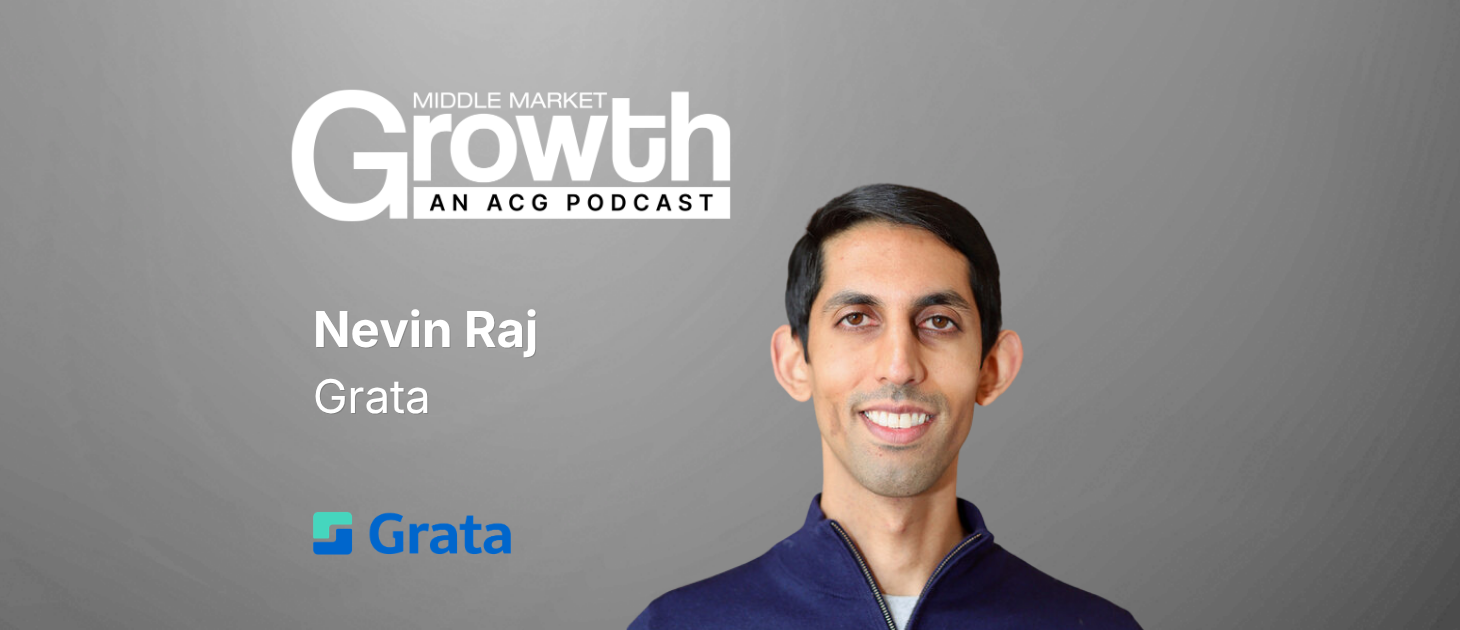
Grata was acquired last year, but the firm still gets emails from investors wanting to participate in its Series A funding round. It could be the result of business development professionals relying on AI to source deals without addressing the technology’s blind spots, says General Manager Nevin Raj. He shares how to mitigate the shortcomings of LLMs and scale AI agents in deal sourcing through better data, improved prompting, MCPs, and more.
This episode is brought to you by Grata. Learn more at grata.com.
Read a transcript of the podcast below.
Middle Market Growth: Welcome to ACG’s Middle Market Growth. I’m Carolyn Vallejo. Large language models, or LLMs, may have sped up your deal-sourcing processes, but that doesn’t guarantee that they’re delivering better results. Grata’s Nevin Raj joins the podcast today to talk about where LLMs fall short, the blind spots AI often misses, and how to verifiably improve your AI-powered deal sourcing. Nevin, welcome to the podcast.
Nevin Raj: Hey, Carolyn. Great to be here. Thanks for having me.
MMG: It’s great to chat with you. Before we jump into the conversation today, can you first tell us about your role at Grata and the work that you do there?
NR: Yes, absolutely. I’m the co-founder of Grata. I started the business 11 years ago, and I was the COO. I am now the general manager of the business unit within Datasite after we were acquired last year. I lead all departments here. I spend a lot of time with product and engineering, a little bit of time with marketing, and time with all the other departments as well.
MMG: And just for a bit of fun, if you had to choose a walkout song, what would it be?
NR: I’m a big EDM buff. I’m going to link it to deal sourcing. I’d say “I Found You” by Calvin Harris.
MMG: That’s great. I love a song that’s on theme. That’s a great choice. Let’s get into our main topic today. As we are all aware at this point, most private equity firms are using AI in some way. Some of the more recent numbers show that adoption rates can be upward of 80% or 90% for middle-market and lower-middle-market-focused PE firms. In many cases, firms are using LLMs as part of their business development strategies to source and discover investable companies, generate investment theses, et cetera. Could you tell me a little bit about where and how you have seen business development teams deploy AI effectively?
NR: Yes, it’s really amazing what teams are doing. As you said, adoption is so high. It’s actually hard to find someone who is not using ChatGPT or Claude, especially the latter, in their day-to-day work. If they’re not, it may not be approved by their company yet. Their company may be stringent on compliance, and they’re probably using their own personal account. So pretty much everyone is using it. What they’re doing in business development really comes down to integrating all the different steps that were once disjointed and happened in different systems. When we first launched Grata, we were solving that problem, or at least part of it, specifically around how to identify companies, get a list of those companies, get good information and contact information, sync it with your CRM, and address all the tangential ways to source around direct, proprietary sourcing. Which conferences do you attend? Who do you meet there? Who are the right bankers, sponsors, accountants, and lawyers to meet to network into a deal? What past deals have happened, and how could those potentially feed into future deals? We were thinking about all of those adjacent questions, but there’s a lot that happens outside of that. That’s just a small sliver. It’s the middle of the pie, or the middle of the timeline, so to speak. What we’re seeing with AI, and specifically with agents, is the stitching together of even more parts of this. For example, one of the first things you do when you’re sourcing is come up with a thesis. You need to figure out where in the world or the economy you want to start looking for companies.
In some firms, the investment professionals will feed the BD teams ideas. In other firms, the BD teams come up with the ideas. In still other firms, the investment professionals and BD teams are one and the same. Everyone does a little BD. You need to come up with ideas. In the past, you would read research, conduct expert calls, and come up with a few ideas. Maybe the partners or other very experienced people would have some insights. Now, a lot of firms are using agents to understand what’s happening in the world and identify trends and insights. They’re asking very interesting questions and generating ideas every day or every week. That part is now fairly agentic. Ideas come out, and they don’t have to be fully vetted. They just need to be interesting. Then they go out and say, now that I have an idea, help me understand the companies in that space. What are the top companies? Great. What are the investable companies in the space? Even better. Once they’ve built out that list, that’s the second step of AI, almost like a second agent doing that work. The third agent crafts ways to get in front of those companies, whether that’s a highly personalized email, a way to network into a company using a person’s relationships, or creative ways to get noticed by companies and get on their radar. Finally, there are all the process items. You have to enter notes into your CRM. You get on a call with a company, and instead of taking notes, AI transcribes the call. We’ve had this technology for years. It transcribes the call, pulls out insights, and gives you follow-ups and takeaways. In real time, it can even suggest topics to discuss based on your firm’s knowledge or expertise, and then write the follow-up. Pretty much every part of that process, including the parts that lived outside the world we first saw when we started Grata, has come together with AI. It’s really cool to see all of these pieces coalesce now.
MMG: It is really cool. It’s fascinating that, in many of your examples of where AI can be useful, it’s not necessarily replacing the human. It’s almost like a really effective sidekick, if you will, to a lot of these BD professionals.
NR: Yes, that’s a good way of thinking about it. I think about it like an analyst or an intern. Now, the BD associates, VPs, and partners are more like operators, orchestrators, or managers. They’re coordinating all these different agents to take these different steps. But from their perspective, it’s like you’re talking to one person, and that one person is doing the job.
MMG: That being said, these LLMs can work fast and in creative ways, as you’ve just outlined, but there are some significant blind spots. As we’ve all figured out by now, the technology is far from perfect. What are you seeing in terms of where some of those blind spots might exist and some of the bottlenecks in AI-powered deal sourcing?
NR: Yes, that’s a really good point. You still can’t blindly trust AI. Some of it is in the way you prompt, and not just in giving really clear direction. The other part is structural. Even if you had the best prompts ever, you still wouldn’t necessarily get the right data and answer. We can talk about both sides. Let’s start with the former, prompting and the way you give instructions. For AI to work really well, it needs very prescriptive direction. It takes some iteration and several cycles to get it right, or at least to get what you expect. A lot of people will write a one-shot prompt. It might be something short, like, “Write me an email to this founder.” It writes an email, and it doesn’t come out the way you think. It sounds robotic. It’s not personalized. Then you go back and say, “Personalize it. I’m XYZ at XYZ firm.” It’s still not good, and you keep giving it direction. After 10 different tries, you get it right, or at least to a point that you like. The problem is scaling it before then, because AI is very easy to scale. You could say, “You wrote me a custom email. Write a thousand of these.” Then you’re going to say things to a thousand people in your space that make you sound, quite frankly, kind of dumb. That’s where problems arise when you’re scaling something before you’ve perfected it. These systems are also probabilistic, not deterministic, meaning you might get slightly different answers even after refining a prompt.
That’s one side of it: How do you make it work for you, and at what point do you scale it? Scaling is very easy, and you don’t want to scale mistakes. The second part is more structural. The data and results that come back are quite limited by the capabilities and the science behind the LLM, which I won’t get into in this conversation. To illustrate where this appears, take building a list of companies. The LLM is designed to give you the top answers, such as the top 10 companies you’ve heard of. Even if it searches the web, it’s going to give you the companies that appear in articles. You see the same results you would see on the first page of Google. Everyone is seeing those results, and your blind spot becomes finding the under-the-radar companies that actually matter and are right for you. You have the same problem you had with Google: Everyone is looking at the same five or 10 companies in a space, and those companies are getting all the attention. That’s one issue with company identification. There are also issues with data. You might say, “Send me an email to this founder,” because you’re trying to source a deal. But you can’t find that founder’s email because it isn’t public. Often, contact information is not public. In certain cases, depending on which LLM you use, it will make up an answer. It will hallucinate. You push it, and it hallucinates. Then you’re sending an email that bounces or to the wrong address. That comes back to hurt you because your domain reputation declines, you get marked as a spammer, and you’re sending emails to the wrong people. It gets embarrassing. These issues can occur with specific data points, whether that’s company identification, email addresses, or ownership structure. Remember, Grata was acquired last year. I’m getting emails from companies asking whether we want to raise money. I’m thinking, if you had good data, you would know that we’ve been acquired. We’re not a Series A-stage startup. There is clear hallucination getting amplified because it’s so much easier to take these sourcing actions. The bar for sourcing has become lower, and you’re seeing it put a lot of slop into the market if you don’t have the right data. AI is very good at summarizing and writing things for you, but it is not very good at getting a consistent answer based on high-quality information. That’s why specialized sources are now a requirement, or a precursor, for powering that AI.
MMG: You just brought up a couple of points that I think are interesting because there are so many ways LLMs can fall short for business development professionals and investment sourcing. At the same time, it’s challenging because, as we always like to say, you don’t know what you don’t know. Blind spots, by their nature, are inherently difficult to identify. Do you have any tips for how PE firms could identify where their LLMs’ blind spots are?
NR: What you brought up, that you don’t know what you don’t know, is a very good point, and it’s really hard to figure out. The only way you identify that is by opening your eyes to what you may not know or, in this case, benchmarking. If you’re running prompts in an LLM and getting responses back, you should compare them with a source of truth, either something you’ve produced manually or a prebuilt, trusted data set. Grata is one example. There are others, depending on the data points you’re looking at. Use that to understand where things are failing. In the example I gave you of people reaching out to me today about Series A fundraising, they’re probably asking the AI, I’m guessing, “What is Grata’s VC status?” or “Has Grata raised money?” It’s probably pulling up an article written about our Series A. Again, it’s designed to pick up the things that are most prominent, like the first page of Google, and summarize them. You wouldn’t know the answer was wrong unless you checked it against a curated data set focused on fundraising events or M&A transactions. That’s one example. You can do this for all the data points you care about: contact information, funding and ownership, industries, locations, and headquarters. You can go through the list, compare the results, and start to see patterns. The pattern tends to be that when the most common information about the company isn’t the right answer, you see a deviation from reality. That’s where you see hallucinations in LLMs.
MMG: Tell me how serious these blind spots and the consequences of missing them can be. I imagine there is a range of severity.
NR: Yes, you’re right. It varies. I’ll give you the doomsday scenario and work backward. The worst case is that you can no longer source a deal because you get flagged as a spammer and your emails aren’t delivered. You almost can’t do deals because even people you email day to day will sporadically have your emails filtered into spam. You can get out of that, but it takes time. Then you stop sending outbound emails. You only take inbound inquiries. You start calling people because you’re afraid your email is going to be dropped. It’s a really bad situation, and no one wants to be in it, especially if it affects business as usual. That’s the doomsday scenario. It’s rare, but it can happen if you’re increasing volume without getting it right. You can accelerate into that wall.
In the middle, there’s reputational risk. A lot of firms, even generalists, have a thesis in a niche. If you’re getting in touch with people, saying things that aren’t factually correct, and coming across as generic, you develop a negative reputation in the industry. That tends to burn some bridges in a space you might have found interesting or valuable. This is especially true if you’re doing add-ons and already have a platform in that space. If you make a bad impression on all the potential add-ons, you’re not going to complete your roll-up thesis or execute the value-creation plan for that platform. That’s the middle. At the lightest end, you might miss some opportunities.
Generally, at least when I was in the space, you would get in trouble if you went to an IC meeting having missed a company that one of the partners knew existed. It’s a very bad look. Especially if you’re in BD, your job can be on the line. If that happens consistently, it’s not a great look. That’s a spectrum of consequences. None of them is positive, and they range in severity. When you’re in finance, you always want to put your best foot forward. Everyone is looking for the best answer and the edge.
MMG: How can PE firms set themselves up for success here? There are limitations in AI’s capabilities that we can only do so much to improve, but I’m sure there are other measures, such as better training on how to prompt more effectively, that can shed light on blind spots and mitigate some of these risks. What strategies can you recommend?
NR: The big trend right now is MCPs, which are framed in Claude and ChatGPT as connectors. They’re API or system connections. It’s like AI being able to talk to other software and other AI in the background to pull the right data and capabilities at the right time. When you write a query and say, “Find me a list of companies,” the LLM is going to ask, “Am I best at doing this?” The LLM might say, “I’m really good at finding the top five names in a space that appear in the most articles. But if you’re looking for a comprehensive list, let me look through my connectors and tools and surface the right one for you.” In this case, it might say, and is likely to say, that you should use Grata. Grata will get you the answer, and the LLM goes in and runs a search through Grata. It’s going to do that for all your different prompts, which means your prompt engineering doesn’t have to be as precise. Assuming the MCP providers, such as Grata, are giving the model the right context, the tool context from the MCPs will surface the tool and tell you, “Yes, you should be using me.” So it’s really about MCPs now. Before AI, when you were connecting different systems, you had to connect APIs. It was very technical. You needed engineers, product managers, and infrastructure. Now, you go into Claude, click five buttons, and you have five data sources and capabilities strung together. Your external and internal data are all in one place. It’s incredible how seamless this works now.
MMG: Do you have any real-world examples of where you’ve seen an M&A firm use AI effectively, perhaps using MCP servers in the way you’re explaining?
NR: Yes, I can talk about a specific client. We have a client, Ridgefield Partners, which is a middle-market M&A firm and a sell-side advisor. It serves the lower middle market, working with companies with $1 million to $25 million of EBITDA. The firm has built a lot of expertise and has been in the transportation sector for a while. It has about eight experts who have been there and completed many deals, and it has started to expand into adjacencies like healthcare. Ridgefield had a data set, or Rolodex, of about 4,000 contacts in its CRM. It was using ZoomInfo and HubSpot, and it was a very slow, manual process. The founding partner discovered Grata and said, “This is really interesting. We can use AI and Grata to expand our reach so we can get into adjacencies from the deals we’ve been doing.” In less than six months, the firm went from being in touch with 4,000 companies to 70,000. A lot of that came from the MCP. Mike Moraski, the director of technology innovation there, said, “The wow moment for me was when the MCP became available. I knew there was good data here, but it really helped us take it out of the platform, connect it to other things, and multiply our efforts exponentially.” It was pretty cool to see. Now the firm is doing more deals because it’s in touch with more people and can get in front of companies at the right time.
MMG: We want to hear about more professionals having that wow moment. I think it’s important to know that there are KPIs and metrics you can track to assess the effectiveness of the AI a firm is using. What metrics should firms be tracking?
NR: It’s no different from how you would track an analyst today. My suggestion is to do it almost like an A/B test. You’re going to have analysts and analysts with AI, or analyst operators, and you can compare all the metrics you normally track across those two groups. Typically, a lot of activity metrics are tracked, such as emails sent, calls made, and people contacted. Activity is definitely going to be higher on the AI side, so that can be a misleading indicator. You need to go one level deeper and look at outcomes: meetings booked and meetings attended, not just booked. Among those meetings attended, look at deals created and the conversion of those deals throughout your funnel, from the initial meeting to the NDA, IOI, LOI, and close. It takes time to build that up. Activity metrics are the easiest to see initially, but you’ll start to see those deal-conversion metrics follow. These are the same metrics any B2B sales team uses. Any BD team, whether it’s in M&A or not, should use these same funnel metrics to determine whether the technology is effective. Initially, AI should have higher output but probably lower conversion. When you start to tune it, get your prompts and process right, and integrate your MCPs, you should see all the conversion rates rise. That’s when you’ve achieved true AI efficiency. At that point, I would recommend scaling your AI and agents, not initially. I would try to limit activity metrics, even though AI can work 24/7. An agent doesn’t work nine to seven or nine to five. It can always be on. You have this tendency to think, let me just keep this thing running. Let me spin up 10 agents. If you can spin up one, I recommend going one for one, pound for pound, making sure it and the funnel work, and then scaling up.
MMG: Nevin, you’ve given listeners a lot of actionable advice and guidance, but to close out our conversation today, is there any final advice you would offer PE firms that want to get the most out of AI in their deal-sourcing initiatives?
NR: This might be obvious, at least to me, but no matter how much AI is out there, it’s still people doing deals with people. AI will never replace the human element. The strength of your network, the way you present yourself, and meeting companies in real life will still go a long way. In fact, in this world of AI agents, that might become the differentiator. Until we’re in a dystopian universe where companies are run by agents and agents are meeting agents, it’s still in your court as a professional to source and close that deal. AI can help. It can be an accelerator. It can be a powerful tool. But again, dealmaking is people shaking hands with other people.
MMG: All right. That’s Nevin Raj with Grata. Thank you so much for taking the time to chat with us today. It’s been a pleasure.
NR: Likewise. It’s been great to be here.
This transcript was prepared by a transcription service. This version may not be in its final form and may be updated.
The Middle Market Growth podcast is produced by the Association for Corporate Growth. To hear more interviews with middle-market influencers, subscribe on Apple Podcasts, Spotify or Soundcloud.