The Next Generation of GF Data
Pairing two decades of proprietary transaction data with AI-powered querying and what that combination means for the professionals who rely on it

The middle market has always had a data problem. Public comps don’t fit. Peer intelligence is unreliable. And the transaction data that actually matters—deal pricing, financing structures, negotiated terms—has historically been unavailable to anyone outside the firms that did those deals.
GF Data was built to change that. Since 2003, more than 5,700 private equity-backed transactions have been submitted to the platform on a blind, anonymized basis, with data on valuations, financial performance, capital structure, debt pricing, and key deal terms. In aggregate, they offer a benchmark that no public database, no anecdotal peer intelligence, and no AI tool trained on public information can replicate.
This section of the report originally appeared in the 2026 M&A Business Development Professionals to Watch issue of ACG Magazine.
GF Data brings the only comprehensive, anonymized private transaction dataset covering the middle market. Now, it’s evolving its offerings even further via a new partnership with Farsight.
Farsight brings a natural-language query interface purpose-built for financial data analysis. Together, GF Data and Farsight create something the market hasn’t had before: the depth of proprietary private deal data, accessible with the speed and flexibility of a modern AI query tool.
What Makes the Data Irreplaceable
Large language models are trained on publicly available information. For middle-market M&A, where trans actions are private, valuations are never disclosed, and deal terms are negotiated behind closed doors, that creates a fundamental problem. AI tools operating without proprietary data are working from incomplete information at best. The comps that matter for a $40 million business ser vices deal are not in any public filing.
They are in GF Data.
Thirty data points per transaction. Not just what a business traded for, but how the deal was structured. Capital stack at closing. Debt pricing by instrument and lender type. Rollover equity as a share of TEV. Indemnification caps, survival periods, basket sizes, escrow amounts, earnout incidence. The full picture of how deals actually get done, across more than 400 NAICS indus try codes, five size tiers, and two decades of market history.
A few of those data points are worth underscoring: Financial performance benchmarks—trailing 12-month (TTM) revenue growth and EBITDA margin—are collected at the time of each transaction, enabling direct comparisons between a company being evaluated today and the universe of comparable closed deals. GF Data’s above-average financial performance (AAFP) designation, applied to businesses with TTM margins and revenue growth both above 10%, quantifies the pricing premium that better-performing businesses command. That premium is measurable because the underlying financial data is there.
Capital structure depth—senior debt, subordinated debt, unitranche structures, equity contribution percentages, rollover equity levels, debt pricing by lender type—present the full financing picture, not just the headline multiple. Meanwhile, deal terms—indemnification caps, survival periods, basket sizes, escrow and holdback amounts, RWI incidence, earnout and seller financing structures—illustrate what’s standard for a deal of a given size, in a given sector, in the current market.
Powered by two decades of historical data, GF Data’s intelligence offers not a snapshot but a benchmark deep enough to distinguish a current cycle from a historical norm.
What Farsight Adds
Accessing this dataset has historically meant navigating a sequential filter interface by selecting a sector, setting a time period, and zeroing in on a size range. A user would pick a data view (Valuation, DebtHead®, and Deal Terms), then run the search and download the output, before repeating for the next cut. Next, they’d switch to the Leverage Report for debt pricing, and pull the Key Deal Terms Report for indemnification context.
It worked. The data was worth the effort, but the interface created friction between subscribers and the full depth of what the dataset could answer. Analysis that required crossing valuation, leverage, and deal terms data simultaneously required three separate filter runs and manual reconciliation. A question that should take a couple of minutes could take 20.
Farsight eliminates that friction. Its natural-language interface lets subscribers query the dataset the way they’d ask a colleague and receive an output that draws on all 30 fields per transaction, across all relevant filters, in a single response. The analytical frameworks GF Data has built over two decades, including the AAFP designation, the leverage visualization, and the size-tier and sector breakouts, are all accessible from a single query rather than requiring separate navigation steps to reach each one.
The result is not a different data set. It is the same proprietary data, with the distance between the subscriber and its full depth removed.
The difference is clearest in practice.
In Practice: A Sell-Side Advisory Engagement
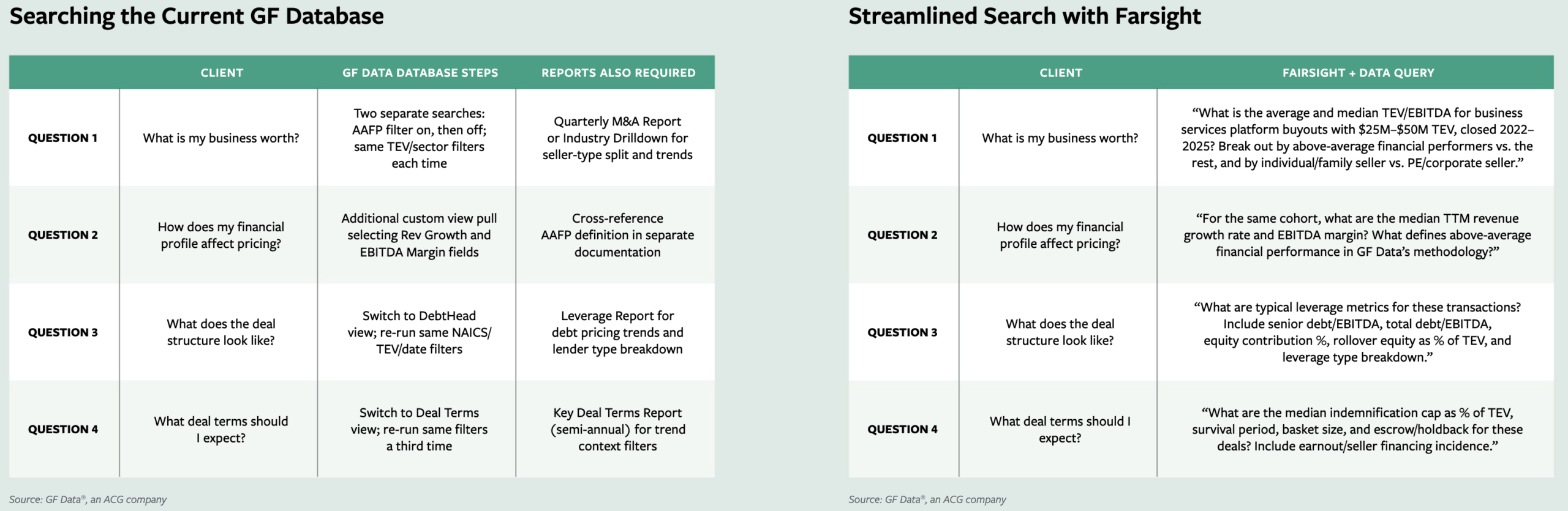
Consider a scenario that plays out regularly across the middle market. A sell-side advisor is engaged by a founder-owned business services company, roughly $6 million in TTM adjusted EBITDA with an estimated transaction value of $40 million to $55 million, and a first-time seller as the client. Before the first formal meeting, the advisor needs answers to four questions that will shape the entire engagement.
Using the current GF Data database interface, answering all four questions requires a minimum of five discrete searches across three separate data views, with additional reference to our quarterly reports for context that isn’t available as a live database toggle. Each query draws on the same GF Data transaction records that power the existing database. The difference is that Farsight assembles the relevant cuts, including the AAFP split, seller type, size tier, leverage structure, and deal terms, in a single output rather than across separate filter runs. A research process that previously took an hour or longer compresses to approximately 10 minutes.
The practical effect extends beyond efficiency. The advisor using the current workflow follows up after the first client meeting with the data. The advisor using Farsight walks in with a brief already built around that client’s specific profile: sector, size, EBITDA, financial characteristics, seller type. The conversation is different from the start. For a first-time seller, that specificity matters.
Abstract market commentary is easy to dismiss. Data anchored to comparable transactions in the same sector, size range, and financial profile is harder to argue with, and it establishes the advisor’s command of the market before the process has formally begun.
The Foundation Stays the Same
The addition of Farsight does not change how GF Data collects its data. PE groups still submit 30 data points per closed transaction quarterly on a blind and anonymized basis. The minimum threshold of three trans actions per output grouping still applies, as does the protection that keeps contributor data anonymous. Aggregated data with NAICS-level granularity, AAFP designation, buyer and seller personas, and more all remain the same.
What changes is access. Users can now query the dataset GF Data has been building for two decades in its full depth, on demand, in plain language. Existing subscribers get more out of the data they’ve always had access to. New subscribers will be able to start with a question and get a complete answer, rather than learning to navigate a multi-step interface before the data becomes useful.
The Combination That Matters
The middle market’s data problem has two dimensions.
The first is the data itself: private transaction records that don’t appear in any public filing and can’t be inferred from public market proxies. Building that dataset requires the trust of a contributor network, a rigorous collection methodology, and an anonymization model that makes contributors willing to share.
That’s not something technology can shortcut. It requires years of relationship-building and discipline, which is exactly what GF Data has.
The second dimension is accessibility—specifically, the ability to extract deal-specific insight from data quickly enough to be useful. That’s where Farsight contributes something the filter-menu interface cannot. Ask the dataset a precise question and get a precise answer—with all relevant filters applied and all relevant data views integrated—in a single response.
Ryan McCann is GF Data’s Senior Middle-Market Analyst.
ACG Insights is produced by the Association for Corporate Growth. To learn more about the organization and how to become a member, visit www.acg.org.