ACG and NCMM Mark Middle Market Week With a Market Retrospective
The National Center for the Middle Market's Doug Farren joined ACG's Brent Baxter for a members-only webinar
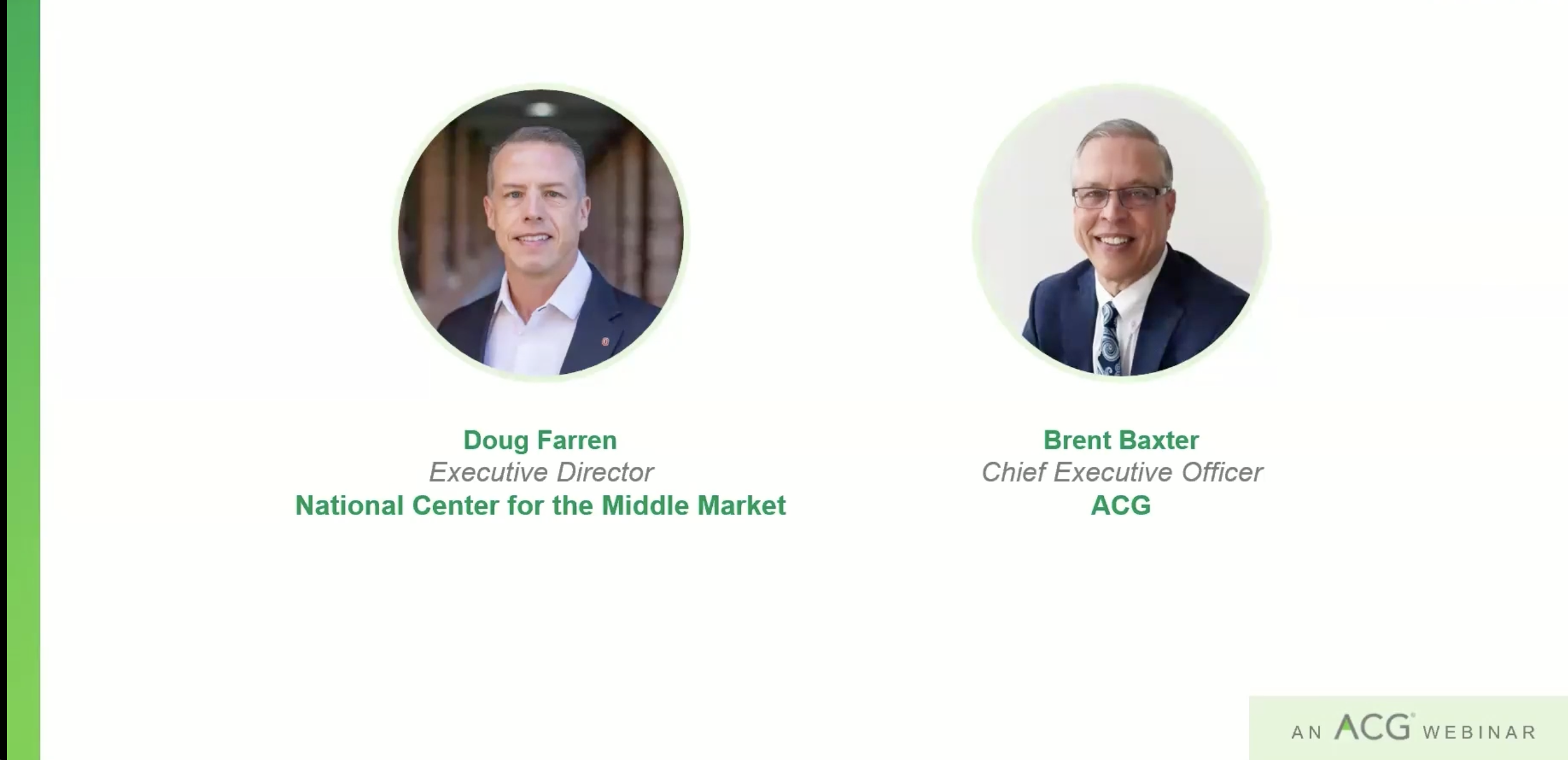
Fifteen years since its founding, the National Center for the Middle Market (NCMM) is looking back on the data it’s collected about the middle-market economy, and brought ACG members an inside look at its findings.
In recognition of National Middle Market Week, NCMM Executive Director Doug Farren joined ACG CEO Brent Baxter for a members-only webinar last week, “The Private Equity Advantage: What 15 Years of Middle Market Data Reveals.”
Together, Farren and Baxter reflected on the NCMM’s 15-year retrospective, including data from its Middle Market Indicator (MMI) survey as well as proprietary research of private equity-backed middle-market businesses.
ACG Insights recaps some of the webinar’s key moments below.
Event Recap
WHAT: 2026 M&A Mid-Year Recap & Outlook Webinar
WHEN: Sept. 22, 2026
THE TAKEAWAY: Deal activity is stabilizing, valuations are holding, and sponsors are looking beyond add-ons to create value.
A Post-Pandemic Growth Spurt
The middle-market economy, comprised of businesses with annual revenue between $10 million and $1 billion, has demonstrated consistently solid growth throughout the last 15 years, clocking in at about 6.5%-7% annual revenue growth up until 2020.
“And then, of course, everything grinds to a halt,” said Farren. “But since that time, there has been a rapid and sustained rebound.”
Despite massive, worldwide market disruptions during the COVID-19 pandemic, NCMM data reveals middle-market companies actually experienced an acceleration of growth, averaging annual revenue growth of about 11% between 2021 and mid-2026.
Further, the percentage of high-growth midmarket businesses—companies with at least 10% annual revenue increases—has nearly doubled since 2021 from about 30% to nearly 60% today.
The middle market’s growth strategy has evolved, too, with businesses prioritizing acquisitions to fuel growth in the pre-pandemic years, shifting their focus towards talent attraction and retention towards the latter-half of the 2010s, and then emphasizing organic growth in a post-pandemic market. Today, the middle market remains focused on initiatives like research and development, and product innovation to drive growth.
Regardless of the strategy, middle-market growth has always been fueled by operators’ ability to act proactively by investing in value creation before realizing revenue gains. “They’re hiring ahead, they’re investing ahead, they’re building ahead, they’re projecting ahead, and that has been consistent across all of these time periods,” Farren noted.
The Private Equity Push
As middle-market businesses have grown, so has private equity’s involvement in the space. According to NCMM data shared by Farren during the webinar, PE pairings with midmarket companies are closely correlated to accelerated expansion.
The portion of PE-backed businesses within NCMM’s survey samples has increased by about 50% since its MMI reports began in 2012. A closer look at what the numbers in the MMIs, as well as other NCMM research, say about those sponsored businesses shows midmarket businesses consistently outperforming non-PE-backed peers in revenue and employment growth—especially post-pandemic.
The findings dispel a prominent myth about PE involvement in the space, Farren said. “One of the misconceptions we tried to overcome with this study was that, for those outside of PE, and those that don’t understand middle-market private equity, there is this thinking that it’s all about making the investment, and then shedding as much cost as possible—which could translate to layoffs,” he noted. “Not the case. In our data, middle-market private equity-backed firms actually were adding people at a higher percentage.”
The Silver Tsunami Meets AI
As the engine for one-third of the U.S. economy, as Baxter mentioned, middle-market businesses are gearing up for a new phase of evolution. Farren highlighted impending ownership transitions, often referred to as the “silver tsunami,” as one of the largest trends likely to shape middle-market growth and PE activity in the coming years.
According to NCMM and Visa data, as much as 40% of the midmarket could experience an ownership transition in the next two-to-three years, a combination of aging founders without a succession plan and operators who postponed planned exits during the pandemic.
Farren also highlighted the space’s AI adoption as another driver of change for the middle market. In mid-2024, not even 10% of midmarket companies reported using AI. By mid-2026, that figure exceeded 90%, with businesses looking towards the technology to both control costs and increase productivity.
As middle-market businesses and dealmakers prepare for this latest wave of change, one thing has remained consistent: the market’s ability to invest proactively to drive revenue growth, not in response to it.
This corner of the economy faces plenty of headwinds, from carving out paths to exit, to implementing AI effectively. According to the NCMM, historical data suggests a proactive, collaborative approach is key to future growth. “There’s going to be all kinds of effects of that change,” Farren said, “and we’re certainly going to be keeping our eye on it as a center.”
Carolyn Vallejo is ACG’s senior editor.
Middle Market Growth is produced by the Association for Corporate Growth. To learn more about the organization and how to become a member, visit acg.org.