Building HR to Scale With Portcos: Part 2 – The Carve-Out Edition
Insperity's Chris Sloan and Mike Iapalucci are back for part two of their series
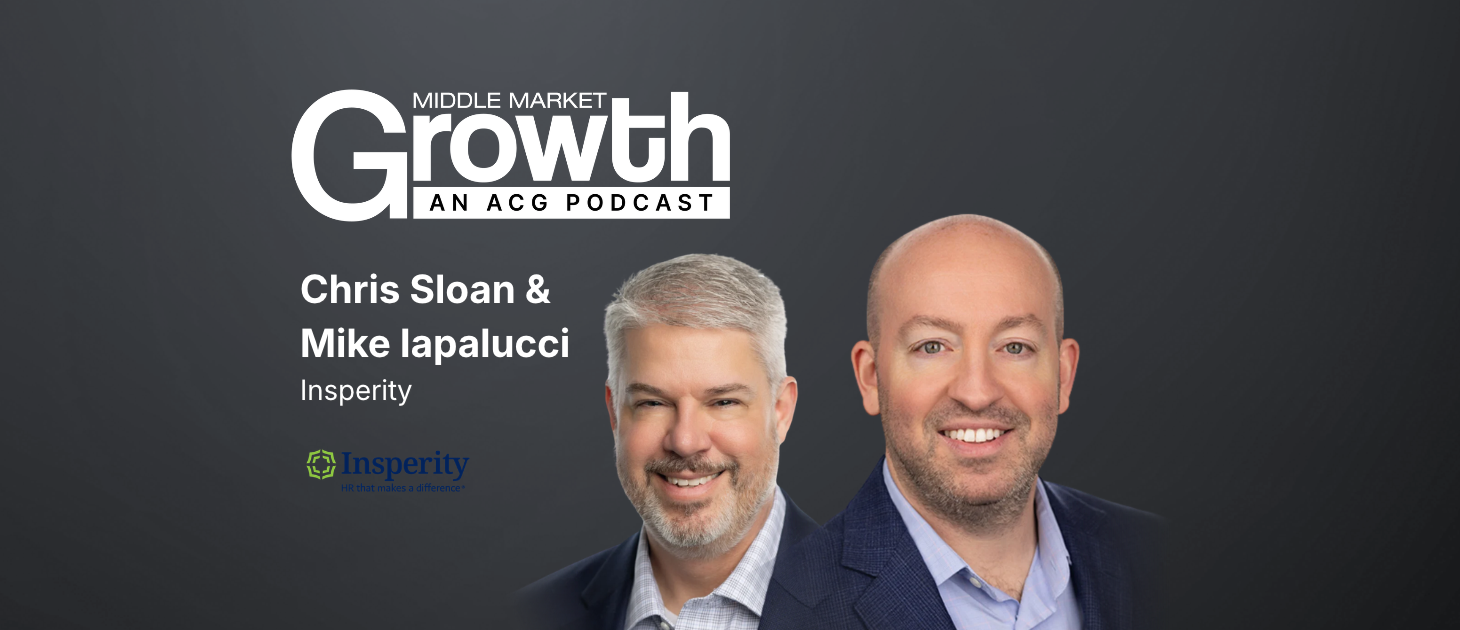
Carve-outs are a growing share of deal volume in recent years, and these transactions present both attractive investment opportunities for private equity firms and unique HR challenges as a business entity is divested from the corporate parent. Insperity’s Chris Sloan and Mike Iapalucci are back for part two of a series diving into scaling portco growth and HR infrastructure, this time to discuss common carve-out challenges PE firms face, how to address the nuanced HR issues that arise in these deals, and how to create an effective TSA.
Listen to part one of the series here.
This episode is brought to you by Insperity. For more information, visit Insperity.com/ACG.
Read a transcript of the podcast below.
Middle Market Growth: Welcome to ACG’s Middle Market Growth Podcast. I’m Carolyn Vallejo. The latest PitchBook data finds that the share of carve-outs among buyout transactions has more than doubled since 2021. Corporate divestitures can present rare investment opportunities for PE sponsors, but these deals bring unique challenges as a business steps out from under the corporate umbrella. Back with us today for part two of our series on scaling portcos with HR are Insperity’s Chris Sloan and Mike Iapalucci. Chris and Mike, welcome back.
Chris Sloan: Thank you.
Mike Iapalucci: Thank you.
MMG: Before we jump into the topic, can you each give our listeners a quick refresher on your roles at Insperity? Mike, let’s start with you.
MI: Sure. I’m national sales director for Insperity’s middle-market and HR Scale solutions. That encompasses the companies we work with that have more than 150 employees. I lead a national sales team supporting the clients we work with in this space.
MMG: Chris, could you give us a quick refresher as well?
CS: I lead our Private Capital Markets, National Accounts, and Contractor Management divisions at Insperity. My teams work across the private equity ecosystem, building relationships with sponsors, operating partners, advisors, and portfolio company leadership teams. Our role is to understand the investment thesis and connect the right Insperity resources to workforce and HR priorities that can affect execution. In a carve-out, that may begin with payroll, benefits, HR systems, employee continuity, and related needs. But the larger conversation is about helping the new company establish the HR foundation it needs to support its next stage of growth. I also bring the perspective of having been an Insperity client and a C-suite operator. When I look at these situations, I’m thinking not only about what has to be implemented, but also about what management is experiencing and what employees need to remain focused during a major transition.
MMG: Got it. We’ve already asked you about your walk-up songs, so for this conversation, just for a little fun, if you could learn a new skill in the next year, what would it be? Chris, let’s start with you.
CS: That’s a great question. I was recently with Mike at one of our Insperity properties in Augusta, and we played a round at Champions Retreat. I set my clubs aside about 10 years ago and got heavily into fly-fishing. But after that round, I realized I haven’t lost too much of my game, so I’m slowly getting back into the swing, pun intended.
MMG: What about you, Mike?
MI: That was a good day. I’m going to go a little more with what’s in the news: I would learn how to code.
MMG: Good one.
MI: I know nothing about it, and it seems like it might be a relevant skill to learn.
MMG: Absolutely. Let’s get into our main topic. We’re talking about carve-out transactions, which are very relevant today. They’ve represented a growing share of deal volume for years and are getting a lot of attention this year in particular. Chris, I want to start with you. In working directly with private equity firms, what common challenges do you see with carve-outs, especially around HR strategy as part of the transaction?
CS: The most common issue is that HR can be treated like an administrative workstream when it’s actually part of the transaction’s operating infrastructure. Before the carve-out, the business may have relied on the parent organization for payroll, benefits, policies, HR personnel, systems, reporting, and other capabilities. Those functions may be deeply embedded with the parent. Once the business starts to separate, somebody has to recreate or replace each of those dependencies. The second challenge is usually timing. The close date is fixed, while the workforce information needed to build the new environment may be incomplete, changing, or controlled by multiple parties. Decisions involving payroll, benefits, technology, employee data, policies, and communications begin to converge at the same time. The third challenge is employee uncertainty. From an employee’s perspective, this isn’t simply a transaction. Employees may wonder whether they’ll be paid correctly, whether their benefits will continue, who they work for, what’s changing, and whether the new company will feel stable. That’s why I tell sponsors HR readiness isn’t just an HR issue. It’s an execution, continuity, and confidence issue. A common pattern is that everyone initially assumes payroll or benefits will remain available through the seller, so building a standalone solution feels less urgent. As the team gets deeper into the separation plan, however, it may discover that the TSA is expensive, has limitations, and doesn’t provide everything the new company needs. At that point, the timeline compresses, decisions become more frantic, and management has less room to test the transition. A carve-out doesn’t inherently come with independence. Independence has to be designed. Employees experience the transaction through very practical moments: their paycheck, their benefits, their manager, and the communications they receive.
MMG: “Independence has to be designed.” I love that quote, and it’s a great point. Mike, I want to turn it over to you. As Chris mentioned, carve-outs aren’t just a change of ownership. The business is coming out from under the parent organization’s umbrella and needs to stand on its own. What nuanced HR challenges come with that dynamic?
MI: There are a number of them. One of the first issues that needs to be considered is what the function and culture of the new entity will look like. Will the culture mirror the organization it’s spinning out of, or will it be completely different? Depending on who moves with the carve-out and who the buyer is, people who helped build and facilitate the previous culture may be coming with the business, or none of them may be coming. You may have to start from scratch. Maybe that’s less of a nuanced issue and more of a big-picture challenge: figuring out who you’re going to be, what you want to be, and how you’re going to create and foster that identity within the organization. Think about a group coming from a company with 20,000, 30,000, or 100,000 employees and becoming a standalone company of 1,000 people. That’s still a good-sized company, but its identity could be vastly different from the parent organization it came from.
MMG: That’s a great point. Investors and operators need to think big-picture about what they want the business to become as a standalone entity. A lot of that process begins well before close, with preparation and proactive decisions. Chris, what are operating partners doing to smooth carve-out integrations, keep employees bought in, and mitigate problems before they emerge?
CS: The best operating partners start working backward from day one. Rather than focusing only on what the parent will continue providing, they ask what the standalone company must be able to do at close, at the end of the transition services agreement, or TSA, and during the first year of ownership. One thing that has changed significantly over the last decade is how organizations think about HR. Historically, it was viewed in pieces: payroll, benefits, recruiting, and compliance. Today, we’re seeing more HR engineering, and sponsors are placing greater emphasis on HR as a total operating system for the entity. When a carve-out leaves the parent, as Mike discussed, it isn’t just losing HR services. It’s often losing a significant portion of its operating system. That’s why the best operating partners spend significant time identifying dependencies early: which systems, processes, data, and support currently reside with the parent, what needs to be recreated, and what should be improved. The earlier those decisions are made, the smoother the transition. They’re also intentional about communication. Employees don’t experience a carve-out through transaction documents. They experience it through their paycheck. These are real people, and they’re also asking where the company is going. There’s a confidence factor. That’s where transition services agreements are valuable. A TSA can provide a bridge, but the most successful operating partners view it as a bridge, not the final destination. The goal isn’t simply to preserve continuity. The goal is to build the infrastructure needed to support growth long after the separation from the parent is complete.
MMG: Chris, let’s keep talking about TSAs. How can sponsors create a TSA effectively with HR strategy in mind?
CS: A TSA can provide short-term continuity, reduce immediate day-one disruptions, give the buyer time to establish standalone capabilities, and provide access to systems. Those are some of the benefits. Key considerations should include the cost of the TSA, how restrictive it is, whether it creates too much dependency on the former parent, and, importantly, whether it delays decisions about the end state. It can also create a second employee transition. Beyond all the HR components we’ve discussed, the systems themselves matter. At Insperity, we’re very sensitive to that. If we have a carve-out with 50 employees today, but expect it to have 100, 200, or 300 employees in three months, I start talking with Mike about whether it should begin with our middle-market service team. We’re very sensitive to changing that service dynamic. Once we’re integrated, we want to be there to scale and grow with the business if we know it’s pursuing a rapid roll-up or carve-out strategy.
MMG: Speaking of speed, in any transaction, speed is of the essence. You need to get everything functional with as few disruptions as possible. Mike, how are private equity firms improving and accelerating carve-out deal speed without compromising the HR strategy that’s so important here?
MI: I think it comes down to finding the right partners. Maybe that’s a different approach, but you need partners whose operating model you understand. You know what they do and where they’re coming from. That helps you put in place what you need on day one so the people joining the new company are satisfied and understand what to expect. At that stage, the most important things are making sure employees are paid, their benefits are correct, and they understand the terms of their employment so you’re starting off on the right foot. One of the best ways to improve deal speed and the stand-up process is to have partners you trust. One way we provide that for our partners is by offering multiple service models and solutions, both in how we deliver the people side of HR and the technology side. To maximize efficiency and move quickly in today’s environment, you have to have trusted partners. That applies to a private equity firm taking ownership and, frankly, to almost any transaction. You need partners whose next move you understand before you get there. It’s like a football team: If the left guard doesn’t go to the right spot, the quarterback gets sacked and everyone asks why the guard didn’t take the expected step. You can avoid those mistakes by working with partners you understand, with whom you have rapport and prior experience. I think that’s the best way to improve deal speed and grow faster.
MMG: Absolutely. We’ve focused mainly on the pre-close and immediate post-close period. Now let’s assume the carve-out transaction is complete, the business is standing on its own, and the systems are functional. Chris, how does the HR focus change or evolve for operating partners at this stage?
CS: The first step is continuity: making sure you don’t miss a beat. Then you move into the second phase, which is capability. In our world, we refer to the human capital management strategy that begins to drive value creation. We know there’s a lot happening from financial, operational, and administrative perspectives, but we believe human capital is one of the most important emerging topics today. What are we doing to improve so we can drive value and scale? Once the lights are on and operating partners stop asking, “Is the business running?” they start asking, “Is the business positioned to scale?” Then they’re asking key questions: Do we have the right organizational structure? Can we recruit and onboard talent at the pace required to meet the investment thesis? Do leaders have the workforce data and visibility needed to make the right people decisions? And, perhaps most importantly, are we establishing the right culture to attract and retain key employees? Mike and I will speak to that until we’re Insperity blue and green in the face. We find that the culture dynamic is critical from the outset to immediate execution of the investment thesis. That’s when HR starts to be viewed less as a support function and more as part of the business’s total operating infrastructure. The goal is no longer continuity. The goal is creating the scalable platform that was part of the reason for the carve-out in the first place.
MMG: Mike, do you have anything to add from your perspective?
MI: Once you get past the initial post-close period, you can take a deeper look at what you’re doing and what you need. I agree completely with Chris on culture. Going back to the beginning of our conversation, one of the key questions is who is coming over. Are you importing the culture you had under the previous parent, or are you going to create something new? At this stage, it’s time to really figure that out. For example, one of our clients might have needed to complete a transition in 90 days or less. We could put the company on our HR360 platform to meet the immediate needs of getting them paid, and getting baseline compliance set up. Once the company moves into day-to-day operations, it may recognize that it needs more technology. It might come back to us and say, “We’re happy with what you’ve done for us through HR360, but we need more technology. We understand that HR Scale is available with Workday as the technology engine, and we’d like to evaluate whether it offers capabilities we don’t have today.” Those are the kinds of decisions that come next once you’re up and running, have air under the wings, and have leveled off at altitude.
MMG: Great analogy. To close us out, I’d like to hear any final advice you each have for people trying to get a carve-out right from a talent and HR strategy perspective. Mike, let’s start with you.
MI: If you don’t have an HR and talent strategy, that’s a major problem waiting to happen. It can be as simple as creating a clear plan for who you want to be as an employer and what you want employees to experience while working for your company. That’s the starting point. Talent is a complicated market today, and it’s important to be intentional about the type of people you want to hire and to compensate them in line with where you want the organization to land. If you want to be an employer of choice, you have to make the decision to pay people accordingly. It all has to be done intentionally. Even when these transactions happen quickly, you can still be intentional if you choose to be.
MMG: That’s a great point. Chris, close us out. Any final words of wisdom?
CS: I don’t know that I can say it much better than Mike did. He hit all the key components. I’ll get a little touchy-feely and say employees don’t experience this process through the lens of a deal model. They experience it in their day-to-day reality. More research is being done on that, and the results are starting to show it. We’ve been studying organizational behavior for many years. I took it in college decades ago, and I thought it was fascinating then. I still think it’s fascinating now. That’s what keeps Mike and me engaged: how much we believe in people. I often have that conversation with people across the ecosystem. One question I ask is, “What’s your HR thesis? What have you established at the firm level, the operating level, and the portco level?” That starts to set the foundation, regardless of the type of transaction. It helps determine what separates a great company out of the gate and enables it to execute on the time and money invested in the original investment thesis. More firms and service providers are recognizing that now. On the middle-market side, they’re increasingly interested and focused on HR Scale and our long-term partnership with Workday.
MMG: Excellent. Once again, that was Chris Sloan and Mike Iapalucci with Insperity. Thank you both for joining us. It was another great conversation.
CS: We appreciate it very much.
MI: Thank you. We very much appreciate it.
MMG: For our listeners, if you want to hear part one of our series with Insperity, visit ACGinsights.org.
This transcript was prepared by a transcription service. This version may not be in its final form and may be updated.
The Middle Market Growth podcast is produced by the Association for Corporate Growth. To hear more interviews with middle-market influencers, subscribe on Apple Podcasts, Spotify or Soundcloud.