Expect the Unexpected: A 2026 Lending Outlook with WhiteHorse Capital
From geopolitical events to tariff fallout, 2025 brought plenty of surprises, and 2026 will surely hold some of its own
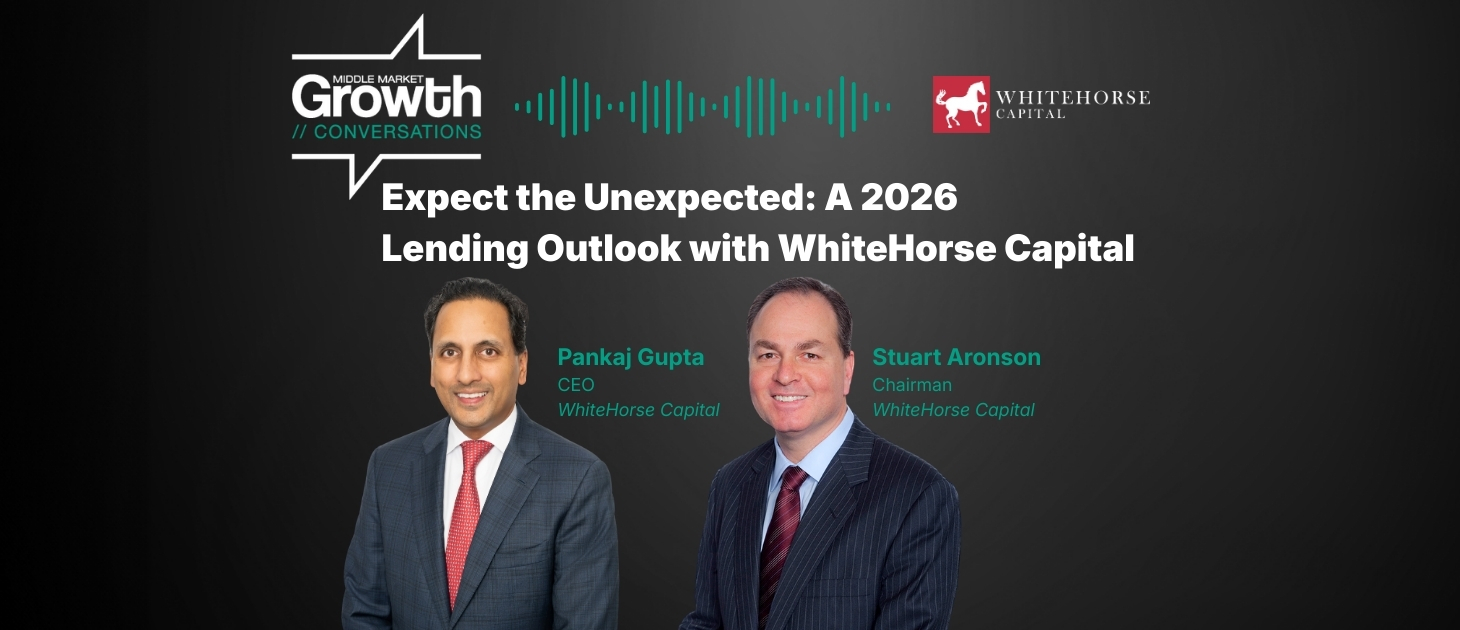
From geopolitical events to tariff fallout, 2025 brought plenty of surprises, and 2026 will surely hold some of its own. Pankaj Gupta, CEO of WhiteHorse Capital, and Stuart Aronson, chairman of WhiteHorse Capital, are back with the podcast to share their observations on how the lending space was impacted by the events of 2025 and their predictions for the year ahead—for the lending world and the broader M&A marketplace.
This episode is brought to you by WhiteHorse Capital. To learn more about WhiteHorse, visit whitehorse.com. Read a transcript of the podcast below.
Middle Market Growth: Welcome to Middle Market Growth Conversations, a podcast for dealmakers discussing the trends shaping the middle market. I’m your host, Carolyn Vallejo, and this is a production of the Association for Corporate Growth. We have a little bit of a recent tradition of kicking off each year with WhiteHorse Capital’s, Pankaj Gupta, and Stuart Aronson in the past. These conversations have provided a lending outlook for the year ahead and some extremely accurate predictions for how markets will take shape. And in 2026, we’re hoping for more of the same. Pankaj and Stuart, welcome to the podcast.
Pankaj Gupta: Thank you, Carolyn.
Stuart Aronson: Thank you, Carolyn.
MMG: We’re happy to have you both back. But to begin, we want to get to know you a little bit and share some more information with our listeners about each of you. So Pankaj, we’re going to start with you. For the listeners who might want a bit of a refresh, can you tell us about your role at Whitehorse U.S. and what you focus on there?
PG: Sure. I am the CEO and head of our WhiteHorse Capital credit platform. We are a middle market, exclusively middle market focused lending organization, focused on working with management teams, with owners of businesses with private equity firms to provide them with all sorts of capital that they need to help their businesses continue to thrive and flourish.
MMG: And Stuart, same question. Tell us a bit about your work at WhiteHorse.
SA: Yes, I am the chairman of WhiteHorse, have been here for 10 years now, and I work closely with all the management team on both the deal flow and fundraising of the business. And as Pankaj highlighted, we’re actively involved in a mix of midmarket, midmarket sponsor, and midmarket non-sponsored lending.
MMG: And just for a bit of fun, if either of you could learn any new skill in 2026, what would it be? Pankaj, let’s start with you.
PG: Well, the main skill that I would first try to figure out is actually a personal skill, which is how to navigate teenage children. So if anyone out there has any ideas and wants to hit me up on that, I would love to hear about that. Look, on a professional level, I think the biggest skill for me, and for everyone on our team as we head into 2026, is how to expect the unexpected and how to navigate that.
MMG: And I think expect the unexpected might also be applicable for teenage children, I would guess. Stuart, what about you? If you could learn any new skill this year, what would it be?
SA: Well, the good news is all my children are passed through teenage years. So whether I did it right or wrong, I made it through that gate. I would say candidly, we’re navigating from a business perspective, very complicated markets. M&A activity, as we’ll talk about, has picked up a little bit, but nowhere near as much as private equity firms and bankers had been hoping. And predicting and navigating the market to do the right types of transactions and make the right types of decisions with competition of a lot of new money flooding in as a complicated thing to do. So, even though I’ve been in the market for 37 years, this is an interesting time to be investing,
MMG: An interesting time to say the least. Well, we’re going to dive into this conversation today and hopefully give our listeners a bit of insight into the many question marks that are out on the market right now. So, Pankaj, we’re going to start with you. We sat down with you and Stuart before, back at the beginning of 2025 to take a look at the year ahead. And you both have a great track record so far. And so first, give me your thoughts on 2026. What are the major market trends that you’re keeping an eye on?
PG: You know, interestingly, Carolyn, I was thinking back to our conversation at the beginning of 2025, and I was actually surprised, pleasantly surprised, that we were not too far off on a bunch of things. You know, things like moderate rate cuts as opposed to, you know, a lot of people at that time were thinking about it in the context of significant Fed fund rate cuts. We sort of thought that inflation would remain sticky throughout 2025, and while it definitely came down it hasn’t retreated down to the 2% levels that the Fed wants, you know, a gradual pickup in M&A, a gradual thawing of the markets with the CEO and business owner optimism that existed at the beginning of 2025. I think the one area that again, it kind of goes back to navigate and expect the unexpected. When we had this conversation last year, the trade policy that was then implemented in March/April of last year was not clear to anybody, including us. And that obviously threw things for a little bit of a monkey wrench as the middle of 2025 unfolded. As we’re looking at 2026, look, there’s a lot that we are focused on and keeping an eye on, ranging from if you start at the macro level again, what’s the Fed going to do, who’s going to be doing that at the Fed, that’s going to have a big impact, obviously on rates, on cost of financing, on growth, and all of those topics. We’re keeping an eye on geopolitical events, as you know, all of the things that have gone on recently as it relates to Venezuela, Greenland, the Middle East, Europe, et cetera. There’s just a lot going on, and, at least from my perspective, I’m not smart enough to predict that, or in the know enough, I guess, to predict that. But it’s, again, being cognizant of things that can occur and how do you navigate that. And then from a more micro deal perspective, Stuart highlighted or touched on it, M&A activity we do think is picking up. We do think there is a thawing between buyers and sellers and more dealmaking that is occurring, that’s generally a good thing and will be a good thing for us and the companies that we work with. And the underlying health of businesses from an economic standpoint is generally pretty good. Businesses are continuing to experience growth as a whole, especially in the middle market. Businesses are expecting growth in 2026. There are forward looking KPIs and sort of all the indicators are generally pointing to health and so that’s a really good thing. So I’d say we head into the year with cautious optimism, and again, the caution stems from the lack of clarity into the unexpected, that we know will occur over the year.
MMG: Right. Well, as you just mentioned, there is a lot going on. We are going to want to dive into some of those specific topics later on in the conversation, but first we also like to explore how these market trends are shaping underwriting standards. So Stuart, I’m going to turn to you. What are some of the impacts of 2025’s economy that have made an effect on underwriting standards?
SA: Yeah, taking it from where Pankaj was, where we see the economy for the midmarket being relatively benign. There’s generally optimism that the administration, while unpredictable in many manners, is pro midmarket, U.S., American companies. That has led to a confidence of people to be underwriting aggressively. The aggressive underwriting is then exacerbated by the fact that a lot of new money has been raised in the marketplace. A lot of people have become aware that direct lending is a good place to be invested for the long term compared to a lot of other sectors. And so that has attracted investors from many corners of the globe and many different market sectors into the direct lending world. So with a supply demand imbalance and a general confidence in the economy, we are seeing bankers claim add-backs, synergies, and cost cuts on deals leading to very highly adjusted EBITDAs. The private equity firms that look at deals take their own view on those, but lenders generally, since they don’t have the equity upside, take a more conservative view, but that more conservative view has shifted over 2025, and we think into 2026, into more aggression. Particularly we’ve seen it on some cyclical credits where people have gone to surprisingly high loan-to-values. So we think it’ll be a competitive underwriting market. And at WhiteHorse we think there’ll be plenty of good deals done where we may not love the price on those deals, but we think that they are good credits and worth investing in.
MMG: Absolutely. Okay. Well, I’m hearing from both of you a decent amount of optimism, which is great. So Pankaj, I’m going to turn back to you. We’re recording right now, still in the first month of 2026. So I want to take this opportunity to hear about the rest of your outlook for the year ahead. And I know you touched on some of that, but I’d like to go a little bit deeper.
PG: From an outlook perspective as it relates to activity levels, we do think 2026 is going to be a bit of a rebound year in terms of M&A activity in the middle market. For years now, there has been a disconnect between buyers and sellers of assets as it relates to valuations. We’ve seen that disconnect narrow and based on conversations that we’ve had with everyone across the market, whether it be investment bankers, advisors, owners, CEOs of businesses, or private equity sponsors, everyone in all of those conversations feels like there is additional activity that is occurring, that will occur, and that the valuation gap seems to be narrowing. It’s not perfect by any means, but it’s narrowing. And so with a heightened level of activity, you know, we’re still though dealing with the items that Stuart mentioned, which relate to a lot of capital has flown into the private credit space across the market in the large cap market, but also the midmarket. And so finding a way to pick and choose your spots where you find good companies with interesting theses where you understand that business model and that sector, and can in a prudent and appropriate manner deploy investor capital. And that’s what we’re doing. And so we anticipate this year will be a good year. We anticipate a growth year over 2025, a step function growth year over 2025, still not to the levels of activity that we saw in say, 2021 which was a pretty active and pretty aggressive M&A market. We don’t anticipate getting back to those levels, but what we do anticipate is rebounding about halfway in between where it has been and those levels. And then again, you know, as I mentioned earlier, based on our portfolio, and we have over 200 portfolio companies across the middle market that we’ve invested in, based on our conversations with those businesses and with the ownership groups of those businesses, we think that the fundamental health of middle-market businesses is pretty good. And so that again, puts you in a little bit of a risk on posture relative to, you know, a viewpoint that you’re heading towards a recession, which again, right now we are not seeing the signs or the indicators for.
MMG: Stuart, what about you? What are your predictions for portfolio performance specifically in 2026?
SA: I’ll start with the fact that I think there’ll be less pressure on companies because I think interest rates will come down more in 2026 than is currently being predicted. I believe the focus of the administration on getting someone in to run the Fed that has a desire to cut short-term interest rates will result in more than a 25 to 50 basis point reduction over the course of the year. And obviously, lower interest rates will help performing portfolio companies as it regards different sectors and how they were performing. Portfolio, we’re optimistic on business services, we’re optimistic on healthcare, we’re optimistic on TMT. The one place where we think there may be portfolio pressure is with inflation staying a little higher than the Fed wants it to be. And the shorter term interest rates, probably if they come down pushing inflation a little bit higher, over six to 18 months. We do think the low and mid-end consumer who has been pressured for years now is continued to be pressured. And you’ve seen that in some troubled companies that have reported including some issues in the restaurant sector. So most sectors we think will be pretty good in the portfolio aided by lower interest rates as well. And only pressure probably in that sector I just identified. Pankaj, do you think there are any other sectors that we’re highly concerned about right now?
PG: No, I mean, I think you’ve highlighted the ones that we’ve spoken about a lot here internally. There’s obviously another subset of sectors that we at least have some difficulties with as it relates to things that can be a little more volatile, right? In terms of the underlying revenue and/or profit stream, things that are more brick-and-mortar retail or consumer, restaurant-related sectors. But again, generally speaking, you know, we’re not seeing broad-based kind of sectors in decline.
SA: The other thing we’re being very cautious about, and we can talk more about it, is the impact of AI across a whole series of sectors, which takes companies that may have had good growth patterns historically, but puts them at risk not only today, but especially as AI continues to advance over the next three to five years.
MMG: We’re definitely going to want to talk more about AI, but first, at the top of this conversation, we mentioned the phrase, “expect the unexpected.” There are still so many unknowns in the market today. So in the event of a recession or economic downturn, Pankaj, what would be your expectations for portfolio performance?
PG: Well, look, there’s two ways to look at projecting out portfolio performance in the event of a recession. One is, what I think of as the traditional way, which is companies that historically have had structures with financial maintenance covenants and more regular way documentation terms, regular way meaning, there’s not an ability to get assets out of the kind of the collateral pool or bring in additional debt pari passu or even ahead of the existing debt in a business. So basically a company underperforms, it trips its financial covenants, the lenders at the top of the capital structure sit down with the owners of the business and figure out a solution that rights the ship. That’s sort of the old way in the traditional way of lending. And in that scenario, defaults rates usually go to, you know, 2 to 3%. And you know, usually there’s about a 40% to 60% loss when there’s a default. And so your overall default loss rate goes to, let’s say 80 basis points or something in that area. What I’m concerned with is how most of the market has operated, at least for my 30 years of being in this industry. But a lot of the market over the last 3, 5, 7 years has moved away from that. And what I mean by that is they’ve moved to covenant lite structures where there are no financial maintenance covenants, even for companies that typically are much, much smaller than the historical norm of $75 million or a hundred million of annual cash flow, but much, much smaller than that. As well as documentation terms that allow for these deals in these companies to then take assets and outside of the kind of the existing loan, raise capital behind that or actually bring in lenders ahead of the existing lenders in order to raise capital. So what happens in those situations is rather than the traditional method of lender sits down with the ownership and figures out the solution and new capital comes in to support the existing senior lenders. It’s sort of the inverse of that, where the ownership then goes out and circumvents the existing senior lenders. The default rates and loss rates in those types of deals, it’s to be written kind of where they wind up in the next recession. We’re already seeing this in the market, and there’s a lot of data in the market that defaults and losses on those defaults are much higher in those scenarios than they are in more traditional structures and deals. And so that’s what is the unknown. Now, the good news, at least from our end, is that the middle market where we focus on working, again with private equity firms and with ownership and management of founders of businesses, generally is still a market that has the old structures. Or the regular way to structure, I should say where there is appropriate protection for senior lenders, appropriate options for owners of businesses. And so in the next recession, we don’t think that our portfolio is going to behave materially differently than in prior recessions. But I can’t quite say that for the overall market where there has been a lot of these newfangled technologies so to speak, that is going to cause a higher default and loss rate.
SA: You know, highlighting what Pankaj said, in addition to the weak documents, high leverage levels, and lack of covenants in the large cap market, you also have a lot of deals that are now being structured with contractual partial PIK. And when you add covenant lite to partial PIK, that means the company is going to decline more and get into more trouble before it has a payment default, which will put even more pressure on the recoveries to the debt. Ultimately when you add in partial PIK no covenant protection so that there’s a delay in the payment default. And then you’ve got the risk of the owner of the company executing a liability management transaction and bringing in senior debt ahead of what the debt was that thought it was senior in the company.
MMG: I had said earlier that I want to touch again upon AI, which, Stuart, you talked about briefly. Tell us a bit more about where you’re seeing AI impact the companies that you work with and maybe even WhiteHorse itself.
SA: AI is amazing. In just the last couple of years, we have seen the impact of AI at WhiteHorse have a very significant effect on the efficiency and productivity of our junior staff. Whereas before you had one and a half junior people for every transaction, we have now shifted to more of a one-to-one structure. So there’s still the role for junior people, but they’re more efficient. So you don’t need as many on the investing side. AI is a very complicated topic. There are certain areas where you’ve seen AI already have significant penetration and impact into the marketplace. On those situations, frankly, it’s easy to duck and cover to avoid the impact and not get in trouble. But the real underwriting goes on where AI is going in the next three to five years and three to five years particularly, because that’s typically the time horizon for a private equity investment. So we’re entering something and three to five years from now, the private equity owner is going to want to exit. And the question is, where will AI have gone? So things that are not an issue today where will they be? And as a quick example, we saw a company that reads radiology and CAT scans for the veterinary industry already, AI can do 70 to 90% accuracy on those scans. And the thinking we had was three to five years out that accuracy is likely to go up much higher and potentially lead to a conversion from humans reading those veterinary scans to more AI work. And that frankly spooked us on that credit. So that would be an example of the forward vision of AI and how we’re trying to underwrite to avoid problems upon exit.
MMG: All right. And Pankaj, you’re going to close us out here. You also mentioned earlier briefly about geopolitical topics, Greenland, Venezuela, the Middle East, Europe. There’s a lot happening. How is all of this activity impacting the world of private credit?
PG: Well, there certainly is a lot going on around the world in terms of the areas that you mentioned. And it feels like there is likely to be more that occurs over the course of 2026 from a private credit perspective, especially focused on the middle market. And I know it sounds a little bit almost not believable, but the reality is a lot of it is noise and it’s just noisy in the lower and the middle market. And then I think the reason for that again is, you know, look, the businesses that we work with tend to be fairly U.S.-centric businesses where you have U.S. operations, U.S. supply chains, U.S. customer bases, and therefore, while clearly the world is interconnected and there is sort of knock on effect, the reality is the direct effect positively or negatively for a lot of the businesses, most of the businesses that we work with is fairly minimal. And so of course we are very aware of and keeping an eye on all of the items that are occurring around the world and what impact that they may have as it relates to the companies that we look at and work with and invest in. But so far our assessment is that the direct impact again, in a positive or negative manner, is fairly minimal.
MMG: All right. Well, Pankaj and Stuart from WhiteHorse Capital, and I really appreciate you both providing your insight and your outlook.
PG: Well, thank you, Carolyn. We appreciate it.
SA: Thank you, Carolyn.
Note: This presentation includes forward-looking statements based on certain assumptions. The views expressed reflect the speakers’ opinions as of the date of the presentation and are subject to change. These statements involve risks and uncertainties; actual results may differ materially. Nothing in this presentation should be considered investment advice.
The Middle Market Growth Conversations podcast is produced by the Association for Corporate Growth. To hear more interviews with middle-market influencers, subscribe to the Middle Market Growth Conversations podcast on Apple Podcasts, Spotify and Soundcloud.