The Year Ahead: Dealmakers on Fundraising, Exits, and More
Forvis Mazars' Scott Linch and GF Data's Bob Dunn reflect on recent ACG discussions held about the state and future of M&A
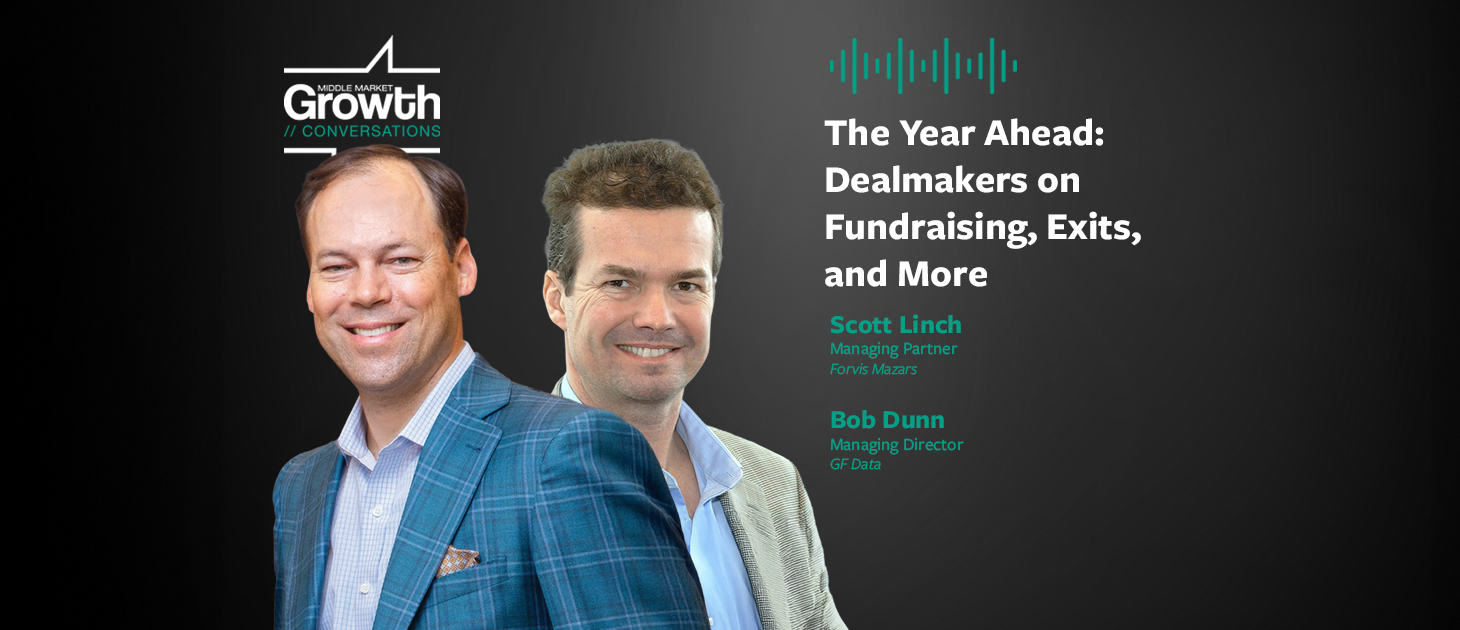
Forvis Mazars recently held a set of exclusive events for high-level dealmakers in partnership with ACG and GF Data, to dissect the latest data on deal activity and to take a look into what 2026 might hold for PE-backed midmarket M&A. Scott Linch of Forvis Mazars and Bob Dunn of GF Data join the podcast to share what they discovered about fundraising, exits, the performance of specific sectors, and much more.
This episode is brought to you by Forvis Mazars, a leading global professional services network.
Midde Market Growth: Welcome to Middle Market Growth Conversations, a podcast for dealmakers discussing the trends shaping the middle market. I’m your host, Carolyn Vallejo, and this is a production of the Association for Corporate Growth. Forvis Mazars, a leading professional services network, recently held two discussions, dissecting the latest private equity-backed deal activity, and here to share some key insights from those discussions are Scott Linch, managing partner and national industry leader of private equity at Forvis Mazars, as well as Bob Dunn, managing director of GF Data. Scott and Bob, thanks so much for speaking with us.
Scott Linch: Thanks for having us.
Bob Dunn: Thanks for having us, Carolyn.
MMG: Before we get into some of the key insights and findings from the discussion, we have this little get-to-know-you segment, and our listeners are probably familiar with both of you, but Scott, let’s start with you. Can you kick us off by telling us about yourself and your work at for Forvis Mazars?
SL: Sure. So, I’ve been with for Mazars for I guess about 15 years now under a few different names given our mergers that we’ve had and our international network that we formed, started out in the transaction advisory space, doing quality of earnings and helping build that practice, but have slowly progressed into helping lead our private equity sector internationally and domestically as well as leading our investment bank called Forvis Mazars Capital Advisors. So really had kind of a unique career, I guess, being an accountant and now an investment banker. So, it’s been fun to have that, those two roles with the organization, but they really are connected with our accounting firm and our investment bank. You know, we work with over a thousand private equity funds in the U.S., serving them in some way and having deals to show them is an added plus. And so we’re really excited to have those two practices very connected.
MMG: And Bob, for those who may not know, tell us about your work with GF Data.
BD: Yeah, certainly, Carolyn. Yeah, I’m managing director of GF Data. I run the business for the Association for Corporate Growth, which acquired it about three and a half years ago. What is GF Data? We believe we’re the best source of valuation information for the middle market. We track deals with enterprise values between $10 million and $500 million that are private equity-backed, and have a cadre of 350 plus private equity firms that contribute their deal data to us. We aggregate the information, anonymize it, and then provide benchmarks for the market related to valuation, leverage, et cetera. On the unique career path side that Scott alluded to, I actually started my career as a journalist covering private equity way back when in the late nineties from journalism. Sort of transitioned to the product side, got into the data side, and worked on that running Dow Jones private markets, and then businesses for euro money institutional investor, and then later on with intelligence. But it’s a real fun business. It’s a great part of the market track, and it kind of feels like I came back to what I started because in the late nineties, everything was mid-market.
MMG: And just for a bit of fun, if either of you could learn a new skill in 2026, what would it be? Bob, let’s start with you on this one.
BD: That’s a tough one. I’ve always wanted to learn guitar, but I don’t think I don’t think 2026 over the year I do that. But with that sort of attitude … but yeah, probably learn the instrument.
MMG: And what about you, Scott?
SL: You know, I was thinking about this question and I don’t know that I need to learn any new skills. I just need to be better at some of the skills that I’ve tried to master in the past. And one of those is the guitar. I can play the guitar, but I’ve been told that the rhythm that I play the guitar in is not great. So if I could figure out how to put the rhythm associated with the guitar, then I like to play golf, but I haven’t mastered that either. So that’s definitely a skill that I still try to learn. So, you know, if I could actually just get better at some of my current hobbies, that’d be fun to have.
MMG: Bob, I found you a guitar teacher if you’re interested.
SL: Just got to learn “Stairway to Heaven” first, one of the few things that I can play there.
BD: There you go. That’s going to be the one.
MMG: All right, let’s get into the discussions and some of the findings from these talks. And you know, Forvis Mazars has held these private equity and M&A discussions in partnership with ACG and GF data. So Scott, tell us about the purpose of these events and what maybe inspired you to hold them.
SL: You know, we’ve been very connected with ACG for a long time. I mean, I’ve served on the local board here in Charlotte and was president and was on the global board and actually got a chance to chair Intergrowth, now DealMAX. So I’ve been very connected with the organization and, you know, once ACG and GF Data kind of merged together, gotten to know Bob and working with Bob and actually learning a little bit more about GF Data and the great work that they do with some of the information that they’re able to provide. We’re a customer of GF Data from our investment bank. We utilize that information on a regular basis, especially in, you know, lower and middle-market transactions that we work with that are typically founder-owned businesses, that it is just helpful to have that kind of private data. And so, you know, as the years have progressed, Bob and I have been doing some quarterly updates of what’s going on in the market, and that’s really gone well and enjoyed doing that. And so, trying to figure out a way to take that to a different level, Bob and I brainstormed on that and came up with the idea of trying to do some of these round table-like events. Where we did, I would say we did one in Boston. It was much more of a round table format in Charlotte, it was more of a, you know, we had some pretty senior dealmakers in the community in the room talking about what was going on and utilized some of the GF Data information while we’re doing that. And so it was just an opportunity to get dealmakers in a room really as a way to get people that are more senior in dealmaking in a room to talk about the trends that they’re seeing. We had pretty much kept the meeting to just investment bankers, private equity funds, and portfolio company C-suite folks. So, a pretty senior audience, which gave some real, real good data out of that.
MMG: And we’ll definitely want to talk about that data, but one of the headline findings as we understand it that was discussed at these events is the still somewhat muted M&A environment that dealmakers have experienced this year. Can you share a little bit about what the data shows and maybe some of the reactions from attendees?
BD: Yeah, in the round tables, the discussions were similar to what we’re actually seeing in the data. It’s been a muted year for deal volume. There’s been challenges there, particularly in some spaces. Manufacturing is one that GF Data has found that’s definitely seen lower valuations and significantly lower deal volume in the previous three quarters. I think on the positive side, there was a lot of discussion about an improving exit environment for private equity. And that’s been one of the big challenges and Scott and I have talked about it before, that whole period for private equity has extended out well beyond the three to five year standard that the industry expects on it. And that’s been a challenge in terms of deploying new capital and raising new funds. But it does seem like exit activity for private equity is picking up. You know, the other side is that we’re also hearing about and heard about, there’s a lot of activity going on, and I think Scott can speak to this directly with companies being prepped, founder-owned businesses, it does seem like there’s a buildup of companies that are getting ready to enter the market. Now, obviously that could be a long period of time or a short period of time in terms of entry, but people do seem to be actively working with companies that will be entering the market, and that obviously bodes well. So, I think from the exit side, the number of companies being prepped, overall positive sentiment, but in the midst of a challenging period of time, just in terms of deal volume.
SL: Yeah, I would probably echo a lot of those same comments. You know, we are seeing people getting businesses ready to take to market. I think this has been a story of the last 24 months, probably at least, where we’re saying some of the same things. But I do think that that’s where we expect some of these founder-owned businesses to definitely go. We are talking to more funds that are actually trading their platform deals and getting some nice exits. I would say a heavy percentage of funds I speak to now have done some of that in the last 12 months, which is different than the previous year. And so we are seeing more of that. Our firm recently did a survey of over 150 funds in the U.S. We actually did a global survey, so we had funds across the world as well. But from the U.S. perspective, there is talk about challenges on volatility from trade interest rates, political and geopolitical uncertainties really kind of holding them back a little bit. But I do think that the funds would say that they’ve learned how to navigate those and have taken steps to mitigate those challenges. And so, we are seeing people get through some of that. Right at the beginning of the year, right after the election, there was a lot of uncertainty around, you call it interest rates, tariffs, immigration, some of those things are still lingering around for sure, but people have learned to navigate especially tariffs where businesses are still performing even though they might have faced some tariff issues along the way.
MMG: And Scott, you mentioned the Forvis Mazars survey. For our listeners that are interested, where would they be able to see those findings and when can they access them?
SL: Yeah, so the full surveys are going to be released early next year, but there is some kind of teaser information out on our website. It’s actually on the global Forvis Mazars website, so they should be able to go there and register to get that information.
MMG: Well, among some of those several ongoing challenges in the M&A ecosystem that have persisted over the last 24 months or so, as you mentioned, is the mismatch between buyer and seller pricing expectations. Are there any signs of this improving?
BD: We’re definitely seeing steps to try and mitigate it. One of the things that GF Data noted over the first three quarters of 2025 is an uptick in earnouts as a component of deals. About 50% of transactions we tracked in the last three quarters included an earnout—that’s an increase from about 40% the last couple of years. So that’s definitely one of the mechanisms that’s in there. I think on the flip side of that, or maybe right in line with that, we’ve had an ongoing trend of diligence stretching out further and further. And I think that is a sign that there’s a lot more focus by buyers to really look at the companies really, they really make sure they understand it and really make sure they properly valued it and properly valued the environment that that particular company is in, both micro and macro. So, I think there are mechanisms there to address the mismatch. I don’t think any seller likes an earnout, but I think in this sort of environment, that mechanism can be very, very helpful here.
SL: Yeah, I would say the same thing on earnouts as well as seller notes sometimes fill in that gap and you know that these are only for privately owned businesses you know, founder, family-owned businesses. When you think about selling your portfolio companies, that’s sort of a different beast. And you know, I think that private equity funds, they’re having to get money back to their LPs. So, there is a time period on getting some exits. Obviously we’ve seen the continuation funds pick up the last two years, but we’re also seeing reason why, you know, if someone has a good asset, a good portfolio company that’s kind of weathered the storm of some of the uncertainties we’ve talked about, it’s a pretty good time to go ahead and get some money back to your LPs. And we are seeing, like we said earlier, that part of the market pick up as well.
MMG: Another topic that is getting a lot of attention right now is the fundraising environment. As we mentioned, it’s kind of a tepid dealmaking ecosystem, which I imagine is having some impact on the ability for firms to raise funds. So, tell me what the observations are here.
SL: Yeah, so I would say that we had a fund in the room at one of our events that had just raised a $4 billion fund, and what they pointed to, I think there was actually a Wall Street Journal article out about them. What they did point to is that they had some nice exits, right? And so the funds that have had successful exits in getting money back to their LPs probably aren’t having as challenging of a time to raise funds. It’s the ones that are still not getting money back to their LPs, where that’s even harder. Our survey that we did, some of the initial results came back that said 79% of the funds that we interviewed were either in the process of raising a new fund or will do so within the coming 12 months. But it also did say that the positivity around fundraising had declined in the last year. So, I think people are seeing, it’s harder to raise funds, especially if you don’t have some good exit stories. So that that’s probably what we’re seeing right now.
BD: Yeah, I completely agree. It’s the fundraising is completely dependent on the exits and the strength of those exits. And, you know, when you’re not seeing as many exits as we have over the last two years, that’s going to slow down fundraising. Also, I believe it was 2023 was the largest year on record for middle-market fundraising, 2023 or 2022. But, you know, a lot of money’s gone into the space already, and a lack of returns makes it more challenging. I think through the first half of the year, middle-market fundraising was down significantly from 2023, and that was down from the prior year. But again, as exits improved, that should improve that market. And I think the middle market’s still viewed from the viewpoint of limited partners as a very strong place to be invested with a lot of potential companies to choose from. So it will rebound, but it’s been tough.
MMG: Well, let’s dig down into some sector specific insights, which I know was also a topic of conversation at these discussions. Tell us a bit about what the data shows in terms of which sectors are maybe faring better than others.
BD: Yeah, I mean, and this is a continuation from prior years, but particularly seeing in the first three quarters of 2025, as with services industries, they’re surging this year, year to date, we’ve seen for the first three quarters, the highest valuation on services businesses that we’ve seen in the last five years at 7.5 times trailing 12-month EBITDA. Add-on activity, which is definitely elevated right now, is driving some of this. But it’s definitely a very buoyant space in the market right now. And again, some of the things we’ve already talked about very low or no exposure to tariffs, good recurring revenue businesses generally. And I don’t want to say a safe haven, but definitely we’ve seen a ton of activity in the services with platforms and a ton of activity with add-on activity. Flip situation on that is manufacturing. We’ve seen that space move in the opposite direction, declining in the last three quarters. And again, it’s the reasons we’re talking about here. There’s the higher likelihood the manufacturing company is going to have tariff exposure. We’ve also seen overall in terms of revenue growth and deterioration over the last 12 months, particularly manufacturing. So, I think there’s been some challenges there, both macro and potentially micro and it’s hurt valuations.
SL: Yeah, I would add that industrial services, business services continue to be strong, just to people trying to get to service-oriented businesses, I think technology opportunities continue to be strong. Anything software, data center-related is pretty hot. Anything that has AI and disruptive kind of technologies. One space that we’ve also seen is infrastructure-related businesses, we’re actually even seeing construction, heavy infrastructure businesses getting some activity. Not always private equity-related, but there’s definitely some consolidation in that space with the money being spent on infrastructure. We did have some folks on our panels that talked about food and brand businesses, you know, there’s a recurring brand and able to put some operational expertise into these businesses really can drive value there. So, those are a couple of the spots that we heard more on.
MMG: Scott, you mentioned tech opportunities and AI in particular, which has been one of the most, if not the most popular topics among dealmakers this past year or so. Tell me about some insights there, both in terms of how investors are looking at AI as an investment opportunity and how they may be adopting it themselves and their own back offices.
SL: Yeah, I think that more funds are using it, just from an internal perspective to help drive consistency around how they do things, efficiency in their decision-making process. But we even heard stories about automating call centers and surveillance at some of their businesses, automating some of their processes throughout how they manage their portfolio so that there’s definitely operational improvement in their businesses. Some of the folks that talked about operational improvement in the businesses, they’re talking about how they can use AI to drive the operational improvement at the portfolio company itself. So it was definitely a topic of everyone’s trying to figure out how to create value. You hear about the value creation, they’re trying to think about how they used AI and other technologies to drive that change.
MMG: Let’s talk about cross-border dealmaking for a second. What trends are we seeing maybe across the pond in terms of middle-market dealmaking that were discussed?
SL: Yeah, I would say that the European funds are really looking to get in the U.S., so any business that they own in Europe, they’re really looking for strategies to put money to work in the U.S. and how do they add on to their existing businesses? They’re not necessarily looking to do their platform deals in the U.S. because those are typically taken by the U.S. funds, but they’re trying to figure out how do they take their businesses into the U.S. and so there’s a lot of focus on that and as I’ve met with international funds throughout Europe, there’s a huge desire for buy-side services for their portfolio companies within the U.S. So that, that’s definitely going to be a space that I think we’ll see increased competition for the U.S. funds by these international funds as they’re trying to enter into the U.S. Also, the U.S. funds are also looking to invest in other markets as well with Canada as probably the biggest one we see in the U.S. In the survey that we had done, it was Canada was the largest, UK, France, Germany, China, were kind of the other leaders that we saw people looking to add investment dollars to.
MMG: As we mentioned at the top of our discussion today, the M&A environment has had this muted feeling for the last year or two. And I know that at these discussions you offered your outlook for both Q4 and 2026. So, could you share some of those predictions with our listeners?
BD: So, Scott and I are eternal optimist, but no, and we’ve been saying this for a couple quarters, but they’ve been a strange few quarters. I think we’re in a spot for an improved outlook for Q4. Will it be a blowout quarter? I think probably not, but definitely probably the strongest quarter we’ve seen in terms of deal volume for 2025. And I do think that coming into 2026, as Scott noted, private equity sort of figured out that this is the environment, this is where we’re working, we need to get out, we need to deploy capital regardless of what concerns we have about tariffs or other things. We’ll find a way to work around it. And again, there’s capital that needs to be put to work on it. I think if you look at the debt markets, they’re in pretty good shape right now, questions about the broader economy, but I think that sentiment seems to have improved over the last few weeks on that. But I believe we’re going to see a very strong environment for 2026. Now, I did say we’d see that in 2025, so don’t trust me entirely, but we do have everything required to really increase the amount of activity going on in the market.
SL: That’s why I’ll let Bob go first. I wanted to see if he was going to remain optimistic.
BD: Eternally.
SL: Yeah, no, I mean, I think anything you read out there would have similar levels of optimism about 2026. Everyone believes that we’re kind of on increased activity for a while now and for all the reasons we talked about, putting money to work, getting money back to your LPs. I mean, the funds have to keep the activity level up and so it’s going to happen. It just a matter of when we see this kind of really blowout of deal activity, I do think it’s going to happen in 2026. You know, the funds just really have to put the money to work. And so, I’m excited to see what’s happening. I did note in our sessions that we had the debt providers in the room [who] would say that the private capital private debt markets are being super aggressive right now. And it’s a very competitive market with the interest rates ticking down just a little bit and maybe again here shortly. I do think that’s going to make that market even more bullish on putting money to work. And so, that will definitely help things as well. And as some of these funds have to sell their platform companies to larger private equity funds, they’re going to have to refill the ship. So, I think we’ll see a lot more activity next year. I’m going to say optimistic with Bob. There you go.
MMG: Tell me more about kind of the mood in the room and what attendees of these discussions are thinking both in terms of Q4 and into the new year as well. Do you think they also have this kind of eternal optimism that you both seem to share?
SL: Most everyone would say, you know, the first part of the year was super slow from their perspective of seeing deals. And they would all say that they had seen increased deal activity here and the number of private equity funds that you’re talking to that are getting deals done, either buying or selling, several of them would say they had deals in the market right now. And so I think there was a similar level of optimism in the room from what I heard.
MMG: And finally, to close out, these discussions were two-way conversations. You always leave an opportunity for attendees to ask questions or make remarks. Were there any themes that emerged in the questions or feedback from the attendees of these discussions?
SL: I think some of the sector discussions that we’ve already talked about, that was one of the questions that came up multiple times in both the [discussions] that we did. So, we talked a little bit about some of those same sector trends. You know, AI was one that people talked about how that’s transforming their business. So those were definitely places that we saw. I was excited to see that the article that we were part of around sell-side due diligence and how that may be impacting selling your business, and there was kind of a consensus that you definitely do sell-side diligence because it adds a lot of value to the process.
MMG: Alright, well with that, we will wrap it up. As always, Bob and Scott, thank you so much for joining us and sharing your insights. It was a great talk today.
SL: Thanks for having us.
BD: Thanks, Carolyn.
MMG: It’s always a pleasure.
This transcript was prepared by a transcription service. This version may not be in its final form and may be updated.
The Middle Market Growth Conversations podcast is produced by the Association for Corporate Growth. To hear more interviews with middle-market influencers, subscribe to the Middle Market Growth Conversations podcast on Apple Podcasts, Spotify and Soundcloud.