The Dealmaker’s Guide to Stress-Testing AI Value
GrowFast Advisory's Stephen Murray joins the podcast
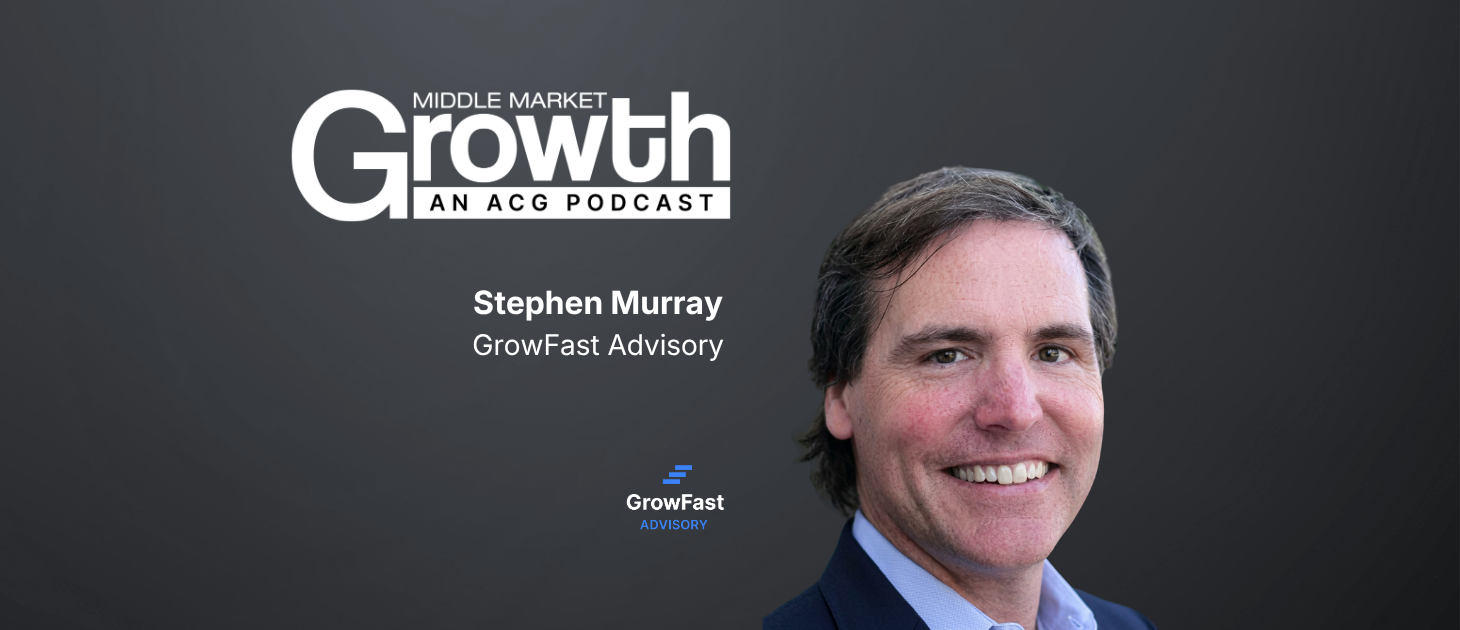
If you ask private equity firms or their portfolio companies whether they’re using AI, the vast majority will say yes, but many still aren’t seeing significant value from the technology. GrowFast Advisory’s Stephen Murray is back on the podcast to share how to identify real AI-generated value, retain and nurture that value, and track the AI metric every leader should watch.
This episode is brought to you by GrowFast Advisory. Learn more at growfastadvisory.com.
Read a transcript of the podcast below.
Middle Market Growth: Welcome to ACG’s Middle Market Growth Podcast. I’m Carolyn Vallejo. According to McKinsey analysis, PE-backed companies that broadly embraced AI traded at a median revenue multiple roughly 130% higher than that of peers that used AI opportunistically. But it can be challenging to kick the tires at a company and stress-test how much value AI is generating and how repeatable that value thesis is. GrowFast Advisory’s Stephen Murray is back on the podcast to tell us how dealmakers can evaluate AI value and how well it transfers post-close. Stephen, welcome back. Can you remind us of the work you do at GrowFast Advisory?
Stephen Murray: Thanks, Carolyn. We maximize enterprise value for an exit in a post-AI world. From that perspective, every deal already has three diligence workstreams: quality of earnings, legal, and commercial. We believe there is a fourth workstream that has not received enough focus: Where is value actually captured, and is it transferable? We would say that is particularly important today in the world of AI. I’ve personally sat in three chairs in a deal. I’ve been in the seller’s chair across from private equity, the buyer’s chair across from Fortune companies, and, perhaps most uniquely, the chair responsible for executing the deal. That pulled back the curtain and revealed many issues and places where value can be lost. We focus on that problem. We consider the individuals who created the value, the work systems, and, particularly today, the way AI and technology are changing the workforce so quickly. We examine the issues that change creates for a company.
MMG: We definitely have a lot to discuss, and it’s helpful that you have that multifaceted perspective. But before we get into it, just for a little fun, if you had to choose a walk-up song, what would it be?
SM: Easy: “Under Pressure,” whether it’s the Queen or David Bowie version. The race to get ahead in AI is constant every day. But if you’ve sat in a management meeting and discussed an upcoming deal, the question becomes: Who actually runs the company? Outside of the CEO, you’ll often find the room gets quiet. That bassline from “Under Pressure” starts building in your head. I always come back to that song.
MMG: It’s also a great song, so that’s a great choice. Getting into our main topic, when businesses, portfolio companies, and their PE backers are asked whether they’re using AI, almost everyone says yes. But many aren’t seeing value from it or even understanding whether they’re getting value. What’s the difference between a company that uses AI to generate real value and one that does not?
SM: About a year ago, many people focused on AI adoption rates and assumed that the more a company used AI, the more effective it had to be. The conversation has since shifted to whether the company gets value from what it has invested. I’ll slow down here and share a statistic that I found fascinating: McKinsey’s latest number indicates that 88% of companies are using AI, but only about 6% are getting real financial value from it. If you pause and consider that, it’s a massive gap. A company can be using AI, but if it didn’t implement it correctly, or lacked the diagnostics, foresight, and structure, it might as well not have implemented it. It may simply have been chasing the shiny object. The companies starting to see major value are the ones that carefully considered what they needed and how AI would affect different parts of the business. It comes down to questions such as: Who owns it? Which work system does it improve? What are competitors doing similarly or differently? The companies creating value are those that examined what sits behind the technology before implementing it.
MMG: Right, doing the work ahead of time. That McKinsey statistic is jarring and probably surprising to many businesses. There are several areas in which companies may want to measure ROI, but it can be difficult to know where to start and how to measure it. What questions can leaders ask to begin determining whether AI adoption is creating real value?
SM: Let me tell a short story about identifying value. Often, it comes down to observation as much as questions. I recently spoke with a very sharp CFO and asked what it costs to get a quote out the door today compared with two years ago. There was a long pause. He didn’t know. Then I asked what the company had stopped doing since it bought AI. There was an even longer pause. That question gets to the relationship between old and new processes. If you implement AI, it should eliminate an inefficiency or replace something you were already doing. If it doesn’t, you’re simply paying for two systems and adding another subscription. In a conversation lasting less than 90 seconds, you can begin to determine whether revenue per employee has increased, whether cycle time is improving cash flow, and whether EBITDA is changing. Look at the management team. Do leaders understand the deeper processes within their own organizations where AI has been implemented? These are basic questions. If they don’t know the answers, the business could be discounted during a deal because they can’t identify the people who built the system or explain what the system replaced.
MMG: I want to focus on one specific area: diligence for PE sponsors. What key questions about AI ownership and responsibility should investors ask potential acquisition targets?
SM: That is the question. Every AI workflow that matters has a person attached to it. Who owns it? I don’t mean the executive sponsor. I mean: Who built it? Who fixes it at 9 p.m.? Who knows why it was configured the way it was? Imagine buying a used car in a parking lot. It looks perfect and has been kept up to date. You kick the tires, and it passes every test. But as soon as you want to drive it off the lot, you discover the person who built it has left. Now you’re holding something that may not mean very much. Diligence is easier than people think because it starts with knowing the people, understanding the audience, and asking the right questions. Those questions lead to answers that help you uncover what traditional diligence may miss.
MMG: One of the risks is that AI value may depend on a single owner or may not adhere to company standards. How have you seen that play out in real life, and what does the risk look like? You offered the analogy of driving a car off the lot after the person who built it has left. What kinds of issues does that create in this context?
SM: The consequences can be significant. In one deal, we bought an advanced manufacturing organization and invested in robotic arms and AI. We determined where to deploy the technology, but we failed to account for the fact that engineers, rather than typical operators, would run it. Engineers have different compensation structures, benefits, training needs, recruiting costs, and other employment requirements. The technology may also replace employees who are no longer needed. If those considerations aren’t addressed from the beginning, they can create substantial unknown and hidden costs and completely erode the value you expected to gain. It can have a significant effect on fixed and variable costs and on EBITDA.
MMG: Many of the points you mentioned involve questions investors can ask and steps they can take before an acquisition, a proactive approach to mitigating risk. Similarly, the companies extracting the most value from AI are the ones that performed diligence and planned ahead. Let’s move to post-close. What becomes most important when retaining and expanding the value created by AI adoption within a portfolio company?
SM: Owner coverage. For every AI workflow that affects revenue, costs, or customers, how many people can run it? Do you have a layer of people below the owner who know how to operate the technology? It sounds simple, but you should begin tracking that today in case key people leave. Go watch the work. Don’t rely only on the CEO’s explanation. If the value story exists only in a deck filled with flashy images of the future or robots, I would put my wallet away. That doesn’t get beneath the surface of what will actually transfer the value, which is people doing the work.
MMG: This is a complex topic, and we could discuss it for hours. We can’t cover everything in one episode, but what is the single metric every leader should begin tracking today when it comes to AI adoption and value creation?
SM: I would say it’s the metric leaders already track: EBITDA. Leaders should also understand owner coverage. AI could help an owner step away, or it could make that person even more important to the business. What is changing in EBITDA? What is changing about the owner’s importance to the business? Several factors contribute to those answers, so leaders need to watch them closely. How much did the company spend, and did the investment affect other critical measures? Those questions begin to pull back the curtain on the value that may be present.
MMG: To wrap up, I’m going to put you on the spot and ask you to distill everything into one key concept. What is the one piece of advice you would give private equity sponsors, portfolio company leaders, and operators who want to test or prove AI value within their businesses?
SM: Go watch the work. Very simply, don’t overcomplicate it or assume the technology is too difficult to understand. Look at who is running the plants and distribution centers. What is said at the conference table isn’t always what is seen on the shop floor. Make sure you understand the reality. It sounds easy because it is, if you take the time to observe it. I’ve done that many times in my career. Break away and speak with the operators. You’ll learn much more about what’s working, what isn’t, and the issues employees are facing. Have someone on your diligence team go do that.
MMG: Absolutely. That was Stephen Murray with GrowFast Advisory. Thank you again for joining us. It has been a pleasure.
SM: Thank you.
This transcript was prepared by a transcription service. This version may not be in its final form and may be updated.
The Middle Market Growth podcast is produced by the Association for Corporate Growth. To hear more interviews with middle-market influencers, subscribe on Apple Podcasts, Spotify or Soundcloud.