Building HR to Scale with Portcos: Part 1
Insperity’s Chris Sloan and Mike Iapalucci join the podcast
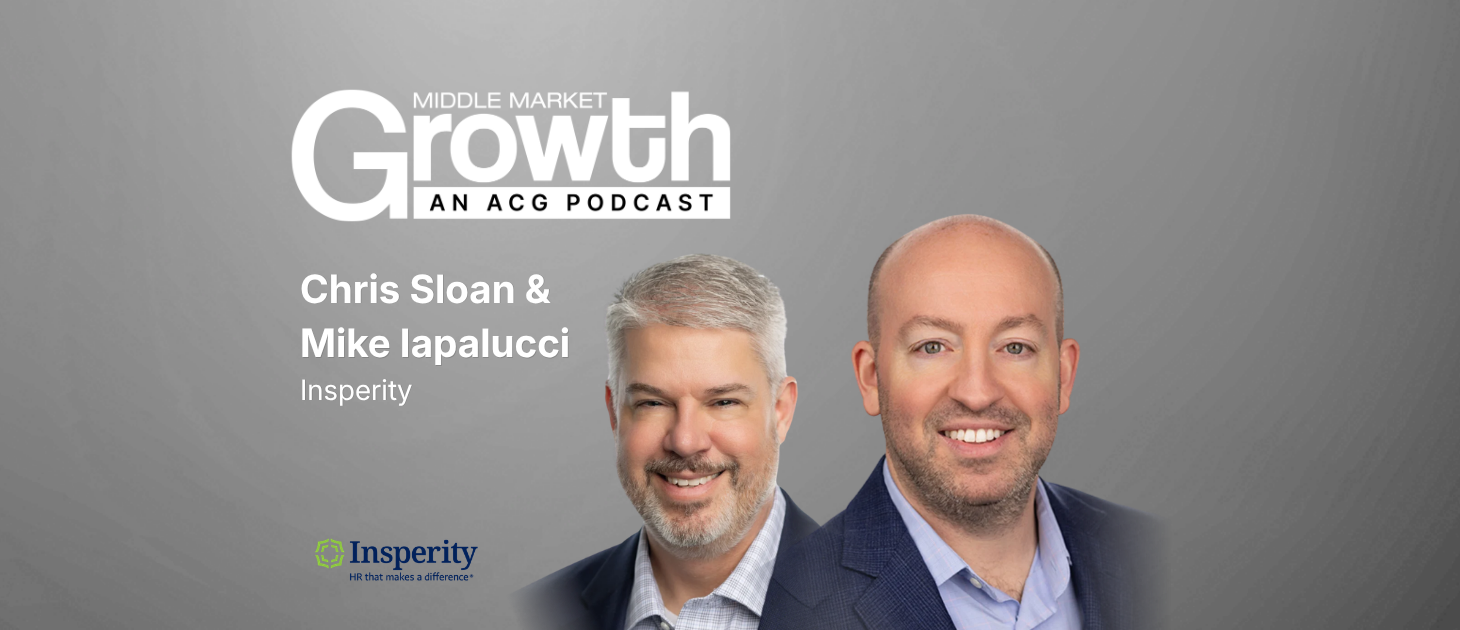
The human resources function can struggle to keep pace with a scaling business, so how can teams implement an HR strategy that enables growth rather than hampering it? In part one of a two-part series, Insperity’s Chris Sloan and Mike Iapalucci join the podcast to talk about the HR solutions that support portfolio companies in the era of AI disruption, longer hold periods, and challenging post-merger integrations.
This episode is brought to you by Insperity. For more information, visit insperity.com/ACG.
Read a transcript of the podcast below.
Middle Market Growth: Welcome to ACG’s Middle Market Growth Podcast. I’m Carolyn Vallejo. As middle-market companies grow, demands on their people, processes, and infrastructure can scale quickly. But as businesses scale, whether organically or as part of a PE portfolio, HR often becomes a bottleneck, and leadership teams are left trying to solve increasingly complex challenges. So, what does it actually take to build an HR solution that can keep pace with that kind of growth? This is part one of a two-part series exploring that question, and joining us today are Insperity’s Chris Sloan and Mike Iapalucci. Chris and Mike, welcome to the podcast.
Chris Sloan: Glad to be here.
Michael Iapalucci: Thanks. Glad to be here.
MMG: We’re so glad you’re here. Can you first tell us a little bit about your roles at Insperity? Chris, let’s start with you.
CS: I’m Chris Sloan, director of Private Capital Markets, focused on our private capital markets strategy. We have private capital consultants on the team who work with private equity firms, management consulting firms, and investment bankers to identify some of the key challenges, strategies, and human capital management issues in the marketplace today. We bring our many years of insight and business service offerings to solve those problems.
MMG: Got it. Mike, how about you? Can you give us a little bit of an introduction?
MI: Sure. I’m Mike Iapalucci. I am responsible for Insperity’s middle-market and HR Scale sales operations. I run a team of about 20 people that focuses solely on selling PEO services to companies with 150 employees up to somewhere in the neighborhood of 5,000. We focus on essentially any business looking to outsource its HR and gain support through our unique business model.
MMG: Excellent. And now, for a little bit of fun, we’re asking guests what their walkout song would be. Mike, how about you start us off? What would your walkout song be?
MI: Well, I’m a kid of the ’90s, so I’m going to go with “Hypnotize” by The Notorious B.I.G. And I know Mr. Sloan gets a kick out of that.
CS: That’s a good one.
MMG: Chris, what would you choose?
CS: I’m going to do “Back in Black” by AC/DC. Get some energy going.
MMG: Classic. Love it. All right. With that being said, let’s get into our main topic today. We are talking about finding the right HR solutions for midsize businesses in general and PE portfolio companies in particular. First, maybe we can talk a little bit about some of the major challenges and bottlenecks that you’re seeing in your work with clients. Chris, I want to start with you here.
CS: I think one of the biggest misconceptions we’re seeing is that recruiting is always the primary problem. Recruiting certainly matters, but often the real challenge is what happens before the job is ever posted. We see companies struggling because they haven’t clearly defined the outcomes they need from a role, how that role fits into the organization, or whether the structure can actually support the company’s next phase of growth. For private equity-backed companies specifically, this becomes even more important. Often, the business is trying to scale rapidly, integrate acquisitions, enter new markets, and professionalize operations. If roles, accountability, and organizational design haven’t kept pace with business strategy, hiring more people doesn’t solve the problem. Beyond that, retention is probably the number one issue we’re seeing. Private equity firms bring administrative engineering, operational engineering, and financial engineering to the table. One of the biggest areas that has been evolving since 2020, and since COVID, is the growing recognition that human capital management, or HR engineering, is one of the most important factors in getting the most out of the people you have. Let’s face it: It is the largest line item on the P&L, and it should be taken much more seriously, both during the LOI stage and as we enter the 100-day change period.
MMG: All right. It sounds like businesses should, and perhaps are starting to, take a more strategic approach to HR. Can you tell me a little bit about how you’re seeing operating partners respond to some of the challenges you just mentioned?
CS: What I’m seeing is that the strongest operating partners are becoming much more proactive around human capital. They’re treating workforce planning, leadership effectiveness, and organizational alignment with the same rigor they would apply to the financial or operational KPIs they develop when they begin looking at the financial models and analyzing a company at the LOI and post-LOI stages. I would say that’s one of the bigger areas where we’re seeing proactivity in the marketplace today.
MMG: Speaking of proactivity, it is always more difficult to address a challenge once a deal has been made or a company has been acquired and integrated. Ideally, investors would identify any HR-related challenges before acquiring a company. Chris, when private equity firms are assessing a potential investment target, what are some of the things they might miss when assessing talent and people risk?
CS: Firms do a really good job evaluating financial performance, market position, and operational metrics. Where less attention is often focused is on people-related risks. Let’s face it: Those risks ultimately determine whether the investment thesis is going to be executed. You typically have a very short hold period of three to five years. That’s not necessarily the case right now, but if you’re not on top of people risk, it could become a real problem. For example, does the company have leadership depth beyond the founder? Is there succession risk? Are key customer relationships concentrated in one individual? Is the culture capable of absorbing the kind of change that can happen post-acquisition? We’ve found that talent risk often doesn’t show up on a balance sheet, but it absolutely shows up in outcomes. If key leaders leave, engagement declines, or turnover starts to spike, growth is obviously going to be affected. The most sophisticated firms we work with view human capital diligence as being as important as any of the other diligence factors they review when considering an acquisition.
MMG: All right. Mike, I want to turn it over to you for a couple of minutes. Chris mentioned how workforce dynamics have changed significantly since 2020 and COVID. In the past few months, what have you seen work to drive post-merger success from a human capital perspective?
MI: It’s a loaded question, to a degree. The obvious challenge after 2020 was getting people into an office, if that was your intent. Then we had a very competitive hiring market in which talent could, for argument’s sake, almost write its own ticket. Over the last eight to 10 months, that has finally started to shift. Many of our clients and the people we’re talking to are developing strategies, approaches, and, in some cases, incentives to get people back into office spaces. They recognize that there is a major missed opportunity around collaboration, and the power of collaboration, when people aren’t physically together even though they could be. There are certainly businesses that have evolved and become more efficient operating remotely since 2020. That’s one of the positives we’ve all learned, but there is a lot to be said for getting together and collaborating when you can, and for figuring out how to move your organization forward faster. The hiring market has also leveled out, in my opinion and based on what we’ve seen. Employers have a little more control than they did in the first several years after 2020. During the “let’s go fully remote” phase, employees were effectively writing their own tickets. If I wanted to leave one organization for another, and the next company wanted me, I could tell them, “You need to double my pay,” and generally they would, or they would do something similarly dramatic. We’re not seeing that as much now. The market has certainly leveled out. I think what will drive human capital success now is finding ways to give people more access to personal development and opportunities to advance their careers. That’s what we’ve seen over the last eight months or so, and it has been a major shift.
MMG: There have been a lot of major shifts, as you just pointed out. One of those, I think it’s fair to say, is HR technology. It has evolved significantly in recent years. Mike, I’m curious about some of the technology solutions you’re seeing and some of the challenges you’re hearing about when it comes to implementing that technology. I’m going to go out on a limb and say artificial intelligence might be part of this conversation.
MI: I think that’s a safe limb to go out on, for sure. There are a lot of things that the issues we just discussed have driven, to an extent, including the need for better applicant-tracking tools and the ability to plan what you’ll need to feed those tools to find good talent. One thing I can tell you firsthand, using us as an example, is the importance of having world-class, nimble technology that meets end users where they are. That was one of the driving factors behind the development of HR Scale with Insperity. As I mentioned at the beginning, we now serve companies with up to 5,000 employees because we have expanded our technology’s capabilities in partnership with Workday. From a technology-solution perspective, we’re seeing platforms that historically were reserved for larger companies, such as Fortune 1000 businesses, move downmarket. Workday is one example. We’re also seeing smaller companies that want to become more sophisticated with their technology, and this is one way to do that fairly quickly from a human capital perspective.
MMG: Chris, I’m curious about your perspective on some of the challenges of implementing the newer and more sophisticated HR technologies you’re seeing right now.
CS: We talk about people strategies. A P&L will quickly show you if expenses are running high, margins are up, or profitability is off. The question is: How do you begin analyzing people challenges? If you’re going to have strong people strategies, as we’ve discussed, then you need people analytics to support them. I think Mike and I agree that having real-time people analytics to help you make the right decisions is one of the biggest changes we’re seeing in the marketplace today. Having access to that information is extremely important. The great news is that there’s a lot of new technology in the marketplace, and AI is having a tremendous impact on it. But data is data. You still need people to formulate a response and execute based on the analytical insights you uncover. Technology by itself is great, but you need people to use it. That’s probably a disconnect, but it’s also one of the greatest opportunities in the marketplace right now.
MMG: Switching gears slightly, longer hold periods are a key concern among investors and LPs right now. How is that trend affecting the way PE firms think about talent within their portfolios?
CS: We’re definitely seeing seven-year hold periods, and secondaries are starting to come into play. Longer hold periods mean firms can no longer rely solely on multiple expansion to generate returns. Human capital and operational execution are becoming increasingly important drivers of value creation. We’re starting to see firms take a much more dialed-in approach and ask: Do we have the right people in the right seats to help us execute this plan? I’m a more seasoned individual, and I’ve been in the workforce for many years. I’ve always lived by this thought: The people who got you from A to B are not necessarily the people who will get you from B to C. That doesn’t mean the B players aren’t great. It means asking what you’re doing to advance them and keep them skilled so they can meet the demands of today’s marketplace.
MMG: You’ve both already shared a lot of takeaways for our listeners, but I’d like to close with some final, actionable advice for those trying to get HR infrastructure right within their portfolios or any middle-market business. Mike, could you kick us off?
MI: Absolutely. I think it’s as simple as looking at what we’re talking about: HR infrastructure, human resources infrastructure, and people. Think about how we buy things today. I do it myself. You go online and do your research. Maybe you talk to a person or two, but in many cases, you try to educate yourself as much as possible before talking to somebody because you want to avoid being “sold.” But when you’re buying something that’s so important to the people within your organization, who are generally your biggest expense and your biggest revenue driver, it’s important to work with other human beings to determine the right solution. Talk to people at the providers you’re considering before forming preconceived notions about what you need. If you do that, you can bring the right stakeholders within your organization to the table to evaluate what you’re buying with a deeper level of knowledge. Often, we see people go to the marketplace, issue an RFP, receive a lot of data, and conduct a lot of online research. They generally have their decision made before they even talk to a provider. At that point, they may be trying to fit a square peg into a round hole because they’ve determined that a provider looks good on paper. Maybe it’s like an engineering firm that builds playgrounds but puts bridges on its website because it wants to capture everyone looking for an engineer. If you’re talking about something that affects your people, work with people to find the right solution rather than trying to overautomate the process.
MMG: Work with people. I like that. All right, Chris, close us out. What would your piece of actionable advice be?
CS: I have a unique perspective because I was actually an Insperity client when I was president and chief operating officer of an international organization with domestic distribution supporting Asia, including Southeast Asia, Shanghai, and Seoul, South Korea. The vast majority of our employees, however, were in the United States, across multiple states, including Rhode Island, Georgia, and California. I know this because I’ve lived it with Insperity, including through COVID. My advice is this: Don’t wait until a people issue becomes a business issue. The highest-performing organizations proactively invest in leadership, organizational design, talent development, employee engagement, and all of those areas. They need scalable HR infrastructure to support those investments. Whether you’re a private equity firm or a midsize organization, your ability to execute your strategy comes down to one thing: people. Markets change, technology changes, and business plans evolve throughout the year. But organizations that consistently outperform are the ones with the right people strategies. Mike will tell you that we’ve lived by that at Insperity for 40 years. When you get that alignment right, you’re not just creating a better workforce; you’re creating a stronger, more valuable business. In today’s environment, talent isn’t just an HR issue. It’s a value creator and a strategy. The companies that win are the ones that treat human capital with the same discipline they apply to capital allocation. If I were going to leave one nugget, it would be this: Don’t look past the most important thing in your organization, which is your people. Mike and I live by that daily. That’s what makes us passionate about what we’re able to do here at Insperity.
MMG: I can tell. I can hear that passion. This is a big topic, especially because, as both of you have emphasized, HR is becoming an increasingly strategic part of business operations and value creation. Considering how important this topic is to our listeners, please stay tuned for part two of our conversation with Insperity, which will be released later this year. In the meantime, that was Insperity’s Chris Sloan and Mike Iapalucci. Thank you both so much for joining us on the podcast.
CS: We appreciate you having us. It was our pleasure. Thank you.
This transcript was prepared by a transcription service. This version may not be in its final form and may be updated.
The Middle Market Growth podcast is produced by the Association for Corporate Growth. To hear more interviews with middle-market influencers, subscribe on Apple Podcasts, Spotify or Soundcloud.