Resilience and Discipline in the Lower Middle Market
Chris Hendrix of TPG Twin Brook debunks myths about why there may be more inherent risk in the lower middle market
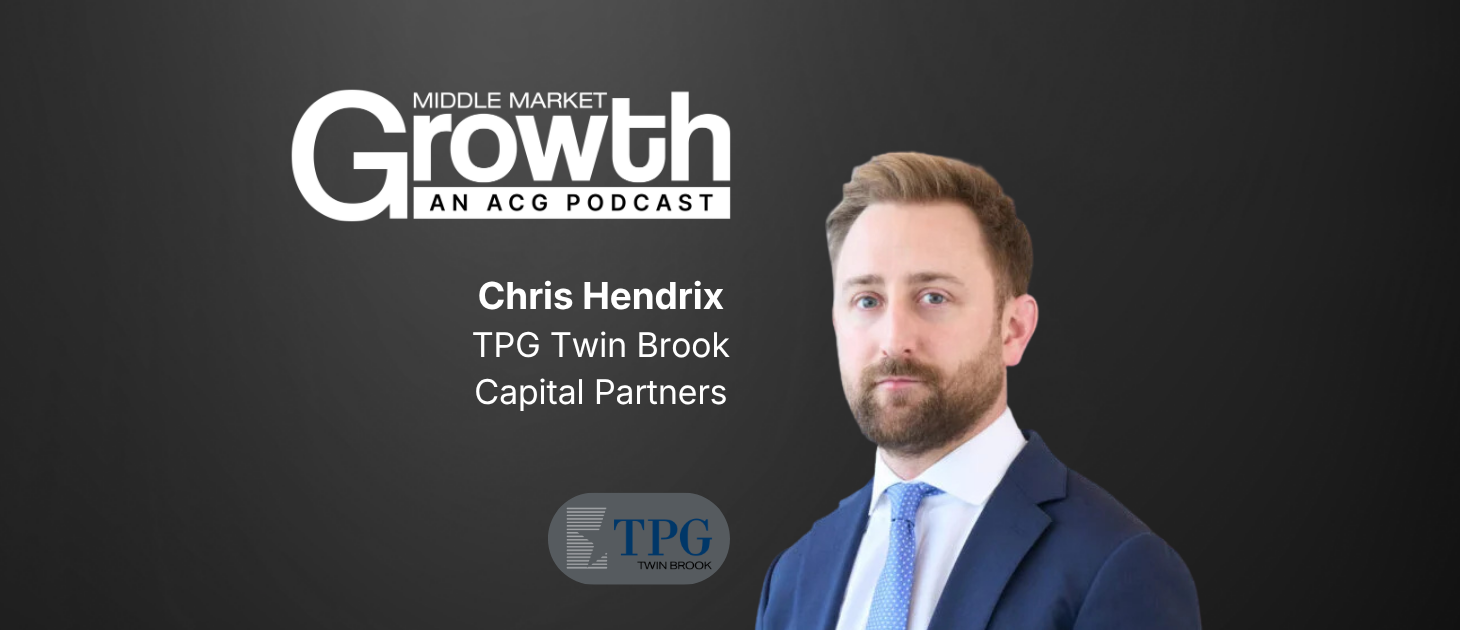
In today’s private credit markets, success is defined by resilience and discipline. As a higher-for-longer rate environment reshapes the lower middle market, new challenges are creating fresh opportunities for those who stay the course. Chris Hendrix of TPG Twin Brook joins the podcast to debunk myths about why there may be more inherent risk in the lower middle market and share the team’s approach to sponsor flexibility and risk management.
This episode is brought to you by TPG Twin Brook Capital Partners, a leading direct lending finance company focused on providing cash-flow based financing solutions for the middle-market private equity community. To learn more about TPG Twin Brook, visit www.twincp.com.
Middle Market Growth: Welcome to ACG’s Middle Market Growth podcast. I’m Carolyn Vallejo. The lower middle market differs from the middle market as a whole and its risks, opportunities, and lending needs. TPG Twin Brook’s Chris Hendrix joins us to share how this space is responding to challenges like a sustained higher interest rate environment, AI disruptions and more. Chris, welcome to the podcast.
Chris Hendrix: Yeah, thanks, Carolyn. Excited to be here and appreciate you having me on.
MMG: Absolutely. We appreciate you coming on. For a bit of context, could you first give us an overview of TPG Twin Brook and where it sits in the direct lending ecosystem as well as your role at the firm?
CH: Yeah. Great. Yeah, I’ll start first with TPG Twin Brook. We’re a direct lender focused on providing first lien loans to private equity backed borrowers operating in the lower middle market. So we generally define that as borrowers with EBITDA of five to 25 million. It’s a strategy that we started back in 2014. Our senior leadership actually has roots within this space. Going back to the early two thousands, we’ve maintained a very consistent and intentional focus within the lower middle market based on our view that both there’s favorable credit risk return dynamics, but there’s also structural barriers from a competitive standpoint within that market. We currently sit today with a portfolio of over 300 borrowers and 27 billion of commitments having closed deals with 150 plus unique private equity firms, and we are the largest direct lender within the lower middle market. In terms of my role, I’m the co-head of underwriting. I help manage a team of 60 investment professionals focused both on new deal execution, so that’s a 60 to 90 day diligence process that our team’s spending with each borrower in terms of evaluating the credit risk and structuring the deal as well as the active management of that portfolio post-close.
MMG: Got it. Thanks. And could you tell me just for a little bit of fun, what would your walkup song be?
CH: Gosh that’s a good one. I think I’ll go with “Tenth Avenue Freeze-Out” by Bruce Springsteen. Feel like particularly when the saxophone gets going, it brings good energy. If you’re heading into a meeting what about yourself, Carolyn, if I’m allowed to ask?
MMG: Well, I’ve honestly never had this question turned around back on me before, but I would say almost anything from Third Eye Blind, probably “Semi-Charmed Life.” I know it’s a classic, but great energy. I love Third Day Blind.
CH: Love it.
MMG: Well, thank you for asking. Let’s jump into the conversation. There’s of course been increased attention on private credit recently. That might be an understatement. From your perspective, can you tell me maybe some mis misconceptions that exist about risk in this asset class?
CH: Sure. I think there’s probably two misconceptions I’d I’d focus on here. I think the first, there’s been a view or I think perception that’s been developed that all managers are the same, and so when somebody’s allocating to the asset class, they’re just buying beta and, you know, managed selection doesn’t really matter all that much. I think if you spend time unpacking the headlines from the first half of this year, I don’t think it’s been an issue necessarily with the value proposition of the asset class itself, which has always been to provide, you know, durable current income at a premium to public fixed income benchmarks. I think what it has highlighted, if you look at those headlines is that not all managers are the same, and you’re starting to see return dispersions. So things like how do you form capital? What sectors do you invest in, and how diversified is your portfolio?
What credit protections do you get? Where do you play in the capital structure in terms of first lien or second lien and Mez within the portfolio? From a risk management standpoint, I think we’ve taken an intentional approach across all those different areas or topics that have positioned us really well relative to some of the noise you see in the headlines. Probably the second one I’d hit on, and we hear this one a lot given our focus in the lower middle market is that lending to smaller businesses equates to a riskier strategy. I’d say data would certainly support that. An average, you know, small business is more likely to default than an average large business.
So I think in terms of unpacking why that is, I think the easiest thing to point to relative to my initial comment is that we are not lending to just an average small business. You know, we have a high degree of selectivity. We see a thousand to 1500 deals a year, and we close on 50 to 65 of those. Each of those names, as I mentioned, we’re spending 60 to 90 days diligencing and utilize a time tested underwriting framework in terms of selecting those borrowers. From there, we create a diversified portfolio of those loans. We avoid industries like highly cyclical commodity retail software. You structure those loans with lower leverage and better credit protections than you get for larger businesses, and you build this overall framework in terms of risk mitigation that at the end of the day,
MMG: Yeah, you, you do have a great track record and you mentioned this kind of time tested framework as you say. Can you give me a little bit more detail about the foundational principles that guide TPG Twin Brooks approach to the lower middle market?
CH: So I think the first one I’d hit on would be on the credit selection side. And so when I say time tested framework, we are looking and we have been for the past 10 years, for the same 15 to 20 attributes of a business that help us build a thesis around the long-term sustainability of cash flow and enterprise value, or in other words, reason to exist for these businesses is we, you know, look at what those could be, right? And you think about differentiation, compelling value proposition, barriers to entry, recurring revenue profiles a lot of these, right? That that’s how you weather difficult economic conditions. I think a big one in the past year, right, or past few years in inflationary or interest rate and higher interest rate environments is really pricing power. So if you have a differentiation or you know, compelling reason to exist, when you think about Porter’s five forces framework, right?
You’re gonna have a lot more leverage working with suppliers and customers which allow you to navigate these uncertain times. The other principles I’d probably hit on right, are just appropriate structuring. We structure all of our deals with meaningful cash flow and enterprise value cushions. So on average, you know, we’re attaching at a 40% loan to value or 60% equity cushion behind us, and we structure every deal so that you’re not relying on growth to service our debt. So every deal that we do, it has to work in a flat case modeling scenario with actual, you know, actually increasing interest rate environments over time in terms of what we model.
MMG: Got it. So you are quite disciplined in your approach it seems, but I’m curious how you kind of manage a balance between disciplined underwriting and structuring with sponsor flexibility and how that might be able to translate into longer term value for both sponsors and borrowers.
CH: Yeah, it’s a, a great question. And you know, something right day to day that we’re constantly working towards and evaluating, I think one of the key value props for us to our sponsors is responsiveness and execution. So we’ve built a library of experience and materials, right? If we’re looking at a thousand to 1500 deals a year over the course of 10 years there’s a lot of comparable situations that we’ve looked at or that we’ve lent to, and that allows us to lean in in terms of being thoughtful and responsive during the execution process. So from a private equity firm standpoint, definitive feedback early on, even if, if it’s a no right, is better than, you know, working through spending a lot of time trying to get up to speed and eventually passing on a deal. On the flip side, right, it allows us to lean in from a risk standpoint when we have a more informed perspective based on our experience, and so we can better determine, you know, where we can lean in from a risk return standpoint.
MMG: Chris, you’ve mentioned a couple times now the interest rate environment. This is kind of a, a higher for longer rate environment, if you will, that we’re seeing right now. Tell me about what’s changed most in your approach to underwriting and in your approach to borrower selection as a result of higher interest rates.
CH: So I think our under underwriting philosophy, as I mentioned, has always been that our deals need to work in a flat, flat growth environment in assuming base rate increases. So for every deal that we do, and this has been over the past 10 years, irrespective of what the forward interest rate curve looks like, we’re modeling in 250 basis points of base rate increases over a five year forecast, and making sure that there is sufficient cash flow cushion within those structures. So I think just as a baseline, right, that has set us up well from a historical philosophy standpoint, I think higher rates have definitely tested borrower’s ability to drive organic growth. So you’re not financially engineering return, but you’re actually driving growth in your underlying business as well as tested borrower’s ability, right, to have pricing power to offset things like inflation or rate headwinds in that regard, right? I think the past five years have been a good test for all these businesses. If we’re doing a new deal underwrite right now, we’re able to see, you know, how did a borrower withstand COVID pressure, post COVID supply chain issues, inflationary environments, tariff uncertainty, political uncertainty, right? In this current environment. And so we have a really good view about both businesses and management team’s ability to be nimble and navigate these environments.
MMG: What structural protections are there that, that, in your opinion, matter most today and why do they become particularly important in volatile or in the least very uncertain markets?
CH: I’d probably start with revolvers, right? So a revolver, you know, generally speaking is almost akin to a, a corporate credit card in terms of an underlying borrower’s day-to-day use of cash and liquidity. We hold revolvers in a hundred percent of the deals that we lend to, and that gives us daily insight into the performance and really, you know, cash flow of a business. So rather than waiting 60 days posted quarter end to get financials for an upper market business, you know, we have real time views, inter quarter of cash positions that allows us to understand could be, you know, growth uses, could be working capital uses, could be a borrower not generating, you know, enough underlying cash to really service day-to-day operations. If we can identify issues ahead of time, that allows us to be proactive working alongside management teams and PE firms to make sure we are setting up the right solutions or putting in the right resources to really help these businesses work through challenges.
The other thing I’d hit on probably, you know, is covenants. So we also get a financial maintenance covenant in a hundred percent of our deals that allows us to get back at the, to the table if there’s under performance that allows us to talk, you know, economics in terms of making sure we’re being compensated for risk, allows us to talk about capital, allows us to talk about, you know, again, appropriate resources if there are needs for consultants or operators to help work alongside management teams. We’re able to do this without having to wait until, you know, a payment or bankruptcy default that you may have to if you don’t have a covenant or if your covenant is so wide such that liquidity breaks before your financial maintenance covenant breaks.
MMG: Let’s dive into that a little bit deeper. You know, speaking of the financial performance and kind of financial resiliency, what are some of the specific indicators that you monitor most closely post-close to ensure that financial and, and overall portfolio resilience?
CH: Yeah, so we take a very hands-on approach to portfolio management. Part of the reason, you know, my team is comprised of 60 individuals is we only want each account manager to have to monitor five to seven portfolio accounts in addition to the daily revolver activity that we may see. We get monthly financial results for all of our borrowers on a quarterly basis. We actually do a full bring down where our team is getting on the phone with CFOs or the private equity firms to understand what’s going on in these businesses and working through a couple pages of MDNA again, to make sure we’re intimately on top of what’s going on. When I step back from a portfolio perspective, you know, stress indicators I track are things like what is the aggregate revolver borrowings within the portfolio? What are the aggregate earnings adjustments? So EBITDA, if there’s a lot of adjustments in it, is not always an indicator of your actual cash flow, your underlying cash EBITDA. So making sure both that your definitions are tight within the credit agreement, but also your ongoing monitoring of how is that converting to cash is important. The other couple things, and I think what BDCs have been a great way to benchmark stats across managers are things like pick as a percent of net income or non accruals. Those will give you a good insight into how a manager’s portfolio holding up.
MMG: So much of our conversation today has been about risk, and I’m curious kind of stepping back what you see as the biggest risks in lower middle market direct lending today and maybe how TPG Twin Brook is uniquely positioned to, to mitigate some of those risks.
CH: There’s probably two answers I’d give and both of them have to do with, you know, investments in, in human capital. I think on the front end, you know, appropriate investment in origination capabilities. I think what you may see out there, right, is people that are raising capital at a faster place than they can deploy that causes potentially unnatural decisions within an underwriting process. I think we’re very thoughtful in matching our capital, raising with our originations capabilities. You know, we agent or co-agent 97% of our deals, so it is very much a control our own destiny in terms of proprietary sourcing. For our loans, we have a portfolio of over 300 names that also actively have add-on opportunities that gives us a proprietary channel or funnel of deployment on the backend. I’d say the other one right is, you know, under investment in staffing for port portfolio management and workouts. You know, I’d say there’s a a lot of work in decision making that goes on if a business has experienced a level of challenge. So for us, having a very low accounts per underwriter, having a scaled team that we’ve invested in from a workout standpoint, that brings a specific skillset around consultant and operating partner networks, the ability to analyze and work with management teams on 13 week cash flows, playbooks to help, you know, rehabilitate businesses that’s important to driving, you know, long-term recoveries for your investors.
MMG: Let’s talk AI for a minute. I’m curious, this is a two part question. First, how you kind of consider and incorporate the potential risk of AI disruption into your investment decisions? And then the other hand is TPG Twin Brook using, you know, technology and maybe AI specifically to enhance portfolio construction and to mitigate risk?
CH: Sure. It is a topic that comes up right in any deal that we’re bringing through investment committee and, and has, has been for a while now. I think the first thing for us is evaluating if there’s disintermediation risk. If an outlook is binary in terms of a company’s value prop potentially being meaningfully impaired by ai, you know, that doesn’t lend itself to a good debt investment given we have a fixed return, right? We, we don’t share in the upside it’s a fixed return. So we need to avoid those binary moments. I think, you know, diving back, you know, diving from there, right, it is understanding is AI going to be a potential margin and enhancer? Could it create deflationary pressures in terms of lowering competitive moats, right? And building anything along those lines into our downside modeling and say, if you look at our portfolio as a whole, there’s very low exposure directly to AI.
You know, we historically software is less than 2% of our overall portfolio and as we, you know, look within it, I’d say we’re probably more optimistic, particularly with private equity firm involvement that these businesses will be on the leading end of deploying AI relative to a, you know, founder owned business. In terms of AI within our own process, you know, I think we’re certainly leveraging it for research. So, you know, I’ll give you an example for a healthcare deal that may have exposure to a state Medicaid program, we can much faster and more easily dissect a state’s budget and budget outlook over the next few years to determine, you know, potential rate pressure within that portion of a business. You know, that’s something that historically we’d have to rely later on in a process on a, you know, a hundred page reimbursement study that we may only get, you know, a few weeks before close. So we’re able to get ahead of diligence and do it more quickly on a proprietary basis. We’re also leveraging it from a portfolio insight standpoint, so being able to query the overall portfolio much faster in terms of geographical risk or counterparty risk from a customer supplier standpoint, things like that are becoming easier rather than manually going through all of our deals.
MMG: Finally, to kind of round out our conversation today, as you think back over some of these risks and challenges that we’ve touched on today, AI disruption, the interest rate environment market volatility and uncertainty, for example, could you give any advice to investors in the lower middle market to better position themselves to respond to and and maybe mitigate some of these risks as well?
CH: Yeah, so, so if I could, you know, probably summarize a lot of the themes we we’ve talked about to answer that question. I do think it’s about applying a consistent credit selection framework, so focusing on mature businesses with long-term reasons to exist, high margins, pricing, power, investing in structures that do provide cushion. Beyond that though, thinking about the overall risk management framework, so not only in individual credit, but what does your overall portfolio diversification look like? How are you going about raising capital? What are your operations teams look like? What investment have you made in terms of origination and portfolio monitoring and workout capabilities? All these come together and are critical components to driving consistent stable returns in this sort of market.
MMG: Well, TPG Twin Brook’s Chris Hendrix, thank you so much for joining us. We really appreciate it.
CH: Great. Thanks Carolyn.
This transcript was prepared by a transcription service. This version may not be in its final form and may be updated.
The Middle Market Growth podcast is produced by the Association for Corporate Growth. To hear more interviews with middle-market influencers, subscribe on Apple Podcasts, Spotify or Soundcloud.