Lending to Consumer-Focused Businesses Amidst Inflationary Pressures
WhiteHorse Capital’s Javier Casillas and Stephen Migdal join the podcast
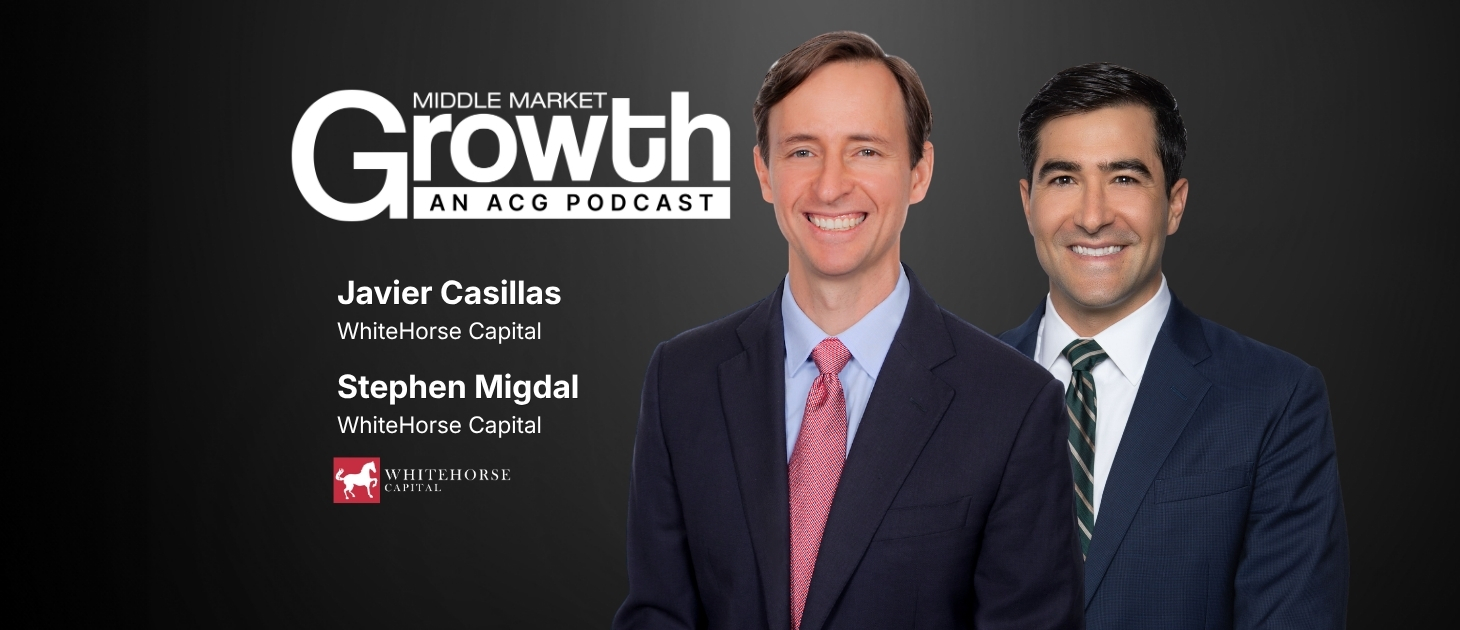
Geopolitical tensions have shaken the markets, spiked fuel prices, and created new financial challenges for consumers at the gas pump and beyond. Joining the podcast to share more about the health of the consumer sector and what it means for lending in the space are WhiteHorse Capital’s Javier Casillas and Stephen Migdal.
This episode is brought to you by WhiteHorse Capital. To learn more about WhiteHorse, visit WhiteHorse.com. Read a transcript of the podcast below.
Middle Market Growth: Welcome to ACG’s Middle Market Growth, a podcast for dealmakers discussing the trends shaping the middle market. I’m your host, Carolyn Vallejo. Today we’re joined by WhiteHorse Capital’s Chief Investment Officer Javier Casillas, and Principal Stephen Migdal. They’re here to talk about private credit and more specifically financing businesses within the consumer products and services space. Steven, welcome to the podcast. And Javier, welcome back.
Javier Casillas: Thank you, Carolyn.
Stephen Migdal: Thanks for having us.
MMG: Javier, you’ve been with us before, but can you give our guests a quick reminder of your role and the work that you do at WhiteHorse Capital?
JC: Of course. I’m the CIO of WhiteHorse U.S. This is a direct lending platform. We have $15 billion of assets under our management, manage a portfolio of about $11 billion across 150 or so positions. In my role, I manage the credit diligence and decision-making process and oversee a team of about 50 people spread throughout the U.S. and have been with WhiteHorse since inception back in 2010.
MMG: And Stephen, what about you? Could you give us a little intro?
SM: Of course. I’m a principal on the underwriting team where I lead new investments and help monitor a portfolio of existing investments. I’ve been with WhiteHorse just shy of eight years, and I also lead investments within our consumer vertical.
MMG: And just for a bit of fun, I want to ask both of you, if you could learn any new skill in 2026, what would it be? Steven, let’s start with you.
SM: A great question. And not necessarily a new skill, but one I need to relearn is, is being more patient. I have small children at home and they like to test the boundaries, so finding a way to be patient through all the mischief has been a real test, a very fun test, and it’s a lot of work and hopefully will result in a high ROI.
MMG: Yeah, parenthood will definitely test your patience. Javier, if you could learn a new skill, what would it be?
JC: I bought a package of online guitar lessons that is still waiting for me and shiny a new guitar that’s in the corner of my den. So that’s the plan for 2026.
MMG: Excellent. Well, sounds like you both have some great plans for those new skills, but let’s jump into the conversation today and to kind of state the obvious, there has been some recent noise around private credit. Can you talk about your view of the current state of private credit and some of the trends that you’re seeing? Javier, let’s start with you.
JC: Of course. So I, I think one way to think about it is distinguishing between the news flow and the underlying reality as we see it day to day. Certainly the news flow—open up Bloomberg and there seems to be something about private credit every day. I would say if you were to chart some common themes across those articles, it relates to three things. One is some of the blowups that occurred in 2025, such as Tricolor. You know, ironically, those were mostly in the syndicated loan market. So I think some of that concern is a little bit misplaced relative to private credit. The other is around credit quality but specifically around ARR and software deals that are potentially disrupted by AI technology. I think that’s real and a function of concentration and exposure based on whichever portfolio you’re looking at. Fortunately, at WhiteHorse, our exposure to software is quite small at below 4%, and so we’re happy with that exposure given some of some of the risks that are well understood. And then the last thing is with respect to consumer or retail redemptions and liquidity concerns in certain portfolios, and that clearly is a real thing as well for some of the vehicles that rely on retail inflows. But again, fortunately for us, we don’t have that exposure our vehicles. Zero of our vehicles rely on consumer inflows or are exposed to redemptions. And so really for us, it’s keeping our head down, looking at opportunities, sticking to our knitting. Our current portfolio is levered at 4.5 times on the underlying borrowers, and that’s been a strategy that we’ve been able to stick with for a while, including a fairly low LTV below 50%. So we think that’s a sustainable strategy and our investors fortunately are happy and there continues to be interest in the institutional space. So we’re just sort of going about our business.
MMG: Excellent. That’s great to hear. Now, in an interview with your colleagues Stuart and Pankaj earlier this year, we talked about geopolitical events impacting the macro outlook. Tell me what you’ve seen in terms of how the current conflict in the Middle East has impacted lending both broadly and at WhiteHorse. Javier, we’re going to start with you and then we’ll turn to Stephen.
JC: I don’t really think it’s actually impacted the U.S. direct lending market materially yet. I think what it has done is that it’s made for some more acute thinking around the energy input exposure for new names, and has changed our thinking around what’s likely to happen, the interest rates, given that higher oil prices are obviously inflationary. And so interest rates are likely not to decrease and certainly will likely remain at least where they are which is a headwind for the consumer. You know, if you think about implications down the road, one possible implication is inflows from Middle Eastern investors to the extent that the conflict is longstanding, but you know, to the extent that timeframe is fairly limited, I think that that’s probably fairly mitigated as well. So no, no major impact other than just sharper thinking around potential impact on new opportunities. Our appetite to lend continues to be fairly strong and deal flow continues to be good.
MMG: And Steven, let’s have you weigh in there as well.
SM: Yeah, to echo what Javier said is just around impact to inflation and potential margins. I think in discussions with our portfolio companies, a lot of companies are prepared for a short term change in energy prices and are probably with able to withstand a short term change if the conflict extends to further kind of more sustained, there will likely need to be some pass throughs in terms of price really to keep a certain level of sustainable margin and cashflow. But it’s a little early to tell on the longer-term outlook.
MMG: Absolutely. Well, we are already kind of mentioning topics like inflation and higher energy prices, price increases getting passed onto the end customer. So to switch gears to lending within the consumer landscape specifically, can you describe the overall health of the consumer today and what your expectations are for 2026?
SM: I’d say overall the domestic consumer is hanging in there showing signs of real resilience. Sentiment is low and we keep hearing about the vibe session where things seem worse than what it really is. The latest report on the sentiment reached an all-time low, which points to consumers definitely feeling the struggle. However you look at the real data around, you know, the labor market’s doing okay, recent job numbers showed growth, unemployment rate is still low and the consumption is still growing for now, paints a different picture and a more resilient consumer backdrop, although the consumption trends are definitely not uniform as the growth is really being propped up by higher income individuals who have benefited from years of growth in the stock market, while middle to lower income households, however, are struggling more as they generally not have benefited as much as that in the stock market appreciation and are just seeing reduced savings buffers as the real wages have not, you know, outpace inflation. So it, it’s definitely been a challenge for those lower to mid income households and we’re seeing that in just higher household debt, higher credit card balances, and starting to see some delinquencies in areas like student loans and mortgages starting to tick up. So it’s definitely been a real challenge for some folks. And then as it relates to just expectations for 2026, I think a key question is just around the sustainability of spending from the higher income households. So that’ll be interesting to monitor.
MMG: Stephen, we’re going to stick with you here for a minute. With the context of the health of the consumer today, can you touch on some of the trends that you’re seeing within the CPG space?
SM: Yeah, from a CPG perspective, in speaking with our portfolio companies, we’re seeing them position their goods to cater to the higher income consumer with a more premium product at a premium price point, while also thinking about creating products that cater to the more kind of middle to lower income consumer at a value oriented price point. This way they can position themselves to compete across various income levels so that they can succeed kind of throughout the year. And in terms of just deal flow, you know, we’re seeing a healthy flow across consumer services and CPG businesses. We’re seeing a lot of interest from sponsors and amateur sports recently over the last few quarters which is definitely interesting. And something that we’re monitoring and see has been just some recent headlines around quick service restaurants and fast casual restaurants with store closures. That’s definitely one area that we try to stay away from.
MMG: There’s consumer packaged goods, amateur sports, as you mentioned, food and beverage. There are so many different segments within consumer. What are some of the segments that WhiteHorse has found success in financing and what, what are their key attributes?
SM: Yeah, so WhiteHorse has found success in various segments within our consumer focus vertical. So difficult to point pinpoint just one area. You know, we tend to focus on businesses that provide essential consumer services, either to the home or to consumers generally, and non-discretionary consumer goods. So that means we tend to shy away from restaurants as I mentioned previously, or discretionary brick and mortar retail and franchisees. And some key attributes we look for in our deals typically include recurring demand for services or goods, you know, high competitive advantages or various entry, sustainable level of margins and cashflow generation, and the ability to pass along price in an inflationary environment, which we’ve seen post COVID. And I’d say also we look for just appropriate leverage levels and equity cushions in the capital structure.
MMG: Now this next question is for both of you. What lessons have you learned from lending within the consumer space during economic downturns or industry disruptions? Stephen, let’s start with you here.
SM: I’d say one of the bigger lessons that we’ve learned is to invest in resilient businesses with strong non-discretionary demand. We find that these businesses perform better than those that are more exposed to a shifting consumer preferences. We’ve also learned that partnering with management teams and sponsors who have strong track records of navigating through prior cycles significantly impacts outcomes. So that’s something that we’re hyper-focused on when we look at new deals and originate new opportunities in the consumer space.
MMG: And Javier, I’d love to have you weigh in on that question as well.
JC: Sure thing. Two points. One is consumer businesses can have significant working capital fluctuations, particularly if they have a larger big box customers, like a Walmart. And so sometimes you are in the senior term loan position, but you can get diluted by a growing asset-based loan in front of you. And you just have to be mindful of that when thinking about what leverage you’re truly at. And then the second thing is for branded consumer businesses, you want to make sure that your borrower actually controls that brand and can make changes that adjust to the market. This is particularly relevant for franchisees who may rely on a franchisor to make any changes and show some flexibility. And so anytime that you’re requiring a consent and the incentives may not be perfectly aligned you as the borrower might be disadvantaged if the company doesn’t perform. So those are two things that come up in our IC discussions pretty frequently.
MMG: And to close us out here, Stephen, what are some key structural considerations for financing opportunities to consumer-focused businesses and how does that differ from other industry verticals within WhiteHorse?
SM: You know, we do this across our portfolio, but we seek to maintain an appropriate level of leverage with meaningful equity cushion to protect on downside that is especially important in our consumer vertical. That said, we do continue to be thoughtful in how we structure our investments at WhiteHorse and work to be a creative and collaborative partner for both our non-sponsored and sponsor partners.
MMG: Excellent. Well, Javier and Stephen of WhiteHorse Capital, there is so much happening in consumer today. So thank you both for touching on the latest for the podcast. It’s been a pleasure.
JC: Terrific. Thank you Carolyn.
SM: Thank you for your time.
Note: This presentation includes forward-looking statements based on certain assumptions. The views expressed reflect the speakers’ opinions as of the date of the presentation and are subject to change. These statements involve risks and uncertainties; actual results may differ materially. Nothing in this presentation should be considered investment advice.
This transcript was prepared by a transcription service. This version may not be in its final form and may be updated.
The Middle Market Growth podcast is produced by the Association for Corporate Growth. To hear more interviews with middle-market influencers, subscribe on Apple Podcasts, Spotify or Soundcloud.