AI and the Talent Pyramid Problem
The size of freshman classes of new hires at professional services firms is shrinking as a result of AI efficiency gains, but that can create a talent challenge further down the road
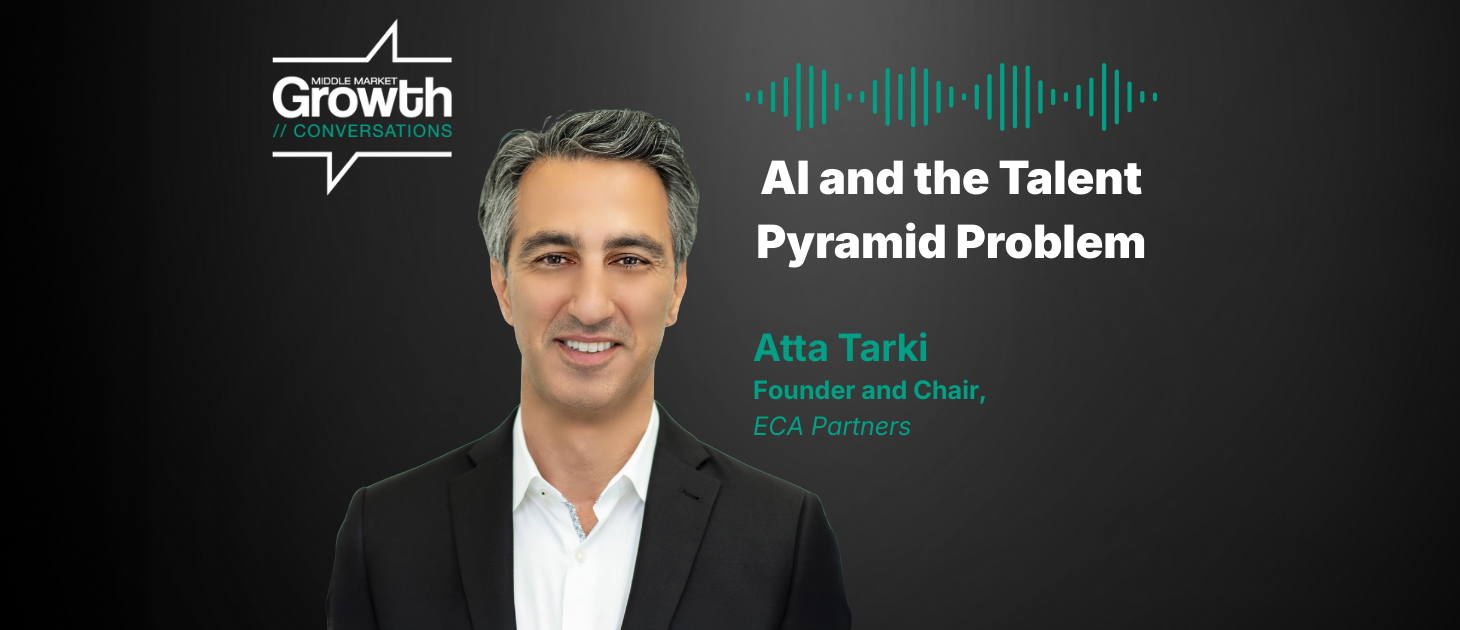
Many industries, including management consulting and legal firms, have long used a talent model that requires hiring large classes of entry-level workers. Now that AI efficiency gains have appeared in many sectors, that large pool of new hires is being trimmed down—but what does that mean for firms that will need mid-career and senior workers in a few years? Atta Tarki, founder and chair of ECA Partners, discusses the challenge, how it will impact PE firms and their portfolio companies, and how business and talent strategies will need to evolve in the age of AI.
A transcript of the podcast is available below.
Middle Market Growth: Welcome to Middle Market Growth Conversations, a podcast for dealmakers discussing the trends shaping the middle market. I’m your host, Carolyn Vallejo, and this is a production of the Association for Corporate Growth. A huge portion of AI’s potential for many sectors is its promise to replace low expertise entry level workers, but experts warn the shift may be removing a crucial segment of the talent pipeline. Here to discuss strategies for balancing AI adoption with the health of that pipeline is at a founder and chair of ECA Partners. Atta, welcome to the podcast.
Atta Tarki: Thank you for having me.
MMG: Thank you for being here. First, we want to get to know you a little bit better. Tell me about your role at ECA Partners and your areas of expertise.
AT: Yeah, I’m the founder of ECA Partners and the current chairman of the company. We partner with over a hundred private equity funds on their executive search and talent needs. And what sets us apart is that we were founded by former management consultants, so we bring in more systematic approach to the talent acquisition function which I summarized in the book, Evidence-Based Recruiting, which was published by McGraw Hill Education. And today I write on this topic for Harvard Business Review and serve on the board of four different recruiting companies, one of which is a $600 million private equity backed one.
MMG: Excellent. And just for a bit of fun, if you could learn any new skill in 2026, what would that skill be?
AT: Well, I would say right now I’m focusing on mi español. So, that’s my focus.
MMG: Muy bien. All right. Well, let’s get into our topic of discussion today. AI is projected to eliminate a lot of white-collar jobs. This is not new. Everybody is talking about this, and it’s becoming a closer and closer reality for a lot of people. There is a unique problem here, though, cropping up at a lot of companies that are seeing these productivity gains as a result of AI, and they’re realizing that it’s going to impact their talent strategy in a pretty big way. So can you kind of spell out what that challenge is for us?
AT: Yeah, right. I try to distinguish between some of the futuristic predictions like the one from Sam Altman saying that AI is going to soon replace the CEO role in your portfolio companies. And then some of the more tangible changes that we already are seeing and are going to be in closer in the near future. And when it comes to the tangible stuff, I’d say that the changes in terms of AI and its impact on hiring is already here. It’s no longer just a futuristic prediction. I say that because when speaking with a top legal tech0 CEO, he has recently revealed to us that some of the top law firms he’s talking to there are significantly scaling back their summer associate programs where in the past, let’s say they would’ve hired a hundred summer associates, now they’re thinking about 30. And similar discussions are being held across different sizes of firms as well as different segments especially in the professional services firms. A consulting firm in 2021 was hiring 15 people in its incoming class; in 2026, they’re scaling that back to three or four people. And this is despite the fact that the firm has been growing at the double-digit revenue numbers. So it’s a pretty significant impact.
MMG: No, it’s a pretty significant impact for sure. And it’s something that’s impacting a wide swath of industries and types of businesses. Now, you wrote a Harvard Business Review article on this topic, and it largely focused on the impact on law firms and management consultancy firms. Can you talk about how this trend could impact private equity and their portfolio companies?
AT: Yes, absolutely. I would say that the apprenticeship model has been the norm across a lot of companies in terms of how they grow, not just the current talent pool and how they get the core of their grunt work done, but also in terms of how they’re fostering their future leaders. And that’s not just true for law firms and consulting firms, or most of their partners are coming from people that they hired many, many years ago as an entry level associate, but also companies like General Electric and Proctor and Gamble popularized this model and across many other sectors in the economy. And what I was just outlining in terms of kind of like the impact of AI on hiring strategies today in terms of shrinking the incoming classes of hires, it’s going to have an implication for the talent pyramid going forward, right? Where if you no longer have that starting class of 100, how are you going to get to those two people in 10 years from now that were going to make partner at your law firm consulting firm, or top management at GE, et cetera. So I think that this changing talent pyramid will have implications for the future of these companies.
MMG: So, you know, as we mentioned, this is affecting a wide range of industries and private equity firms are really becoming industry specific. They’re really targeted in their approach oftentimes. So I’m curious which spaces in which sectors are most likely to be impacted by changes to their talent pipeline as a result of AI?
AT: Yeah, absolutely. I think the changes that we’re seeing from the data so far is that business services is impacted the most, like we talked about law firms, we talked about consulting firms. If you look into the software space whether it’s IT consulting firms or software and tech companies themselves, those are the ones that are impacted the most. But like I was mentioning even companies like GE and Proctor and Gamble who’ve had this apprenticeship model and where they bring in a lot of entry level talent and large cohorts of them to do a lot of the grunt work, they’re going to start seeing changes to that because those tasks can be done much more efficiently with AI. And I don’t think that the companies will just over hire at that level and have people sit around without being busy.
MMG: So, I know already that the answer to this challenge isn’t to just forget about AI—you know, we have to adapt, we have to evolve. So let’s start with the hiring process itself. How would you suggest that firms alter their hiring strategy in the age of AI efficiency gains?
AT: Yeah. I would suggest to take a step back and think about what that hiring strategy is doing for your firm. Is it only to take care of tasks that people are coming in to do today, or are we also utilizing this as a way of hiring future leaders? And in many cases, it is the latter part as well. And if you’re doing that, I would suggest becoming a little bit more focused on hiring for future leaders and not just to get the current grunt work done. If you were having a very wide bottom of the talent pyramid, so to say, and you could hire a hundred people, but only expected two people to become a partner in eight or 10 years, you didn’t need to be very deliberate about trying to screen for those two people. You would hire a hundred smart, hardworking people and you would know that they would self-select out. You could promote people who are doing better throughout the years, and eventually you would end up with those two superstars who could make partner at your firm. But if the bottom of the talent pyramid is shrinking, you need to become much more focused. And what we’ve seen at some of the best practices where firms are already doing that, they are being very thoughtful about a lot of the assumptions in their talent models. Like for instance, they’re asking like, well, why does a person need six to 10 years to become a partner at a management consulting firm or build a book of business, whereas in other industries, for example, if you’re a doctor at, in certain clinics you are expected to build your own book of business from day one. And maybe that is a kind of like a model that we need to experiment with, or maybe there is something we can learn from that. And it doesn’t need to take six to 10 years to become partner, but we can speed up certain elements of that process.
MMG: I like that you said maybe that’s a model we need to experiment with, because that kind of suggests that there will be a little test, a little trial and error here. Of course, these firms can make educated guesses and educated assumptions to refine their strategies, but maybe this will be a moving target. Would that be fair to say?
AT: Yes. I think that the best firms will start doing some experimentation and not just look at what their peers are doing in their very niche industry, but also looking at other verticals like I was mentioning, and try to kind of like find a talent model that makes a lot of sense for their firm and not just what has been done the last 20 years in their sector, if you will.
MMG: Absolutely. You also noted in your Harvard Business Review article that it’s time to reconsider some of the older quote unquote rules and business models that may not be particularly effective in the age of AI. You know, as these businesses kind of get their footing, do some of these little experimentations that you just mentioned, what are some of the components of their business models that you think will need to change?
AT: Well, I mean, I think if you’re looking at a lot of the business services firms, for example they’ve based their models on billable hours. And I think that that’s going to be less sustainable if you can do a lot of the work and clients know that you can do a lot of the grunt work in much less time with the help of AI. So what we are seeing in a lot of the law firms, fixed fees have become much more common. We’re even seeing some subscription-based models gaining traction. And these are some of the initial changes we’re seeing. What we are seeing that a lot of the other types of companies are doing are essentially breaking out part of their services and offering that as a separate product line or service line. Take the company that I mentioned earlier, for example they were doing a lot of expert interviews. They found that their clients, they just wanted the expert interview and not to pay for the billable consulting hours that comes on top of that. So now they have launched an expert interview network where they can monetize that product stream for clients who want to do only that. Other examples are people who are experimenting with adding additional service lines to their business model. If you look at Next Gen Healthcare, which was acquired by Thoma Bravo in 2023 they’ve expanded from primarily being a SaaS EHR practice management platform for ambulatory practices to also adding additional service lines where they can expand into other areas such as revenue cycle management consulting and AI training programs for physicians delivered by clinicians that are leveraging NextGen’s data platform.
MMG: Okay. Wow. Well, so certainly there needs to be some change on the horizon, if not a lot of change on the horizon, but I know that there are businesses that can probably learn from past periods of transition and disruption, especially when it comes to their business and talent models. Can you tell us what we might be able to learn that investment firms and portfolio companies can maybe use and take those strategies from the past to implement today?
AT: Absolutely. If we go back to the early 1900s and the business model of a lot of law firms, we can learn a lot from that, I think. And back then a lot of the law firms didn’t have the current talent model. They were just loosely configured, kind of like groups of professionals that were working together. And some of the less experienced professionals would join the firm in the hope that they could learn a little bit from the more senior professionals, but they would be responsible for their own book of business and developing their own skills, if you will. And in the early 1900s, Paul Cravath transformed this model by hiring fresh graduates from top law schools and training them over time and developing them, rotating them into different roles, developing different skills for them. And if you look at between 2017 and 2025, you’ll see that his company Cravath has been ranked number one on Vault’s list of the 100 most prestigious law firms. So by experimenting with the talent strategy, he was able to build a competitive edge for his firm that lasted a very long time. And to my earlier point that you can learn a lot from adjacent sectors, McKinsey & Company learned from this sector by hiring their first MBAs in 1953 in the hopes to train these MBAs up in house. And now, of course that model of hiring MBAs versus what McKinsey was doing before, which was to hire experienced executives, has become by far the most popular talent model in management consulting and not a lot of other segments of the economy as well. So, I think that what this lesson tells us is by experimenting with the talent model, you can gain a competitive edge that can last a very long time.
MMG: Excellent. Well, don’t be afraid to experiment and evolve. Thank you so much, Atta. I really appreciate you taking the time to speak with us today.
AT: Likewise. Thanks for having me on.
This transcript was prepared by a transcription service. This version may not be in its final form and may be updated.
The Middle Market Growth Conversations podcast is produced by the Association for Corporate Growth. To hear more interviews with middle-market influencers, subscribe to the Middle Market Growth Conversations podcast on Apple Podcasts, Spotify and Soundcloud.