The 2026 Economic Outlook with Michael Feuz
What middle-market business leaders and dealmakers can expect from the year ahead
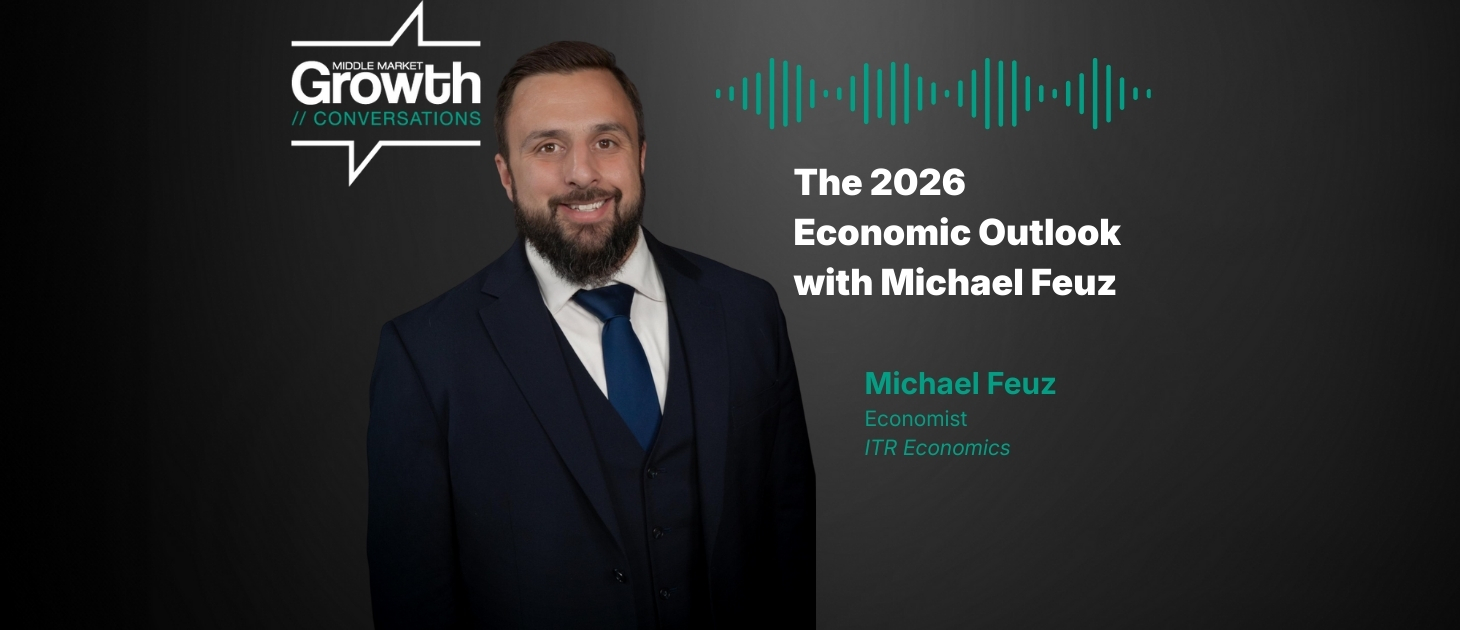
Michael Feuz, economist with ITR Economics, is back to share what middle-market business leaders and dealmakers can expect in the year ahead. From interest rates and inflation to deal flow and AI, Feuz discusses the biggest trends that will shape the economy in the U.S. and globally in 2026.
A transcript of the podcast is available below.
Middle Market Growth: Welcome to Middle Market Growth Conversations, a podcast for dealmakers discussing the trends shaping the middle market. I’m your host, Carolyn Vallejo, and this is a production of the Association for Corporate Growth. As we kick off a new year, dealmakers are hoping to encounter a more vigorous market than the uneven ones of the past few years. Michael Feuz, an economist with ITR Economics, is back with us to give his economic outlook for 2026 and share what dealmakers can expect in the year ahead. Michael, welcome back.
Michael Feuz: Yeah, thank you for having me. It’s great to be back.
MMG: It’s great to have you back. And you of course have been a guest with us before a couple times, but for those who might need a refresher, can you tell us a bit about your role at ITR?
MF: Absolutely. So, I’m one of the many economists here, but specifically within the team of fantastic economists we have at ITR I’m on I guess what you would call the speaking side. So that’s sharing my time between—I am the face that a lot of our clients see on a regular basis, that get to meet with us and discuss their forecast that we’re producing and putting out. And then I spent another, probably half of my time, on the road going to different association meetings and conferences across the U.S. and other countries as well internationally speaking to these groups. So, I am a rare extroverted economist, I guess.
MMG: An extroverted economist. Well, you’re definitely the right person to speak to for a podcast discussion. But before we get into our topic today for just a little bit of fun, can you tell us, if you could learn one new skill in 2026, what would that be?
MF: Wow. I want to say something cool, but I’ll be honest instead. What I want to do is get better at chess. My oldest child who’s just eight, we’ve been playing a little chess, and early on I could beat him without trying very hard. And now every game I have to try a little harder. And then I have one of my many brothers-in-law, I have a really big family, he just beats me handily at chess. So, I would like to become more competent at the game.
MMG: Hey, chess is cool in my personal opinion.
MF: I feel like I should like downhill skiing or something cool. But I’ll just, you know.
MMG: No, I love chess. I think that’s a great answer. But let’s talk economic outlook for 2026, which of course is your bread and butter, and I want to start with a broader view. What are some of the biggest kind of economic trends percolating, bubbling that you’re keeping an eye on for this year?
MF: Yeah, big top view is we are seeing the economy expanding. It’s growing. It’s still kind of early in this growth phase, but you know, big ones that I’m always watching are industrial production, which is all manufacturing, energy, utilities, overall manufacturing, the service sector’s expanding. But maybe the big one that I’m most interested in, especially as we move into the next four to five years, the next decade, the 2030s, is very much inflation. Inflation’s starting to heat up again. We have a Federal Reserve that’s trying to manage its dual mandate. And our overall message to a lot of our clients that we work with is, your top line’s going to do great these next four or five years, it’s probably going to be more or less not a big concern of yours, but it’s that bottom line pressure, those margin pressures maintaining and growing profitability where the real challenge, obstacle, and focus needs to be.
MMG: All right. A couple of important points for businesses and investors there. Tell me about kind of a global view or a regional view. Does your economic outlook differ by country or region? You know, ACG does have members in Europe and Canada, so we are global, and I’m sure some of our listeners may not be in the U.S. so I’m curious what that global outlook looks like.
MF: Yeah, generally right now, the global economy is expanding. Now, if we go just to our friends to the North, Canada, their economy, if we look at their GDP, it’s more flat right now. While ours is rising, we look at their industrial production, it’s showing some early growth, like ours, a little more bumpy, but we expect Canada to grow, similar to Europe. Europe’s kind of somewhere between late recovery and early expansion. And China’s still growing, but slow in growth. Overall, the global economy is expanding. Our outlook for the next, the rest of this decade is general growth across the globe. China is kind of becoming a little different. It’s a more mature economy, so it’s not getting double digit growth rates. Europe, depending on if you’re on Eastern Europe or Western Europe, both should grow, but could be a little, some varying differences. And similar to Canada, Canada should see an expanding economy and the good news for our friends in the north—because I know I feel like we’ve been kind of like two kids in the backseat of the car squabbling the past year with tariffs and trade—is they’re getting what every country has, its problems, right, that they’re trying to work through. But the good news with Canada, they’re really getting their financial house in order, which I think will help bode well for them.
MMG: All right. Tariffs and trade. You mentioned tariffs. Huge topic in 2025. A lot of uncertainty as a result of the tariffs. A lot of pressure there as well for business owners and investors alike. We’ve spoken to you in depth about tariffs before, but this is a quickly changing dynamic here. Tell us how you see tariffs impact in the economy in the U.S. in the coming year. Do you expect it to be different in any way from what we saw last year?
MF: It’s a combination of, I do anticipate some difference and I would say I’m hoping for difference as well in this year. I think the big difference that I’m hoping for and anticipating if, I guess if I had to put my money where my mouth is and make a bet, is we’ll get a little bit more certainty than the past year. There was a lot of, I call it ping ponging back and forth with, there’s tariffs here over here, there’s no tariffs. Let’s delay it. Let’s delay it again. I’m not sure, oh, I’m going to wake up this morning and it’s going to be 25% tariffs over here—that I expect should settle down. Kind of the nature of this being an election year and off your election year. Our Congress critters all want to get back to Congress. You know, the Republicans currently control the White House and the legislative, they want to keep power. So I think they’ll settle down. The Democrats obviously would like to take the house and or the Senate. So I think they’ll be a little bit calming down on those fronts as the Republicans who are currently in power want to incentivize, to hold onto it. And the big thing coming that we’re going to get sooner is the Supreme Court ruling. We had the challenge, we had oral arguments a few months ago in the fourth quarter of calendar year 2025. And it was specifically a challenge to the IEEPA law which was the primary tariff law that President Trump and the administration were leveraging for a lot of these tariffs. I get the privilege when I travel on the road, I go to a lot of these associations. And a lot of these associations have a lobbyist that supports whatever industries in the room. They go to the hill, they represent that industry. They try to get favorable regulations and things written into laws that are going through Congress and the in the legislative branch. And so, when I get to hear them, I also get to kind of pick their brain, you know, behind the scenes as all as speakers get to hang out sometimes. And the general consensus that I’ve gotten from them is that there are in Washington DC anticipating that the administration will lose this case. But they kind of put the brakes on it there. And they’ll say, that doesn’t mean tariffs are going away. It means they will no longer be able to use that IEEPA law and the IEP law, the very unique aspect of it is that it’s nation-specific, and that’s what allows President Trump and the Trump administration to say, hey, we’re going to do, you know, 30% on Germany, you know, 45 on China, 15 on Canada, or whatever it may be. If that’s off the books, the Supreme Court says no more, you’re misusing it, they still will have the 301 and the 232 tariff series. The big difference is those aren’t nation-specific. They’re product part, component input specific. So, and they have much more laid out specific guidelines or rules to follow of when you implement a tariff, how long it has to wait or before it’s goes live time to appeal. So that will make the environment much more predictable for businesses, because the Big W with the other gene, IEEPA, which allowed for more arbitrary rolling out of tariffs, it shot our economic uncertainty sky high. And when uncertainty is sky high, businesses don’t invest. We had a lot of CapEx spending not pop the way we anticipated. If we were looking, if we were sitting a year ago today in January and thinking about where we’d be six months later, June 2025, because businesses aren’t going to spend, if they can’t feel confident about what the environment’s going to be the next three, three and a half years. So I think the positive, if the Supreme Court rules that way—and I have no legal background, so I’m just kind of going off the conversations I’m having—it should help create a more predictable, less uncertain environment.
MMG: And that’s huge, especially for the M&A environment, because as you mentioned, businesses aren’t going to invest amid uncertainty. A lot of dealmaking doesn’t get done amid uncertainty as well. So that’s also great news for dealmakers. One of the other major topics that was huge in 2025 is artificial intelligence. Of course, it’s also a topic that we highlighted in our 2026 Outlook Report, which by the way for our listeners, is available now on middlemarketgrowth.org. We’re exploring how AI could potentially have an impact on M&A in kind of the back office and private equity firms, et cetera. But AI is also having an outsized effect on the U.S. economy. So tell me about what you’re seeing there in terms of how AI investment and technological advancement and innovation could shape the economy in 2026.
MF: It’s still so early with AI. I mean, it is topic number one. It is what’s driving the S&P500 and its performance heavily weighting. There’s so much movement, but it’s so early in the sense of we haven’t seen meaningful adoption. And by meaningful getting that true return on investment and seeing real proficiency, efficiency, productivity gains by it. I mean, I saw an MIT study a few months back that put out roughly 1% of businesses that they surveyed in the study are reporting real ROI return on their AI investment, which means 99% of businesses aren’t, give or take, that’s, you know, based off that study. It’s going to be the pivotal tool that organizations really of all sizes should be and need to be actively investing in. But it has to be done well and intentionally because while it should and will yield proficiency gains and productivity gains, which we will need more and more, especially in a higher inflationary environment, which we are going to be in, are in and going to stay in, that’s going to be pivotal. But misuse, mismanagement, sloppily implementing it could really harm organizations as well and actually be a drag. So it has to be done well from that perspective. So the outsize effect, I’m bullish on it, but it’s a tempered bullishness. It’s not going to lead us into, you know, we’re going to need the terminator to save us. It’s also not going to lead us to the Gilded Age overnight. It will, when we get there, usher in more material wealth, especially when it probably marries with like quantum computing and stuff. It’s going to be wealth. We can imagine that’s a good thing, right? More people out of poverty, more opportunity. That’s always a net positive for the world. No one’s going to argue with that.
MMG: Now, interest rates also a huge topic. At the end of 2025, we saw some easing of interest rates. Deal makers are I imagine on the edge of their seats—what’s going to happen in 2026? So what do you expect from the Fed in terms of interest rate changes in the coming months?
MF: Yeah, the Fed has been, they have their dual mandate, right? So they need to focus on keeping inflation down. The goal is 2%, which we’re not there, we’re closer to three. And then it’s employment, full employment, which is what we decided it’s about 4%. They are choosing to focus more and have been for the past several months on the employment side, the risk is there. They want, you know, it’s, we’ve been more dovish, so looser monetary policy to try to support the labor market, but that opens up the door for inflation to rise at a faster rate. So our general view at ITR is we’re not going to see much change on where interest rates are right now. I’d tell most of our clients, it’s reasonable to expect some further easing of interest rates in the first half of 2026, but they won’t be meaningful enough that it’s worth trying to time that low if the tradeoff is delaying ROI on an investment that you need sooner rather than later. I want our clients to ask the question first and foremost, when do I need the return on this CapEx investments, to be their priority. Then trying to find the sweet spot low. Now, if you’re like, I don’t need the ROI for another, you know, six quarters or so, sure. Play the game—April, May, you might find that sweet spot, but it won’t be very meaningful. It won’t be much of a meaningful difference. Now, I don’t think where we are from an interest rate standpoint is hindering the M&A market too much; somewhat, but it’s not culprit number one. I really think it’s what we talked about previously. It’s that uncertainty aspect. Looking at business’ overall position, we’re seeing a rise in CapEx spending already. We see profitability in the U.S. at record highs. We see corporate cash holdings. So business liquidity rising again. And it’s still 34 to 35% higher than it was before the pandemic. Businesses are positioned to spend, to invest and to, you know, be more active in M&A.
MMG: Well, that’s great news. And I know you mentioned inflation, you’re anticipating increasing inflationary pressures this year. Is there anything else that you want to mention about inflation in terms of how that’s going to impact the economy this year?
MF: Our forecast is this year, you’re going to get about 4%, 4.1% to be specific probably in the CPI side of things. So what we talk about mostly we’ll get a little easing in 2027, disinflation, which means just less rise, probably in the mid twos, and then things heating up again in 2028, 2029. So the general trend is more this year we expect a softer economy in 2027. By softer, meaning kind of flat. So not a recession—maybe in some sectors. So again, not a broad macroeconomic recession, but there might be some slight downturns in 2027 and some verticals in the economy in 2027, but overall still kind of growth the flatness and then heating back up in 2028, 2029. So, the big focus, and then probably more important for businesses, is looking at the producer price index currently up, that’s a reflection of their bottom line. That’s what I’m trying to keep my clients focused on, thinking about, hey, what should your price increases be just to cover your costs and protect your margins and your profitability? Generally this year, I direct our clients to our producer price index forecast. It’s in a trends report we put out every month, about three and a half percent this year is probably what you should be thinking about. Maybe you get away with one, you know, one and a half to 2% in 2027, and that’s just to cover your rear, as I call it. And that’s really where I’m drawing their attention. But those input costs are going to continue to tick up. So it’s making sure you avoid profitless prosperity, which is top line growth and you lose control of the margins.
MMG: Right. Well, I just kind of put you through a rapid fire hot take on all of the biggest topics for our economic outlook. So let’s get a little bit more into the nitty gritty. One topic that we’re particularly interested in is there have been some concerns from some economists as well as Fed Chair Powell about the accuracy of the data that’s being reported by the U.S. government. Powell previously noted that he believes job numbers, for example, are being overstated. Some economists have said they believe that November inflation data was a bit flawed—there was missing data, they claimed. So how do concerns like this impact the economic picture and how do you approach an issue like this?
MF: Yeah, so the government shutdown certainly had the impact. You know, we went without job reports and the inflation report for October, just because those folks aren’t working during the shutdown. They don’t have time to do the surveys. That is a lot of hard work. So it makes sense that they did not release it. I had a few family members text me, you know, just watching the news and the headlines, thinking it was some political agenda to hide something, but it’s like…they have to survey businesses and households and just don’t have the bandwidth if you’re sitting at home now, that absolutely can have some of a trickle effect into November. We did get those job revisions, those were pretty hefty. They were headline grabbing, downward job opening job revisions earlier in 2025, which caused a lot of anxiety to pick up. I think the important thing for the job side of things is, well, we can be charitable here and give the media a pass if we would like to. I know we’re still coming out of the holiday and Christmas season, so maybe charity is what’s called for, but the media often predicts, or often not predicts, but positions the jobs reports as if it’s a leading indicator, as if it somehow tells us where we’re going economically. And the important thing to remember is that jobs lag, they don’t tell you where you’re going. They tell you where you’ve already been. Because the economy slows, and then businesses will stop hiring, the economy will heat up, and then they’ll start hiring. And the other thing to note is the data collection that we’re doing has become more challenging since the pandemic. The responses on these surveys is down about 20% from about 60% to 40%. We’re getting less responses, and small and medium businesses delay their responses to a lot of these because they’re just wearing more hats. They’re busier. So usually the initial report is what’s going on in big business. And then when they issue the revisions, they’ve finally gotten those small and medium businesses to respond. And we’re getting a probably the tale of two different types, you know, tale of two economies, essentially.
MMG: Okay. So important kind of data to consider, but not the end all, be all for business owners.
MF: No. I mean, I’m more interested on the inflation because I mean, both of those, jobs and inflation, so important, especially deciding monetary policy. And my opinion is very much, I think we should drop—this is just me, if I was king and I could have it my way—I would get rid of the dual mandate and just have the Federal Reserve focus on inflation and the jobs will take care of themselves. You have low inflation, you’re going to hire more people. So I am a little nervous because I know Jerome Powell’s heir apparent is going to be more dovish as well, so he’ll want to make cuts. I think he won’t have as much bandwidth, whoever it is, as they would like. But there’s still probably be a few more rate cuts. But the bond market doesn’t have to respect what the federal rate is set at. If the investors want bonds at four, four point a half percent, they don’t care if, if the fed sets rates at three point a quarter.
MMG: We recently surveyed middle-market dealmakers, and we reported the results of that survey in our Outlook Report that I mentioned earlier. We found a steady but tempered optimism for M&A in the year ahead. So I’m curious what your outlook is for dealmaking activity in 2026.
MF: That sentiment is very much in line where I am. I would say tempered optimism. I expect growth in M&A. I wouldn’t expect it to be gangbuster per se. Currently I’m seeing we’re seeing growth in the data in the M&A activity. It’s increasing, but it’s kind of a slower increase. So the rate of rise in what we’re seeing is kind of slowing, looking at the fundamentals of, you know, the leading indicators most point to that, mild to moderate increase, just kind of steady activity. I mean, one, uncertainty indexes are still sky high. That’s the biggest concern of what could be a drag on M&A activity. Business confidence, small business confidence is ticking up. Overall business confidence is ticking up. That’s good. The overall position, the one thing that’s going to be different too is just, you know, identifying both profit as profitability gets eaten into in some of these organizations, that’s going to slow down some of the activity or just hesitation. That’s also where AI is going to become real advantageous to dealmakers. It’s going to be able to open up the top of the funnel hopefully, and then be able to sort through a lot of faster sourcing, faster diligence, and then being able to identify those deals. But, and then I think a lot of investors are going to be shifting where their appetite is into what type of businesses. It’s going to be a lot of what are the more demand resilient businesses, we’re going to start weighting them more and more heavily. What are those must haves? And we’re already seeing that. You know, I was just thinking that, like I was just a few months ago, I remember I was at a pest control association meeting and a lot of M&A activity and consolidation in those markets, thinking about the HVACs, all those types of businesses are more and more going to be weighted more positively.
MMG: All right. Well, that’s pretty positive. I like that. We’re going to close out our conversation today by touching on a theme that we’ve talked about in some previous conversations. Could you remind our listeners of the ITR Great Depression prediction, and could you give us an update on that as we edge even closer to the 2030s?
MF: So yeah, for those who remember the 2030s, our outlook since 2014, when Brian Beaulieu, Alan Beaulieu, the Beaulieu brothers put out their first forecast saying, hey, the first half of the 2030s from 2030 to about 2036, it’s going to be an economic depression. Not like the 1930s. We’re a much different economy, but really a global six-year economic downturn where we see GDP decline, we see industrial production decline. That is still on target. A big tell is going to be what I mentioned at the beginning of our conversation, kind of watching inflation. But essentially what’s driving this it’s kind of all of the decisions we’ve made, and we’ll call it the consequences, kind of coming to a head around that 2030 standpoint. You know, the big one we always like to joke about, but it’s true, is the demographics. It’s the baby boomers, the aging population exiting. But to paint a picture, hopefully concisely here for listeners, especially if this is new, is we have these baby boomers and a large demographic exiting the workforce not enough folks to replace them. And putting a massive strain on entitlement spending, both social security and Medicare. This is going to demand much larger tax base from the younger workers. The folks will be working the young Gen X, the millennials, the Gen Z, and remember what I just said about inflation. By 2029, we, we are forecasting, you know, between 6 to 7% inflation. So inflation already higher, eating into the income of these younger workers. And then the need to support these entitlements really at a peak, as these baby boomers have been putting money into social security and expect to get the money out, and Medicare expenses being through the roof. In 1970, we had four workers for every one retiree pulling from social security; we’re down to about 2.6. So now we’re saying like, hey, we need more taxes and we’re going to have inflation eating into your income. This is going to cause a demand pullback. So preparing this for our clients is one, we are telling them these next five years, invest in efficiency gains, right? Inflation-proof your business as best you can. Take market share and expand markets. Looking at markets that are adjacent that you can enter. And also thinking about which markets are going to be more resilient. You want to be a dynamic company. By dynamic, I mean the ability to pivot when demand softens in one sector or region into another very quickly. And then minimizing your debt as you approach the 2030s so you’re cash-heavy. Cash is always king. And in the second half of this downturn, which is 2034, 2036, there will start to be a huge buying opportunity. You want to, both individually and in your business, there’s going to be a great sale going on and on the upswing in the second half of the 2030s, there’ll be a lot of wealth to be made, but you have to be ready to strike when the opportunity, having cash on hand is where that’s going to be. And then focus on markets that are going to be demand resilient, the service sector, the maintenance, the retrofitting, those types of the need to haves, must haves, not so much the nice to haves, obviously.
MMG: All right. Well, Michael Feuz from ITR Economics, thank you so much for joining us on the Conversations podcast. I think you are now on the hook to speak with us yearly through at least the mid-2030s.
MF: Love it. Can’t wait.
MMG: Great. Well, we’ll speak with you then. It’s been a pleasure. And for our listeners who want more analysis of what middle-market dealmakers can expect in the year ahead, our 2026 Outlook Report is out now middlemarketgrowth.org.
The Middle Market Growth Conversations podcast is produced by the Association for Corporate Growth. To hear more interviews with middle-market influencers, subscribe to the Middle Market Growth Conversations podcast on Apple Podcasts, Spotify and Soundcloud.