Redefining the Middle Market for a New Age of M&A
RSM's Tuan Nguyen makes the case for redefining the middle market
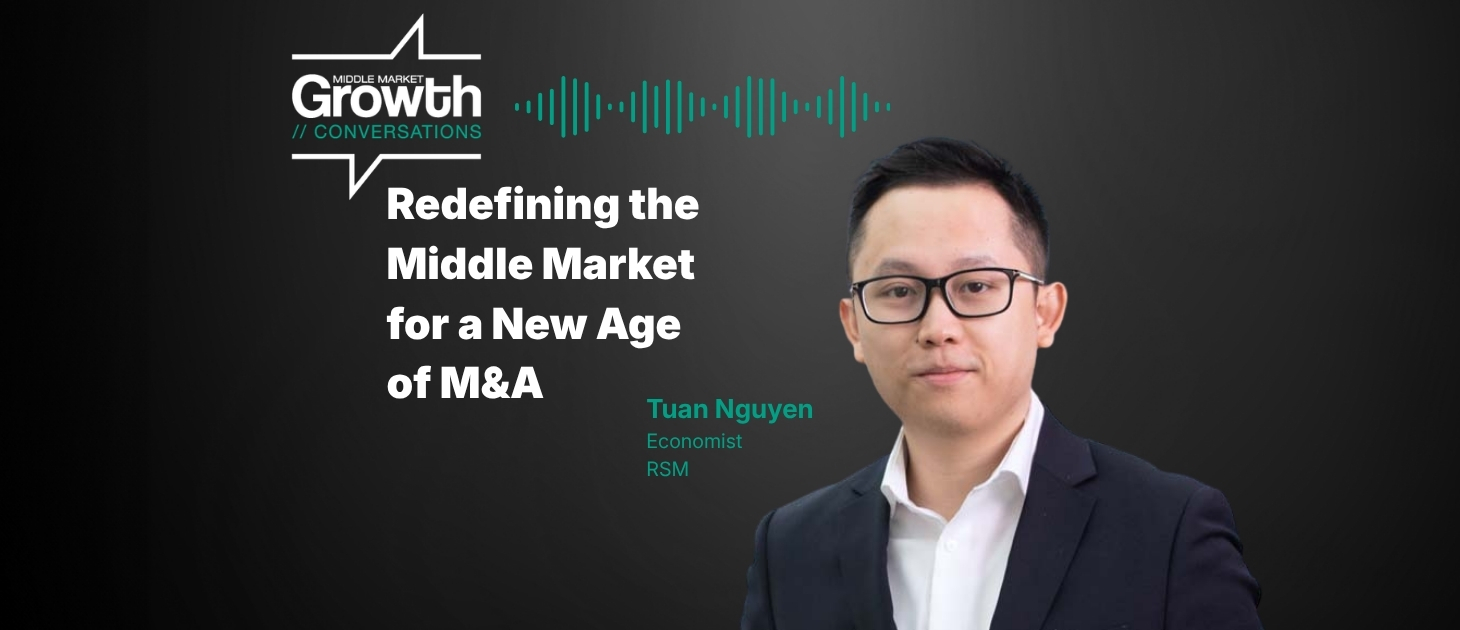
New research from RSM argues that the way we define the middle market is due for a major change. Tuan Nguyen, an economist at RSM, says the shifts in the makeup of the middle market have major implications for the people that work within it. Nguyen joins the podcast to dive into the findings and share the biggest takeaways for middle-market business leaders and dealmakers.
This episode is brought to you by Hilco Global. Learn more at hilcoglobal.com. Read a transcript of the podcast below.
Middle Market Growth: Welcome to ACG’s Middle Market Growth Conversations, I’m Carolyn Vallejo. The middle market has never had a black and white definition, but new research from RSM argues that the way we’re defining it is due for a change. Here to share what the shift means for middle-market business leaders and dealmakers is RSM’s Tuan Nguyen. Tuan, welcome to the podcast.
Tuan Nguyen: Thanks for having me, Carolyn. Always great to be back.
MMG: Always a pleasure to speak with you. And you know, our listeners might already be familiar with you from our video channel. You’ve given us some economic updates in the past, but just for a refresher, can you tell us about your role at RSM?
TN: Definitely. My main job at RSM is macro, keeping tab on the economy, understanding what’s driving it, and making sure the businesses we work with actually have useful intelligence to act on. At the same time, it’s also about thought leadership and strategy. Like what do these economic shifts in the U.S. actually mean for the middle-market company trying to make decisions right now. That question is what led us to the new research on the middle market that we are going to talk about later.
MMG: And just before we get to that research for a little bit of fun, if you could learn any new skill in 2026, what would that be?
TN: Well, that is an interesting question. I, I think the boring answer is learning how to work with AI because that is basically what everybody’s trying to learn right now. But you know what, I, I really like to learn how to ski jump. I’m a new skier and, and I have always thought that people who could do tricks with their skis look so cool. So that is going to be my goal this year.
MMG: Well, I don’t deny that it looks incredible. If anybody out there has seen the Winter Olympics recently, those ski jumps are absolutely wild. So, Tuan, I commend you for that goal. Please wear a helmet.
TN: Definitely.
MMG: But like you mentioned, like I mentioned, we’re here today to talk about recent research from RSM and it shows that, you know, there have been some major changes in the middle market over the past couple decades. So, to start us off with this conversation, could you give us a high-level overview of this research? Tell us how the middle market has been defined and what the research kind of reveals about the way it should maybe be defined today.
TN: Yeah, so the thing that really jumped out us and this is what motivated us for this whole project, is that the middle market has changed enormously over the past 20 years. But the way we talk about it and define it really hasn’t, and it’s not just that revenues are higher, although they are it’s that the businesses themselves fundamentally more complex than there used to be. More markets, more sophisticated supply chains, broader product lines, more technology baked into everything. So these are not the same companies the old definition was built around. So we really want to build a definition that actually captures that. The approach we took was pretty straightforward and simple. We looked at the U.S. private sector, which generated about $46 trillion in revenue in 2024 and divided it into three roughly equal parts, small firms on the bottom, under $30 million in revenue. Large firms on the top, over $10 billion in revenue. And the middle market is everything in between. Now that leaves you at about 125,000 companies doing between $30 million and $10 billion in revenue and generating around $16 trillion collectively and employing roughly 50 million workers. The old definition, we’re just leaving a huge portion of the market on the floor. Companies that are genuinely middle market in every meaningful sense weren’t even making it into the conversation now.
MMG: Wow. So this, I presume, has pretty major implications for dealmakers and business operators and business leaders in the quote unquote middle market. In your opinion, why should this matter to these leaders and dealmakers in terms of how we’re defining the middle market itself?
TN: You know what—the honest and straightforward answer is that if you are using an outdated definition, you are making decisions based on a picture of the market that no longer exist. And in a competitive environment, that gap between your map, your understanding and reality is where mistakes happen. But the bigger reason this matters right now is the complexity piece around the middle market. Middle-market companies today are operating in a way that would have been unrecognizable to their counterparts 20 years ago. They’re managing supply chains with international exposure. They are competing across broader geographies. That’s why things like tariffs matter, they’re running more diversified product and service portfolios. They’ve got technology embedded in their operation at every level. So that’s also important when it comes to AI and automation. Now that complexity changes everything. How you value a business, how you integrate it after an acquisition, how you rate it, how you finance it especially when it comes to elevated borrowing costs. The type of borrowing cost that we are seeing right now for dealmakers, that means the old mental shortcuts don’t work as well anymore. A company that looks straightforward based on its revenue might be carrying a level of operational complexity that completely changes the risk profile of a deal. You need a framework now that helps you to see that. And finally, for business leaders, it’s really about knowing where you stand. Not just are we middle-market, but which part of the middle market? What does the tier above us look like? What are the different segments going to help us understand more about the middle market and what would it actually take us to get there? That’s strategic information, and most companies just simply don’t have a clear answer to those questions.
MMG: Now, you mentioned that this kind of new generation, this current age of middle-market business is more complex than it has been in the past. You know, operating across borders, as you say, integrated with more technology, as you mentioned, but I want to go deeper here. Were you able to identify some of the root causes that kind of triggered this evolution and triggered the shift?
TN: Yeah. The, the simple answer is that the old definition was created almost 20 years ago. So a few things piled on top of each other over a long period of time. You have the 2008 financial crisis. It was probably the biggest single inflection point in this time period. A lot of smaller, thin-margin businesses just didn’t survive it. And the ones that did had to get leaner, smarter, and bigger to stay viable. So you had this consolidation happening where the number of middle-market firms shrank, but the ones that remained came out more capable and more complex and bigger, obviously. Then you have the pandemic when the pandemic hit and did something similar, but on a faster timeline and in ways nobody really anticipated. Supply chains, global supply chains that companies had been running on autopilot for years, suddenly fell apart and rebuilding them meant making choices, more diversification, more technology reshoring, and becoming more sophisticated. Companies that navigated that well came out the other side genuinely transformed. And underneath all of that is the longer-term trend of businesses just getting more ambitious; middle-market companies that used to be helping, serving original market, for example, started to, started thinking nationally. Companies that had one core product started to build out adjacent product lines. The scope of products of what a middle-market business is willing to take on, has expanded significantly, and the complexity that comes with that is real.
MMG: Now in this paper, you also broke the middle market into eight distinct segments based on revenue. Could you tell us about any interesting differences between the higher, middle or lower ends of this newly defined middle market once broken out like this?
TN: Yeah, honestly, I think this part is the most interesting and also important to talk about this research because the range across those eight segments is just enormous. When you put them side by side, you start to realize that calling all of these companies middle market is almost like calling a corner deli and an original grocery chain both food businesses, right? Technically true, but not super useful. When you lump everything together like that at the low-end segment, $30 to $50 million, you’ve got about 80,000 companies. These are typically founder-led, often family-run, deeply rooted in a specific region or niche. They are entrepreneurial and they move fast like a startup. But the complexity they’re managing is still relatively contained. One or two product lines, a local supply chain or a small leadership team making most of the calls. When you move up to segments like four or five, companies with $250 million to $1 billion in revenue, and the picture you have here changes significantly. These companies are often operating across multiple geographies, managing real international supply chain exposure, serving more diverse customer bases. At the top, segments seven and eight, you’ve got a few hundred companies that are essentially running at a near enterprise scale. Bigger firms, thousands of employees, sophisticated technologies stacks, institutional private equity relationships. They look at operate a lot more like large corporations than they do the smaller firms, the family style businesses at the bottom of middle market.
MMG: Revenue is of course one of the major ways that we define the middle market; labor and employment numbers are another huge way. So, turning to this labor side, you mentioned that this new definition of middle market collectively includes about 50 million workers, but can you break that down for us a little bit? Do you see any changes in middle-market employment that kind of accompany this broader shift?
TN: Yeah. The labor data here is really interesting because it reinforces the complexity story in a very concrete way. The middle bucket employs about 50 million workers in total. Same number with the smaller market, but spread across far fewer companies. So you’ve got these middle-market firms each carrying a much bigger workforce and everything that comes with it. At the low end of the market, segment one, firms are typically running between a hundred to 249 employees. That is still a very pretty lean operation where the founder or a small senior team can have direct visibility to most of what’s happening. By the time you get to the upper segments, you are talking about 5,000 to 25,000 employees for a firm, which means multiple layers of management, HR infrastructure, complex compensation structure, all of it. What really stood out to us is the revenue-employee dynamic. As you move up the ladder, upper segment firms generate significantly more revenue per worker, and that’s not an accident. Those companies have made deliberate investments in technology and automation that are showing up in their productivity numbers. They’ve essentially figured out how to scale without hiring proportionally. That gap is going to keep widening as AI becomes more embedded in business operation. We think that companies at the top of the middle market are already operating in that reality. The ones in the middle market in the middle and lower segments are at a real decision point here. And the ones that make the right bets on technology now are going to look very different in five or 10 years down the line.
MMG: Absolutely, and I think any middle-market dealmaker, any operator in the market, would agree with you, and I would also go so far as to say that dealmakers in the middle market and business operators in the space, they know very well that these businesses are complex, they’re sophisticated. So it does almost sound like this redefinition of the middle market has been a long time coming, and this is all such a fascinating conversation. But to really break it down for dealmakers who are listening today, what does this mean for them? How can dealmakers and business leaders take this information and move forward? Are there any changes they should be making to their thinking or their processes in reaction to this redefinition?
TN: I’ll try to make this practical because I think that is where it matters most. For dealmakers, the biggest thing is to get more granular. Stop thinking about the middle market as one bucket and start thinking about which segment a company is actually in, what the complexity profile, the risk profile look like, and whether the capabilities of the business match the complexity it’s managing. A lot of deals run into trouble post-close, not because the financial model was wrong, but because somebody underestimated how hard the business actually was to run because of that complexity piece. Getting serious about mapping operational complexity, doing diligence is not optional anymore. The eighth segment framework also helps in this case with sourcing. If your deal thesis is built around a particular type of complexity transformation, say helping a company in that middle band inflection point, build the infrastructure it needs to scale, you now have a much clearer map of where those opportunities are. For business leaders, especially those in segment two to five, the middle part of this new definition, the message is really about getting ahead of your own growth before it outpaces you. The companies that successfully move up the ladder are almost always the ones that invested in systems, talent, and organizational structure before they felt like they had to. Waiting until the complexity is causing real problems is a much harder starting point. And the capital piece matters here too. Don’t forget, private equity is more present at every level of the middle market than it’s ever been. And understanding what that means for your business, whether you are thinking about partnership and acquisition or an eventual exit, it’s just part of being a sophisticated operator in this market. Now, with this new definition for everyone, we’re going to keep building on this research. This is not a one-time thing. The definition we put forward is meant to be a living framework. We are going to revise this, it’s something we’re going to update as the economy evolves rather than something that gets published and then quietly ignored for decades like the old definitions. There’s a lot more to understand about how these segments are changing, and we are just getting started on that work.
MMG: Excellent. Well, RSM’s Tuan Nguyen, it’s always a pleasure to speak with you. You give us such wonderful insights and actionable insights for dealmakers here. Fascinating topic of discussion and thank you again so much for joining us.
TN: Thank you.
This transcript was prepared by a transcription service. This version may not be in its final form and may be updated.
The Middle Market Growth Conversations podcast is produced by the Association for Corporate Growth. To hear more interviews with middle-market influencers, subscribe to the Middle Market Growth Conversations podcast on Apple Podcasts, Spotify and Soundcloud.