Private Equity Meets the 401(k)
Adams Street's Jim Walker discusses the democratization of private equity
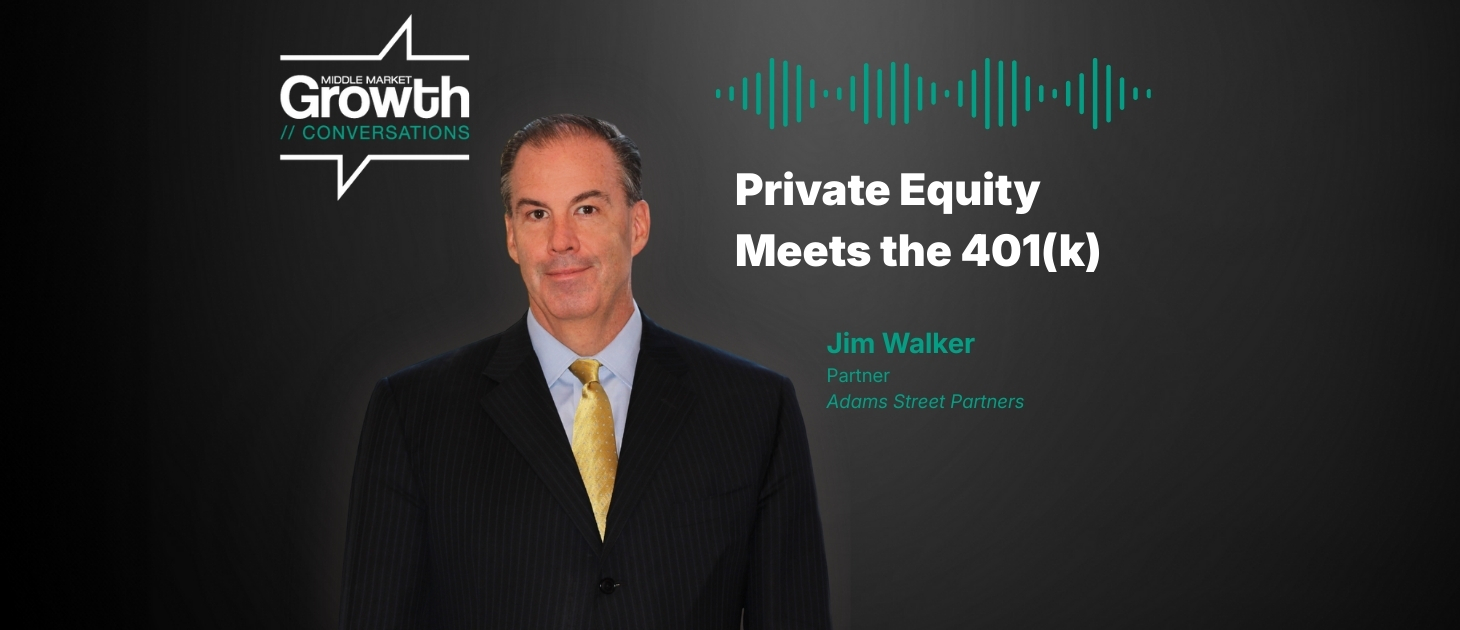
Last August, President Trump issued an executive order for the Department of Labor and Securities and Exchange Commission to lay a framework allowing private equity investments within 401(k)s. The initiative would unlock a new, potentially massive source of capital. But democratizing private equity for retail investors would have many implications for firms, says Jim Walker, partner and global head of wealth at Adams Street Partners. He joins the podcast to discuss how this initiative might play out, how the PE community can prepare, and what firms can learn from existing funds developed for high net worth individuals.
A transcript of the podcast is available below.
Middle Market Growth: Welcome to Middle Market Growth Conversations, a podcast for dealmakers discussing the trends shaping the middle market. I’m your host, Carolyn Vallejo, and this is a production of the Association for Corporate Growth. In our 2026 Outlook Report, out now on middlemarketgrowth.org, one of the emerging trends we dove into was what the democratization of private equity to non-accredited or retail investors might look like and what that could mean for PE firms. Joining us today to delve further into the details of this much-discussed, but as of yet unrealized opportunity, is Jim Walker, partner and global head of wealth at Adams Street Partners. Jim, welcome to the podcast.
Jim Walker: Thanks for having me.
MMG: Thanks for being here. And before we jump into the topic, we always like to get to know our guests a little bit better. Could you tell us about your role at Adams Street and what you focus on there?
JW: Sure. As the head of global wealth, I focus on the wealth segment as the title would suggest. So, I have responsibility for the creation of the product marketing and investor relations that faces off against both the wealth firms and the advisor community.
MMG: And just for a little bit of fun, if you could learn any new skill this year in 2026, what would it be?
JW: That’s a great question. Maybe it’s a doubling down on an existing skill, which would be setting expectations. And maybe that’s not the answer you’re looking for, but, you know, I say this because what is trending a bit in the industry is a large focus on early markups and short-term performance of these types of funds. And I think that that’s something that needs to be better understood by the advisor community. And certainly, those of us that kind of create products to make sure that people are buying them for the right reasons. Certainly, the magic I would say in private equity, like it is with public equities, is a long-term compounding of returns and focusing too much on, say, a quarterly markup or some short-term performance numbers will likely draw the wrong expectations from clients that are investing in these. So, that’s something I think the industry should be careful of.
MMG: Okay, great. I love it. A skill that you want to kind of build on and a skill that others in the industry should build on too, it sounds like. I love that. So here at ACG, we’ve covered the gradual, so-called democratization of private equity, as many are calling it. And this is, you know, the opening up of private equity investments to individual investors, including possibly retail investors. Could you tell us where it currently stands in terms of the ability for PE firms to open their funds up to individual investors? Who’s able to participate in that dynamic?
JW: Sure. So, you know, there’s drawn capital funds, which is the typical way that the industry has offered the asset class to institutional clients that has been available for some time to certain types of clients, certain levels of wealth and Adam Street, my firm, has been no different. While we’ve been primarily an institutional firm for most of our life, we have served wealth clients for quite some time, but it’s been in a less focused way, right? Somebody may have found us and said they would like to invest just like they would alongside any particular institution. That’s evolved as that demand has gone up to the use of feeder funds, which it is administratively easier for drawn capital. So, you know, firm like ours, we would get one capital call, and you might have 200, 300 investors underlying that for a given wealth manager, but we can administratively handle it. That’s a very specific type of investment that’s not broadly available. So, you kind of touched on the oft-used word “democratization,” but you know, it’s not necessarily attractive to a large swath of the clients. And specifically that’s around one, the fact that it’s completely illiquid, which would eliminate many investors. And also, really for tax reporting, this sounds very basic, even for larger clients, you assume that they have infrastructure in place to handle K ones, but they may just not want to deal with it. They just prefer a 1099. So they want it to look and feel like the other funds that they’ve got. And so that’s where evergreen funds come in, which solves for both. You have a semi-liquid feature to these funds where you’re able to tender for liquidity on a pretty regular basis. In most cases, that’s quarterly, and you’re going to produce a 1099 for tax reporting purposes to that client. So therefore, as simple as that sounds, their taxes are not on extension and it’s going to look and feel like everything else they have. That’s the area of growth, I think, as everyone knows. I mean, I’m not saying anything that any of these listeners don’t already know. So, that area is growing very quickly. It had been inhabited by a handful of firms and a handful of funds until more recently. So, making that origination available to clients via something that has got both liquidity and proper tax reporting, that’s really expanding it to a very large pool of investors.
MMG: And when we’re talking about these investors, in terms of individual investors, these are high net worth individuals, HNWIs as they’re also called, but via this kind of intermediary, like a wealth advisor. Is that accurate?
JW: Correct. So at least in the case of our firm, we work a hundred percent really through advisors, right? So, when the role of the advisor is quite important, you know, we’re producing something that is going to be a representation of an asset class. And the role of the advisor is, you know, what proportion and what levels of risk and illiquidity can that individual client assume. And that’s the most important thing is that they are selecting it on behalf of their client.
MMG: So, I’m assuming that these advisors are aware of this opportunity for their clients. But you know, on the investor side, are these high net worth individuals aware of this opportunity? Are they demanding it?
JW: They’re certainly aware of private equity and they’re certainly aware of venture capital more and more, and I’ll state what I think a lot of people know in more and more cases. There’s just interesting parts of the market portfolio, names that are just not public and may never be public by the way. They may trade hands on private markets almost indefinitely. And clients want access to those returns. And so, they may hear that from their advisors and their advisors also look at this as an additional diversifier, as the number of public companies has shrunk in the United States over the last 30 years, it’s basically half of what it was 30 years ago. There’s big parts of the economy you would like to have your portfolio represented, and then that’s how you do it, is really through these types of vehicles.
MMG: Okay. So high net worth individuals are aware of this as asset class. There is rising demand for it. What about their advisors? Are they offering this to their clients? Are they aware of this opportunity as well?
JW: So, they’re certainly aware of it. The question is, are they doing it? So we deal with a number of the, you know, very large wealth managers and all the way down to, you know, RIAs and everything in between. What we hear almost universally is 10 to 12% of the advisors are doing 90% of the business. And that is a function of their comfort level. You can use the word education, but I’d say probably familiarity is a better word. When you’re sitting in front of your client, you want to have a high degree of comfort of in what you’re recommending. So I think as that percentage of advisors gains more comfort, they will show that to clients more frequently. At the same time, clients are demanding it, which is kind of pulling advisors towards, I do need to make sure that I’m fluent in this, so I’m going to have to get myself up to speed. And then what are the right products and what are the right strategies for my clients to own?
MMG: Now I want to talk about Adam Street and what you offer specifically, because the last time we talked, you had informed me of a new fund recently launched, designed to support individual investors demand to access the PE asset class, which is meeting the demand that you just mentioned. So how do you tailor the fund to address the needs of individual investors and how do those needs differ from institutional investors?
JW: You know, I would say the portfolio goals are actually somewhat similar, which is be quite along the lines of what I just described, which is participating in parts of an asset class that you wouldn’t otherwise have access to. And really what you’re doing is diversifying the timing and sources of returns. So that’s important way to think about it in my view, which is not necessarily that it’s going to correlate with public markets, but also that it’s going to pay out over extended periods of time and it’s going to give you the benefits of long-term compounding. So the goals of those two investors really are the same, you know, how they’re consuming it is somewhat different. I mentioned the evergreen funds as something for individuals. We are actually seeing small institutional tickets go into those too, because one of the real advantages there is they might say, gee, you know, I’d like to invest in private equity and I have $5 million to invest, I’m a community foundation. I don’t really want to wait three or four years to get that money to work. I’ll just use the evergreen fund. You see some combination of demand in the evergreen funds from both individuals and institutions. So, one of the ways I would think about the expression of the asset class is how can somebody really complement what they’ve already got? And that’s what they’re effectively trying to accomplish.
MMG: Now, we’re talking about the quote unquote democratization of private equity. And to go even a step further with this trend, there is now discussion of opening up private equity to individual non-accredited investors—people like you and I, who may not be high net worth individuals working with wealth advisors. And this topic of conversation really exploded last year when President Trump issued an executive order back in August requiring several key regulators to explore opening up 401(k)s to private equity firms. And it’s been about six months since that executive order was issued, we still don’t have word exactly on how this would work, but as someone in the industry, as someone who is so well informed, could you offer us a hypothetical how this might pan out? What could this look like?
JW: Well, I guess the disclaimer is anything I say is purely hypothetical because there is no regulatory framework right now. You know, there’s been discussion over many, many years of how you would make private markets available within retirement accounts and specifically 401(k)s, and this is a recent, it’s the purview of the Department of Labor and the administration head has instructed the Department of Labor to come up with a framework for how that might work. You know, the Department of Labor typically has, and under ERISA is going to, you know, be very focused on investor protections for good reasons. So, it’s going to be very heavy on what are the disclosures and also on fees. So, I think one of the ways that I think many industry participants see that unfolding, at least in chapter one, I would say, would be to have private markets expressed within a target date fund. So, target date funds are very well established and through, you know, major providers at the T. Rowe Price and Vanguards of the world, you know, have very large franchises in those funds. And those funds are designed to be defaults for somebody who’s coming to work at a company. It’s going to correlate with their age and risk tolerances and make adjustments as they go on. It’s easy to see that private markets could be an asset class represented within a target date fund, and in that case, it would be higher allocations for a younger individual than it would be for an older individual given illiquidity of the asset class. So, I think that’s how it may manifest itself early on, but there’s lots of ifs there. So, I don’t know that I see it as for 401(k)s in the first version of it being lots of choices of individual funds.
MMG: So, when an employee signs up through their employer for a 401(k), they do have choice and control over where their allocations are made. The kind of education level and awareness level, and the amount of active participation in their accounts differs from one person to the other, of course. So, what would this look like in terms of awareness from the investor and perhaps their financial advisors in terms of being able to invest in PE funds?
JW: Yeah, it’s a good question. I mean, the vast majority of plan participants will choose whatever the default is. When you go to work for a company and you’re signing up for the 401(k), you know, take a certain amount out of your check and where’s it going to go? And in many cases, that’s going to be into the target date funds. So in the case of the target date funds, I think I might have alluded to this earlier, but you know, that’s going to be subsumed into the funds. You would have a private markets representation within that fund, but you wouldn’t really see it, but it would manifest itself in a percentage of the fund based on your time to retirement. So that’s not an active choice, if you will. 401(k)s tend to be, you know, they’re menu driven and here are the offerings that you have as an employee of the company and what can you choose? You typically don’t have an advisor, meaning an individual calling you and saying, you really should move money from, you know, the SB 500 into this private market’s offering. So that’s not likely to exist anytime soon. I think if you have those line items within 401(k)s, ultimately that’s probably going to be the most broadly diversified options, broadly diversified private markets options, if in fact, companies are even comfortable with offering that. That ultimately I think is going to be dependent on the framework and fees and all the other things that come out of what the DOL’s going to ultimately produce.
MMG: I want to talk about what potential implications could be both for private equity firms and for individual investors. So let’s talk first on the PE side. How would opening up these funds to individual retail investors via their 401(k)s affect the way they operate? You already have some great experience there. You’ve talked about how, for example, high net worth individuals need a product tailored to their needs. How does that go even further when we’re talking about an individual retail investor?
JW: Yeah, well, I think when you say an individual retail investor, that is a broad swath, I think really, this gets down to suitability and where somebody is. So, you know, one of the things I just described with target date funds is that as a product tries to take into account where that individual is in their life and in their ability to take on illiquidity or any kind of investment risk. So if you kind of pull that string a bit, that’s where I think most of the activity will be focused, like I said, through advisors. How do we as an industry offer the right set of solutions for advisors to choose from, to populate those client accounts. Now, there’s kind of two pieces of what you’re getting at. There’s the 401(k) market, which tends to be, you know, very plan driven. It’s you know, the Department of Labor is heavily regulated, and those firms that are offering those plans are very loath to take any kind of risk and offering that’s going to be potentially risky to their employees. The IRA rollover market is as big or bigger, and then that tends to correlate with individual advisors making those decisions as opposed to a plan that is, you know, a little bit more prescribed, you know, a menu of choices. And so I think you see probably two paths. You know, one is what I described with 401(k)s, which is menu driven, probably target date funds. And then as you get into individual IRAs, large rollover accounts, which can be into the many millions, then the advisor has an opportunity to craft something that’s much more specific to the client. And then you can be, you can drill down on a certain strategy. So, you know, for example, the client might be approaching a period where they’re going to want income from that account. The advisor might choose private credit funds which provide a higher degree of income than they might get from public credit. There’s certain strategies like secondaries, which have a shorter J curve and are expected to pay off a little bit sooner. Those are great strategies to maybe concentrate on when you think the client’s going to go into a distribution phase. You know, conversely, when somebody’s much younger, maybe they do want to invest in a venture capital fund that’s got a longer duration, but potentially higher payoff, but is not going to be liquid in the near term. So that gives you some examples of the two populations and how they may consume with the private equity business private, private markets business as producing.
MMG: I mean, this is interesting because this initiative potentially opens up a very significant new source of capital for PE firms. However, as you’ve mentioned, clearly firms will have to really tailor a product to meet investors’ needs. Are they going to face administrative challenges on the backend to be able to set up a product that that not only meets the client’s needs, but meets the needs of the private equity firm?
JW: Well, so administratively, they work very differently than the traditional products that the firms have had. So think about how a drawn capital fund works. The administrative aspect of that is reasonably straightforward and it’s kind of accounting driven, drawn capital money comes in, it’s invested, you’re producing quarterly capital account statements, then it’s drawn down and paid out. What you’re adding now are new vendors, lots of different types of requirements because you’ve added liquidity and you’re in a new regulatory environment. So it’s a fundamentally different offering on every level. So it’s that administrative challenge. If the firm is coming from an institutional legacy like our firm, you’re going to have to build it. And that’s what just a requirement for how to offer maybe an identical portfolio, but just in a different wrapper.
MMG: So we’re hearing on the ground that PE firms and others are watching this initiative closely, but as you mentioned earlier, this is all hypothetical at this point in time—there are still so many unknowns, and any changes being implemented are likely quite a ways off. So from what you’re seeing and hearing on the ground, what are other PE firms saying? Are they preparing? What is the sentiment you’re hearing from the industry?
JW: I think everyone’s expecting something to happen and you’ve seen, everyone’s seen, publicly announced, a number of different partnerships with large firms seeking to, you know, maybe a large traditional firm with a private markets firm that can produce something that would be able to be combined into a retirement offering. Since people don’t know exactly what that is, I think that’s probably, you know, you’re at the early stages of creating those partnerships. But certainly those partnerships are also, even if nothing happens in the retirement aspect of the business, a traditional firm who’s been offering traditional mutual funds and asset management product is interested in distributing something that has a private markets aspect to it. So I think even that type of scenario planning, it’s not for naught, if nothing comes of this, you will have something that I think is of lasting business value. And I think that’s why you’re starting to see these partnerships.
MMG: Excellent. Well, Jim Walker with Adam Street Partners, thank you again so much for taking the time to speak with us and share insights on this.
JW: Thank you for having me.
This transcript was prepared by a transcription service. This version may not be in its final form and may be updated.
The Middle Market Growth Conversations podcast is produced by the Association for Corporate Growth. To hear more interviews with middle-market influencers, subscribe to the Middle Market Growth Conversations podcast on Apple Podcasts, Spotify and Soundcloud.