Finding the Entry Point Into AI’s Hyperscale Buildout
BGL's Brian Thom and Ryan Gillis share insights into M&A opportunities amid AI's explosive growth
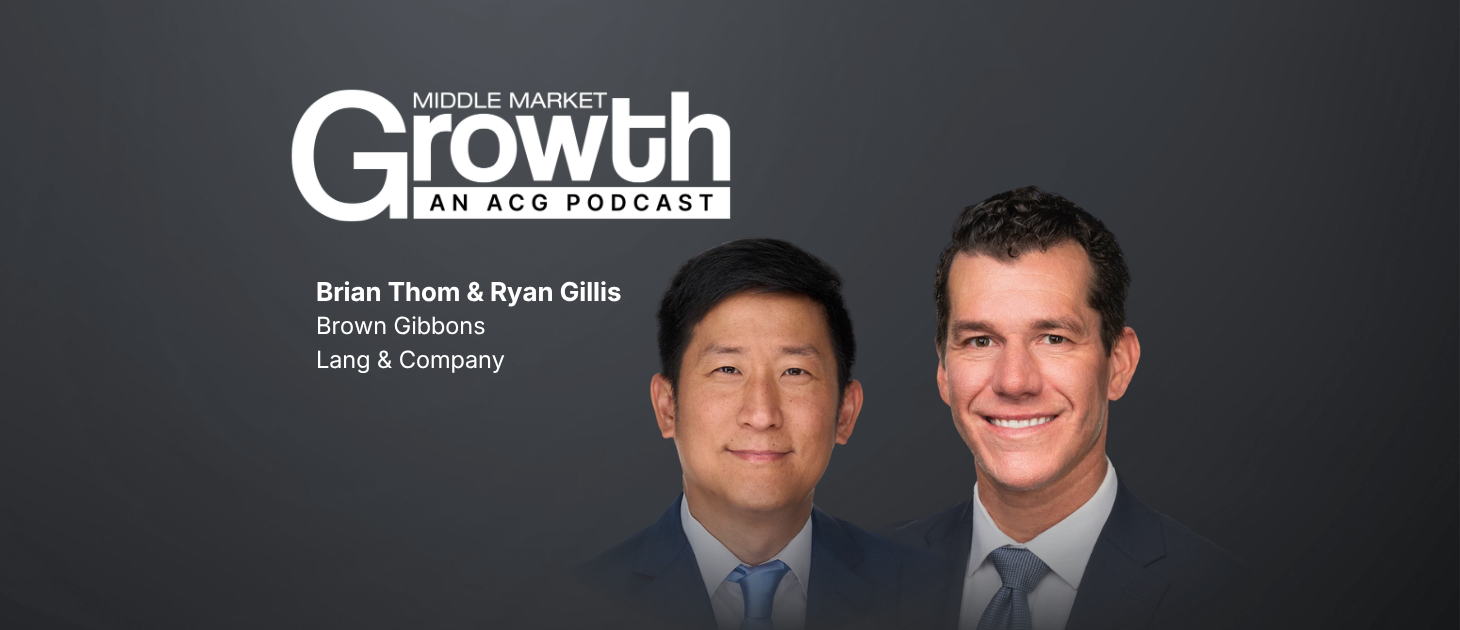
As AI drives an unprecedented wave of data center construction, where can middle-market investors find a foothold? Brian Thom and Ryan Gillis of Brown Gibbons Lang & Company join the podcast to explore the M&A opportunities emerging beyond the headline-grabbing megaprojects, share where deal activity is accelerating, discuss the challenges facing AI infrastructure development, and more.
This episode is brought to you by Grata. Learn more at grata.com.
Read a transcript of the podcast below.
Middle Market Growth: Welcome to ACG’s Middle Market Growth. I’m Carolyn Vallejo. A massive AI buildout is taking place, attracting trillions of dollars in investment across the globe. Pew Research Center reports that more than 1,500 data centers are in development here in the United States alone. Here to take us inside this buildout and explain how middle-market investors are getting involved are Brian Thom and Ryan Gillis of Brown Gibbons Lang & Company. Brian and Ryan, welcome to the podcast.
Brian Thom: Thank you. Good to be here.
Ryan Gillis: Thanks a lot, Carolyn. Happy to be here.
MMG: Brian, I know we spoke with you for an article on this topic in our 2026 Business Services Report, which is out now at ACGinsights.org. For those who might not have read that piece yet, can you tell us about your current role at BGL and your area of focus?
BT: Absolutely. I’m a managing director at BGL. I primarily cover infrastructure software and cybersecurity. Think of any software or service that touches a developer or IT professional within an organization, or anyone who works with the CISO or the security operations center, or SOC, at a company.
MMG: Ryan, what about you? What’s your role at BGL, and what do you focus on?
RG: I’m a director at BGL. I’ve covered the telecommunications sector for more than a decade, although the trendier term now is digital infrastructure. We advise founders and private equity-backed companies, typically across the broader digital infrastructure space. That includes fiber in the ground, steel in the air, towers, cell towers, and data center development. Particularly relevant for us at BGL are the services and adjacent businesses that support those sectors and help build, connect, and maintain the networks and facilities associated with digital infrastructure assets.
MMG: Excellent. We’ve been asking our guests lately: If you had to pick any walk-up song, what would it be? Ryan, I’ll ask you first.
RG: It’s not the most exciting answer, but it’s relevant today and comes from one of my favorite artists: Stevie Wonder’s “Signed, Sealed, Delivered.” It’s relevant as an M&A banker, but it also applies to data centers. Getting through permitting and securing energy and power for the sites means that “signed, sealed, delivered” is a good outcome.
MMG: “Signed, Sealed, Delivered.” Great. Brian, what would your walk-up song be?
BT: Given the topic of the AI infrastructure buildout and its related adjacencies, I’m going to say “Welcome to the Jungle” by Guns N’ Roses. In my opinion, the AI buildout is a jungle right now. It’s a matter of separating the wheat from the chaff, identifying the crème de la crème, and determining who’s on top.
MMG: Let’s get into our main topic. Ryan, I’ll start with you. You mentioned that you focus on hard assets, including towers and data centers. What middle-market trends are you watching in the space right now?
RG: There are two parts to the story. The first involves legacy hard assets. As you mentioned, trillions of dollars are flowing into data centers. These multibillion-dollar megaprojects aren’t especially relevant for the private equity middle-market investors we work with because the return profiles and investment horizons aren’t a natural fit. What they are targeting are smaller, phased developments of modular data centers that can be developed and brought online faster. Instead of focusing on hyperscalers, those projects often serve enterprise customers, regional markets, specialized cloud providers, and neocloud providers. The investment case begins with demand, and we’re seeing demand from those customers. While many investors focus on hyperscalers and megaprojects, we see significant potential and interest in this other segment. Beyond the hard assets, we’re spending a lot of time on services. The data center boom of the past decade has created business lines that largely didn’t exist more than 10 years ago. These include engineering and commissioning work, cooling systems, flushing and filtering those systems, maintenance, retrofitting, testing, and inspection. At BGL, we view these businesses through the picks-and-shovels analogy. You can mine for gold and perhaps strike it rich, but many miners go bust. By serving those miners, you can be insulated from some end-market risk while still benefiting from the data center and AI tailwinds. The more complex these facilities become, the more advanced their service and engineering needs become. This work also extends well beyond initial construction. Facilities need retrofits, ongoing maintenance, testing, inspections, and equipment upgrades as workloads become more demanding. We see substantial opportunity throughout the data center life cycle.
MMG: Interesting. Brian, let’s turn to you. I know you focus more on the software side. What middle-market trends are you seeing?
BT: First, we should agree that the AI data center buildout is happening right now. From a hardware and services perspective, there are investable themes today. Software comes after the hardware is installed because software can only run on infrastructure that is operating. Some of the investable themes I’m watching have always existed, but they now have an AI angle. One is observability. Once a data center is running and applications are being built within its workloads, developers and management teams want to understand what’s happening inside those workloads. Companies addressing that need have already been built and continue to develop. Another ecosystem I’m watching is FinOps, which is essentially cost management for software and AI usage. Cloud usage, OpenAI usage, Gemini usage, and similar tools are expanding rapidly within enterprises. FinOps software helps rein in those costs. These companies have always existed, but historically they focused on cloud, SaaS, and other software expenses rather than AI-specific costs. The third area is cybersecurity. Attack surfaces are expanding, and attackers are using AI to target enterprises and governments. Many cybersecurity companies are creating solutions to protect personally identifiable information, websites, enterprises, and other critical assets. Those investable themes exist in the middle market, but AI is currently the hot sector, so those companies are generally growing rapidly. From a middle-market perspective, it may be harder to find the perfect fast-growing company at the right check size, but it’s easier to find companies growing rapidly on AI tailwinds. There’s some give and take. Ryan’s point about services is also absolutely right. Firms that implement cybersecurity for enterprises, SMBs, and middle-market organizations remain attractive to middle-market investors. The same applies to companies implementing AI within enterprises and helping businesses become more productive. Services that maintain and support data centers and AI data centers overlap with Ryan’s coverage and are also attracting middle-market interest. To capitalize on these themes, investing in picks and shovels rather than the gold mine is a strong approach.
MMG: As you both explained, a great deal goes into this landscape. We continue to hear about hyperscale projects with massive budgets. Where do middle-market investors and dealmakers fit into this investment wave? Ryan, let’s start with you.
RG: There are limited ways for a middle-market investor to participate directly in hard assets, but opportunities do exist. Some real estate-oriented middle-market investors that might not historically have fallen under my coverage are moving toward data centers because of the sector’s demand and returns. They may participate in one part of the development life cycle. For example, an investor may take land it already owns in an attractive geography near water and utility infrastructure, then seek an interconnection agreement. By investing a smaller amount of capital early, building the necessary infrastructure, and securing power, the investor can remove lead time for the next buyer and create significant value. It’s also a shorter-term project. The timeline doesn’t have to match the longer horizon of a traditional infrastructure investor, and it doesn’t require hundreds of millions or billions of dollars on day one. It can support a timely exit because there are many potential offtakers once the site is powered. That said, only so much land and so many sites are attractive for this strategy. We’re spending more time on services within BGL’s digital infrastructure team, especially for middle-market investors. One strategy is to acquire an established service provider that operates in a limited geography, then provide financial backing to scale the company and expand geographically. Cooling is one example. There are different technologies for cooling GPUs and chips in next-generation data centers, from single-phase direct-to-chip systems to immersion cooling. The constant is that legacy air cooling is insufficient for today’s chips and facilities. An investor might acquire a company focused on one cooling technology and help it become a one-stop cooling provider. Because different data centers have different cooling needs, that expansion can increase the company’s capabilities and address more of the market. Investors can also help a company expand geographically, deepen customer relationships, and move along the data center life cycle into engineering, maintenance, and retrofitting. The opportunity is to begin with a provider embedded in key relationships, then expand wallet share. We’re also seeing joint ventures and SPVs. An investor may not participate in data center development nationwide but can invest in a unique project. These are often smaller edge, enterprise, or neocloud sites rather than campuses dedicated to AWS or another hyperscaler. They may be colocated among multiple tenants or serve one smaller tenant. Sites in the five- to 50-megawatt range can be accessible to middle-market investors. Middle-market investors can serve the largest campuses and hyperscalers through service businesses, participate in hard assets at a smaller scale, and invest on a timeline and with a check size that fit their funds. The investors we speak with find the thesis compelling. When we present a data center or infrastructure services business, they’re eager to learn more. Appetite is strong.
MMG: That’s great to hear. Brian, beyond the data center itself and the physical services, what are some of the most compelling areas benefiting from the AI buildout?
BT: One area that comes directly to mind is software that gets as close to the chip as possible. People have heard of CoreWeave, Nebius, neoclouds, and hyperscalers investing significant capital. What receives less attention is the software that wraps around chips and hardware, turning raw compute infrastructure into a platform that can run AI workloads. Companies have been created, and continue to be created, around GPU orchestration and AI orchestration. If an organization wants a sovereign cloud without relying on neoclouds or hyperscalers, it can create an on-premises GPU cloud. That gives it more control over sensitive and proprietary data. The software effectively allows a company to create a lighter version of AWS or Azure without relying on third parties to host its data. We’re seeing this particularly among large conglomerates and companies outside the United States. My prediction is that more middle-market and smaller companies will care about where their data resides because they view that data as proprietary and don’t want AI companies controlling it. Investors should watch the software that wraps around chips and transforms raw hardware from Nvidia, HPE, Cisco, Dell, and others into intelligent infrastructure. Another area is data. An AI model is only as good as the data it receives. Data can be broken, incomplete, or unclean. Companies that host data, improve data quality, and make it accessible can help models perform better. These businesses have always existed, but because data is foundational to AI, they are becoming far more important. Investors also need to consider whether data warehouses and data lakes can support AI workloads and make data accessible to models quickly and accurately. We all care about speed and quality. Models need to retrieve data in a way that minimizes hallucinations and incorrect answers. AI models are probabilistic rather than deterministic. They may provide an answer with 95% confidence rather than absolute certainty, and that remaining 5% can make a significant difference to users who need the correct answer.
MMG: Let’s turn to energy and power needs and the services around them. Energy appears to be a major constraint on data centers and AI infrastructure more broadly. Ryan, can you explain the power bottleneck and the risks and opportunities it creates for middle-market investors?
RG: Absolutely. The data center boom has experienced shifting bottlenecks, and the milestones investors need to achieve are constantly moving. Most recently, power generation and availability have become key constraints and critical components of bringing sites online. The first consideration is the timeline to power. There is significant permitting and regulatory work, and power may not be available near the intended site. The constraint could involve generation, transmission, substation upgrades, or unavailable equipment. One recent theme is the repurposing of turbines and equipment from unrelated industries because the lead time for newly manufactured equipment can be five to seven years. By then, a proposed site may no longer be relevant. Some developers are walking away from projects because they can’t obtain the equipment needed to generate power. We’re also seeing more behind-the-meter generation. Power produced at the facility can supply the site directly, often through natural gas systems, and bridge the gap while developers wait for grid power. If utilities can’t provide power for a project, developers increasingly look behind the meter while pursuing a longer-term supply. Behind-the-meter plans still require dependable fuel, permitting, specialized equipment, and a design suited to the site. Those complications have created an emerging subsector. Some developers are building behind-the-meter grids and hoping to sell powered sites. For middle-market investors, this creates opportunities in electrical engineering, microgrid integration, installation, testing, inspection, and maintenance. Unlike infrastructure projects that require a large upfront investment and then produce stable cash flows, many of these service businesses are asset-light and generate recurring revenue. That’s exactly what many middle-market investors want. The power bottleneck has created another opportunity for investors seeking asset-light businesses with reliable, repeat business.
MMG: There have been many headlines about residents rejecting data centers in their communities. Is this pushback stalling or stopping a significant portion of development? How are you thinking about the risk, and how can it be mitigated? Ryan, let’s start with you.
RG: It’s certainly a risk. I recently attended an industry conference where protesters gathered outside, largely over data center water usage. Local communities are concerned, and local politicians and representatives respond to those concerns. Anyone operating in a geography needs to understand local approval processes. It can also be helpful to engage policymakers and make sure stakeholders understand the project. Most data center developers understand the pressure these projects can place on water supplies and energy systems. We generally don’t see operators who ignore those effects simply to make money and walk away. We see businesses trying to limit water and power use, and new companies are emerging to help achieve those goals. States, communities, and countries are taking action. California recently signed bills requiring data centers to report regular water and energy use. Developers need to understand local conditions, build support before entering a market, engage communities early, and address practical questions about water, electricity, infrastructure upgrades, and who will pay for them. Developers should also be transparent about local benefits, including jobs, training, and tax contributions, and distinguish temporary construction jobs from long-term employment.
MMG: Brian, anything to add?
BT: Ryan covered most of it. There is real risk that local, state, or federal opposition can stall data center development. Construction delays reduce ROI for developers. The community pushback is also legitimate. I’ve visited sites, including in Huntsville and across Texas. Data centers can be loud, use significant amounts of water and electricity, and increase utility prices for surrounding communities. Early in the buildout, there was some euphoria around splashy headlines announcing a $5 billion data center in a nearby community. People saw dollar signs and immediate construction jobs. Once a data center is built, however, it may require only 30 or 40 people to operate, depending on its size, rather than supporting thousands of jobs for the next 30 or 40 years. The solution requires community buy-in. Projects can incorporate microgrids, strive for electricity and water neutrality, contribute resources and utilities to the community, and avoid making life less affordable through rising prices. It requires genuine collaboration between the company building the data center and the community in which it will operate.
MMG: Let’s return to deal activity. Brian, what are you seeing in the broader data ecosystem?
BT: In my area, significant middle-market private equity activity is occurring in services, including AI implementation, cybersecurity, and IT services. As AI data centers and digital infrastructure are built, those services become necessary. There are many regional operators in Texas, Alabama, the South, and across the United States. National providers exist, but so do many regional companies, which creates middle-market activity. Software is different. In my opinion, there is currently a pause in middle-market software activity as private equity firms, including larger sponsors, assess what will happen after this phase of the AI buildout. One key question is how lenders view these businesses. The typical private equity model involves raising debt, acquiring a company, and contributing only part of the purchase price in cash. Lenders are also trying to determine how sustainable a software business is in light of AI disruption. I’m seeing many services transactions but less private equity activity in software. I think that will evolve, and activity should increase in 2027, 2028, and beyond. Strategic acquirers, including Cisco, Dell, CrowdStrike, and Palo Alto Networks, are active. Companies described as AI-native, meaning they were created after AI became mainstream, are being evaluated by large, diversified strategic technology companies. Those acquirers are filling product gaps through acquisitions rather than building everything internally because many emerging companies are on the leading edge of technology and would take time to replicate. There’s significant activity, but it’s bifurcated between private equity and large-cap strategic buyers.
MMG: Ryan, anything to add? What are you seeing in transactions across the data ecosystem?
RG: First, I’ll briefly toot BGL’s horn. A good example of buying rather than building specialized capabilities is Strategic Thermal Labs, which developed advanced cooling technology and thermal management capabilities for data center infrastructure. We advised on the sale of the company to Vertiv. Strategic Thermal Labs’ direct-to-chip liquid cooling expertise complemented Vertiv’s broader offering. It demonstrated how a middle-market business can create substantial strategic value for a larger player, and it was a great outcome for our client. On the services side, attractive businesses often have recurring, contracted maintenance revenue, repeat project work, and strong visibility into future work. Investors also evaluate customer concentration, and a diversified customer base is more attractive. We like to see strong backlog. Ultimately, cash is king. Most investors seek businesses that generate cash flow or have strong near-term cash flow potential. Those are some of the characteristics we consider when identifying attractive targets.
MMG: To wrap up, this is a prolific market attracting significant attention. You’ve described many ways middle-market investors can participate. What advice would you give an investor entering digital infrastructure for the first time? Ryan, let’s start with you.
RG: If you’re new to the space, begin with a business model you understand. Investors with industrial services experience can pursue the data center service businesses we’ve discussed. Specialty manufacturing is another business model that can translate into middle-market data center opportunities. Software can also provide a natural entry point, although I’ll leave that to Brian. During diligence, investors can learn more about the broader digital infrastructure sector. When evaluating a business, a mentor early in my career taught me that case studies sell companies. Find out why a company is winning. If it can explain how it secured a contract, achieved a strong outcome for a customer, and generated repeat or expanded business, that story is compelling because it’s likely repeatable and demonstrates differentiation.
MMG: Brian, what guidance would you provide?
BT: If an investor is completely new to digital infrastructure and primarily invests in software or services, I would focus on the basics. The key metrics include growth, contracted pipeline or pipeline visibility, gross retention, and profitability. Gross retention shows how often customers leave after adopting the platform or service. In my area, I would look for a company growing at least 25%, although some companies can grow more than 100%, depending on their scale. Gross retention should be above 90%. On profitability, I would look for an EBITDA margin above 10%, or at least a profitable business, although I would accept somewhat lower profitability in exchange for meaningful growth. Assuming the numbers are clean, a company growing 25% or more, with gross retention above 90% and a 10% EBITDA margin, merits a closer look. Investors should ask why the company is growing, why customers remain, and why the company is profitable. Strong answers should be supported by case studies, useful anecdotes, and a healthy customer base, ideally including blue-chip enterprise customers that are financially stable. Many middle-market investors have clear thresholds. They may not invest in a company growing less than 20%, losing 20% of its customers annually, or generating no cash flow. Those factors help de-risk the investment from day one.
MMG: All right. That’s Brian Thom and Ryan Gillis of BGL. Thank you both so much for joining us today.
BT: Thanks a lot, Carolyn.
RG: Thank you so much.
MMG: For our listeners, if you’d like to hear more from Brian on the data center boom, you can read our article on the subject in ACG’s 2026 Business Services Report, out now at ACGinsights.org.
This transcript was prepared by a transcription service. This version may not be in its final form and may be updated.
The Middle Market Growth podcast is produced by the Association for Corporate Growth. To hear more interviews with middle-market influencers, subscribe on Apple Podcasts, Spotify or Soundcloud.