The Founder’s Guide to Capital
National Business Capital's Joe Camberato talks about founders' common capital misconceptions
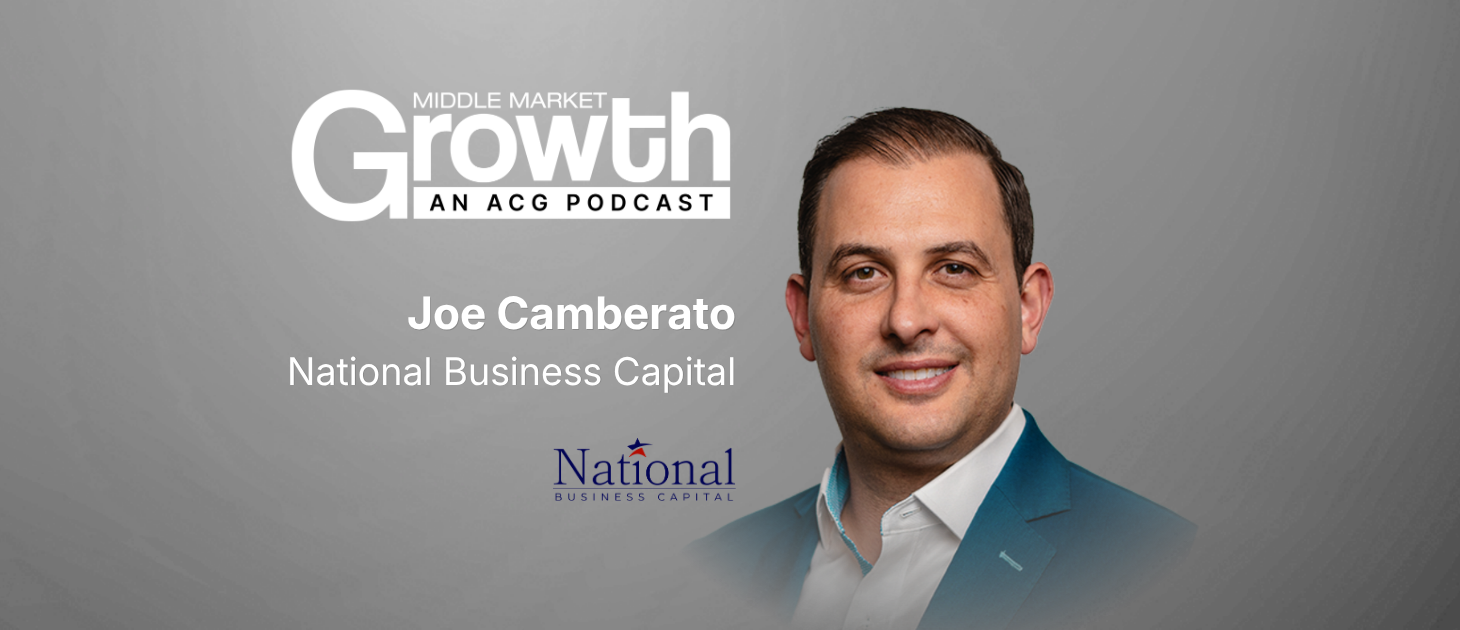
For a founder or entrepreneur, choosing whether or not to opt for outside capital is an important inflection point. Joe Camberato of National Business Capital sits down to talk about the misconceptions many founders hold about capital, how they can prepare for a first-time capital infusion, and how to best utilize that money when they get it.
This episode is brought to you by National Business Capital. Learn more at nationalbusinesscapital.com.
Read a transcript of the podcast below.
Middle Market Growth: Welcome to ACG’s Middle Market Growth. I’m Carolyn Vallejo. Founders often spend years bootstrapping their businesses customer by customer, but at some point, they face a decision: Would outside capital help them graduate to the next level of success? Joe Camberato of National Business Capital is back on the podcast to share how founders should think about capital and how to best prepare for and use a first-time institutional investment or capital infusion. Joe, welcome back.
Joe Camberato: Hey, thanks for having me.
MMG: By now, you’re a frequent flyer here on the podcast, but let’s start by reminding our listeners about the work you do at NBC.
JC: Sure. I’m just trying to rack up my frequent flyer points, so thank you for having me again. I’m the founder and CEO of National Business Capital. I founded the company in 2007. We’ve provided more than $3 billion in funding to entrepreneurs and small and medium-sized businesses. We focus on funding amounts from $250,000 to $10 million. We also have a large lender network, so we’re active in the small and medium-sized business community and work with many founders.
MMG: You are a founder and entrepreneur yourself. What advice would you give your younger self if you could go back to before you founded NBC?
JC: There’s probably a list. I started the company from zero, in the early days of what became small business lending. I didn’t know it at the time, but I became a pioneer in the space. When I got started, there wasn’t much focus on small business lending, and there weren’t platforms available. People were still faxing applications. That shows how far technology has come in only 19 years. When you start something from zero, or really do anything in business, even if you buy an active business, things take longer than you expect. I often thought I would be much further along within a year or two. As you move forward, however, you realize that the really big needle movements become apparent when you look back over your life. I think this applies to everyone. If you’re taking action, staying focused, and doing the work, the movement over five-, 10-, or 15-year periods can be significant. In the beginning, however, everything takes longer than expected. Maybe it’s better that I didn’t know that because you dive in without realizing how much commitment it will take to get something off the ground. That’s especially true if you’re building something from zero or creating something innovative. There is so much focus on small business lending now, but there wasn’t when I started. It was a road less traveled.
MMG: Patience is certainly a virtue, and that’s great advice for founders. We want to continue that conversation about what founders should know. This time, we’re discussing accessing capital for the first time and how founders can accelerate growth, perhaps into the middle market, through a capital infusion. Let’s start with the most common misconceptions you see from founders when they begin thinking about capital. What do they most often get wrong?
JC: Founders, and people in general, often think money solves every problem. When you’re building a business, opportunities are coming at you, cash flow challenges arise, and many things are happening at once. When the business is growing, people may rush to assume money will solve the issue. Before you take money from someone, especially private equity or another equity investment, you need to slow down. Those are major decisions. If your business can support debt, you might consider debt, but you need to be very clear about why you’re borrowing money. Sometimes companies have cash flow issues even though they’re booking sales and doing business. Things may be going well, but capital gaps emerge. Sometimes that’s a process issue. A better collections process may prevent cash flow gaps. Maybe you’re selling products that lack sufficient margin and disrupt the business. Or perhaps a few clients pay slowly and disrupt the flow of the rest of the business. It’s important to understand why you’re borrowing money and to identify the root causes of any cash flow challenges. I’ve seen many founders who don’t understand their cash flow cycles. Their sales are profitable, but collections are the challenge. They keep borrowing and throwing money at the problem without addressing the root cause. They can continue borrowing and booking strong sales, but they’ll still face those gaps. Then they may choose the wrong financing solution, which makes the problem worse. It becomes a hamster wheel. You need to understand what’s happening in the business, why you’re borrowing, the expected ROI, and the cash flow cycle. Those points are often overlooked because people keep moving without getting to the bottom of the issue.
MMG: You’ve mentioned cash flow and accounts receivable challenges in previous conversations. It’s important to guide founders toward understanding the actual problem and whether capital will adequately solve it. When and how can a founder know the business is ready for outside capital? What are some of the signs?
JC: There are many types of outside capital. Private equity can come from a private equity firm, an institution, or friends and family. Then there’s debt, including bank and non-bank financing. In the non-bank financing world, there are many options, including factoring, ABL, cash flow lending, and equipment financing. Each serves a different purpose. We’re entering a new era with more focus on debt rather than equity. Before COVID, and for a period afterward, private equity was considered exciting and attractive. The markets were disrupted, and people are now a little more hesitant to raise equity if they can raise debt. I try to keep it simple. If you have a business that can service debt, a profitable opportunity, and the ability to use debt to accelerate that opportunity, then you should consider debt. Then it comes down to the type of debt. If you can obtain bank financing, that’s usually your lowest cost of capital. With banks, however, you need to understand the covenants and any restrictions on the business. If you’re entering growth mode, you may have to manage the business to meet the bank’s requirements. That may involve profitability, reporting, and other guidelines that founders don’t always realize come with bank financing. Founders often focus only on the interest rate and don’t understand the guidelines. Other options include ABL, factoring, equipment financing, and cash flow lending, all with different requirements. You need to understand the available financing and what the business needs. If the business can support debt, you should consider it. If the opportunity requires far more capital than the business can support through debt, that’s when you might consider private equity. This usually applies to major technology builds, large ideas, or initiatives that require significant capital to execute. The plan and opportunity may make sense, but debt at the company’s current stage won’t get it there. First, the business may not qualify for the debt. Second, even if it qualifies, the business may not be able to service it. Break it down into two questions: Can the business support debt, and is the opportunity profitable? If so, consider debt and retain the equity. If not, but the opportunity still makes sense, look at private equity. There is a time and place for each. There is also a time and place to combine debt and equity. Some of the best businesses use a combination of debt and equity from multiple partners and lenders, not just one private equity partner or lender. We see very well-run, private equity-backed businesses that have bank financing, non-bank financing, and multiple private equity investors.
MMG: There are many financing products available to founders and business owners. Before we dive further into them, what are some of the red flags, or perhaps yellow flags, that indicate a founder should wait before taking capital?
JC: A red flag is trying to solve a problem that capital can’t realistically solve. People think money can solve every issue. If your business is losing money, isn’t profitable, or simply isn’t making sense, sometimes you do need a lifeline to bridge gaps or survive a difficult period. But we’ve seen companies take multiple rounds of financing from different sources and get into significant trouble. You need to identify the core issue. Sometimes you have to step back, clean things up, examine the business closely, and make necessary cuts in several areas. That may mean examining processes, including accounts receivable collections. It may also mean evaluating product lines or services to determine which support the business and which hurt it. I recently went through this exercise with a founder who operated a service-based business offering five services. Two were extremely profitable, while the other three were only marginally profitable. After allocating back-office costs and other expenses, the company was losing money on those three services. They also took the longest to collect. The company was being paid in 90 days for those services, while its most profitable work was paid in 30 days. The founder kept doing more of everything. We concluded that the company should eliminate the services that weren’t sufficiently profitable. It was very hard for the founder to walk away from them, but once the company did, its cash flow situation changed quickly. The red flags I see are founders doing things they believe make sense without understanding the cash flow cycle. They don’t truly understand the ROI of everything they’re doing, and they assume money will solve a challenge. Sometimes it’s best to step back and look at the business as an outside observer with fresh eyes. You can also bring in a strong outside advisor who can examine the business objectively and identify the root of the problem.
MMG: Once founders get to the bottom of the issue, as you mentioned, there are many types of capital products. You discussed mixing and matching those products and even working with multiple capital partners. It almost sounds like matchmaking: pairing capital products with the appropriate issue or opportunity and matching a provider with a founder in a way that creates a symbiotic partnership. Can you provide more insight into the types of outside capital founders should consider based on their particular circumstances?
JC: It’s difficult to cover every option here, but the capital you should pursue depends on what you’re trying to accomplish. If you’re acquiring a business and it’s a large purchase, you might use an SBA loan and put down only 10%. If you have strong accounts receivable and inventory, you might use ABL or factoring, or obtain a similar product from a bank. If you have a strong business that isn’t an ideal bank credit, you might work with a non-bank lender. We typically focus on bridge and growth capital. Companies may be growing quickly and need a bridge to fill capital gaps, or they may be outpacing what a bank can support and need additional working capital to drive growth. In the example I gave, once the founder eliminated three product lines and focused on the two profitable ones, working capital through a line of credit or term loan could be redeployed into the business. Once she uncovered the strong ROI, she needed capital to do more of what was working. A term loan or line of credit made sense, and we were able to help her. There are many different situations. If you’re buying equipment, for example, I often see people use a line of credit or operating cash. Equipment is one of the easier assets to finance, usually over three to five years at favorable rates. Every scenario is different. My team and I work through these questions with founders and with other advisors to determine what makes the most sense.
MMG: Getting the investment is only the beginning. What changes should founders expect once they bring in outside capital for the first time? What should they know about working with institutional partners and investors, and how can they prepare for the changes ahead?
JC: If you’re bringing in private equity, you need to know who you’re getting into bed with because it’s a marriage. Money alone won’t solve problems. You could solve one set of issues and create another. There is no cookie-cutter private equity deal. You need to understand the terms, what the arrangement will look like, and who you’ll be working with. Those are major decisions that shouldn’t be taken lightly. The terms can change how you operate the business, make decisions, and obtain approvals. The wrong partner can put you in a very challenging position. The same applies to a lender. Earlier, someone reached out to me about bank financing for a deal involving a roughly $100 million facility. One of the first things I told them was that they need to understand the covenants. Everyone focuses on the interest rate but may not understand the true covenants. In this case, they’ll bring in a strong financing attorney to review everything. They need to understand whether there are cash reserve requirements, what the accounts receivable and inventory mix must look like, and whether there are restrictions on distributions. Many loan agreements, whether from a bank or non-bank lender, include guidelines and covenants that can change how you operate the business. I saw a bank deal involving a $10 million line of credit with restrictions on distributions. A percentage of each distribution had to be used to repay the loan balance. If you don’t understand that going in, you can unintentionally breach a covenant and create problems. You need to understand the loan terms, guidelines, and covenants. Otherwise, you may take actions that trigger a breach and then have to deal with the lender. In many agreements, the lender can call the note. That can open a large can of worms and be very disruptive to the business.
MMG: Founders need to be aware of those challenges and avoid them when possible. Choosing the right capital partner can be essential to identifying blind spots. What mistakes do you see founders make when deploying the capital they’ve accessed?
JC: Often, founders deploy capital into the wrong things, or into the right things in the wrong order. If there are five areas in which you want to deploy capital, you need to distinguish between long-term growth initiatives and short-term growth opportunities or wins. Running a business is difficult. You’re constantly focused on short-term goals, opportunities, and wins because you need them to keep the business moving today. At the same time, you have to focus on long-term opportunities and build toward where the company needs to be in 12 or 24 months. The actions you take today should prepare the business for that future. Sometimes founders put too much capital into long-term growth. That’s important because it’s where the business needs to be in 12, 24, or 36 months, but they don’t invest enough in what has to happen today. They borrow money and spend it on long-term initiatives. Everything takes longer than expected when you’re running and growing a business. They may think an initiative will take six months, but it can take 12 to 24 months to generate a return. Now they’re in a bind. They’ve borrowed money, taken on debt, and invested in the right initiative, but returns are taking longer than expected or the plan isn’t working as anticipated. They may unintentionally neglect the short-term needs of the business and run out of cash. Their financials may show low margins, limited profitability, or a loss. Then they return to the lender for additional capital, and the lender says no because the business appears to be losing money. The company may indeed be losing money, even though it invested in the right things, because it hasn’t generated a return yet. Companies can put themselves in this position without bad intentions. They didn’t borrow the money and go to Las Vegas. They simply misjudged the timeline, invested too heavily in long-term initiatives, neglected short-term needs, and didn’t see the plan develop quickly enough. It’s a balance, and every business is different. You need to focus on both simultaneously. A strong entrepreneur is a master juggler. Running a business is a never-ending, long-term balancing act.
MMG: We began this conversation by asking what advice you would give yourself as a young founder. The conversation has been full of advice and guidance, but let’s bring it full circle. What other advice would you offer young or newer founders as they think about outside capital?
JC: Many of us were raised to think debt is bad, especially in old-school families where debt was a dirty word. If you’re borrowing money to do something without an ROI, such as financing a vacation or another luxury, that’s probably not a good idea. But if you’re borrowing money for something that has a return, you’re using leverage in the right way. It can be a great tool and accelerate growth. Don’t be afraid of outside capital or borrowing, but have a clear plan and understand the numbers. One thing that took me a long time to understand was the importance of surrounding myself with other founders and entrepreneurs. When I started, I was all in, 24/7, and that’s what it takes to build something from zero. I wish I had joined founder and entrepreneur groups earlier. Today, there are many options, including EO, YPO, Vistage, and others. Those groups can be extremely helpful. When you’re starting, you may not be ready to hire a full-time CFO, although you may need that skill set. Most founders are very good at what they do, but they may not be good at the detailed planning a CFO handles, such as building a model and spending time in Excel. You don’t necessarily have to hire a full-time executive because there are many fractional professionals available today. If you’re preparing a plan and considering borrowing significant capital, spend extra time on the plan. Bring in a fractional CFO, consultant, advisor, or someone with experience in your industry. Get clear on what it will take to pursue the opportunity, how it will affect cash flow, how much you need to borrow, and how much you need to operate. That preparation can help you avoid mistakes. It may show that you have a strong opportunity and should double down. Or it may show that an idea will never make financial sense, allowing you to pass and focus on another area of the business.
MMG: It sounds like it’s all about surrounding yourself with the right people. That’s a great piece of advice.
JC: Always. Yes.
MMG: All right. Joe Camberato of National Business Capital, thank you again for joining the podcast. It’s always great to speak with you.
JC: You as well. Thanks for having me, guys.
This transcript was prepared by a transcription service. This version may not be in its final form and may be updated.
The Middle Market Growth podcast is produced by the Association for Corporate Growth. To hear more interviews with middle-market influencers, subscribe on Apple Podcasts, Spotify or Soundcloud.