How Human Capital Drives Operational Agility
Insperity sits down with the podcast to discuss human capital strategy pre- and post-acquisition
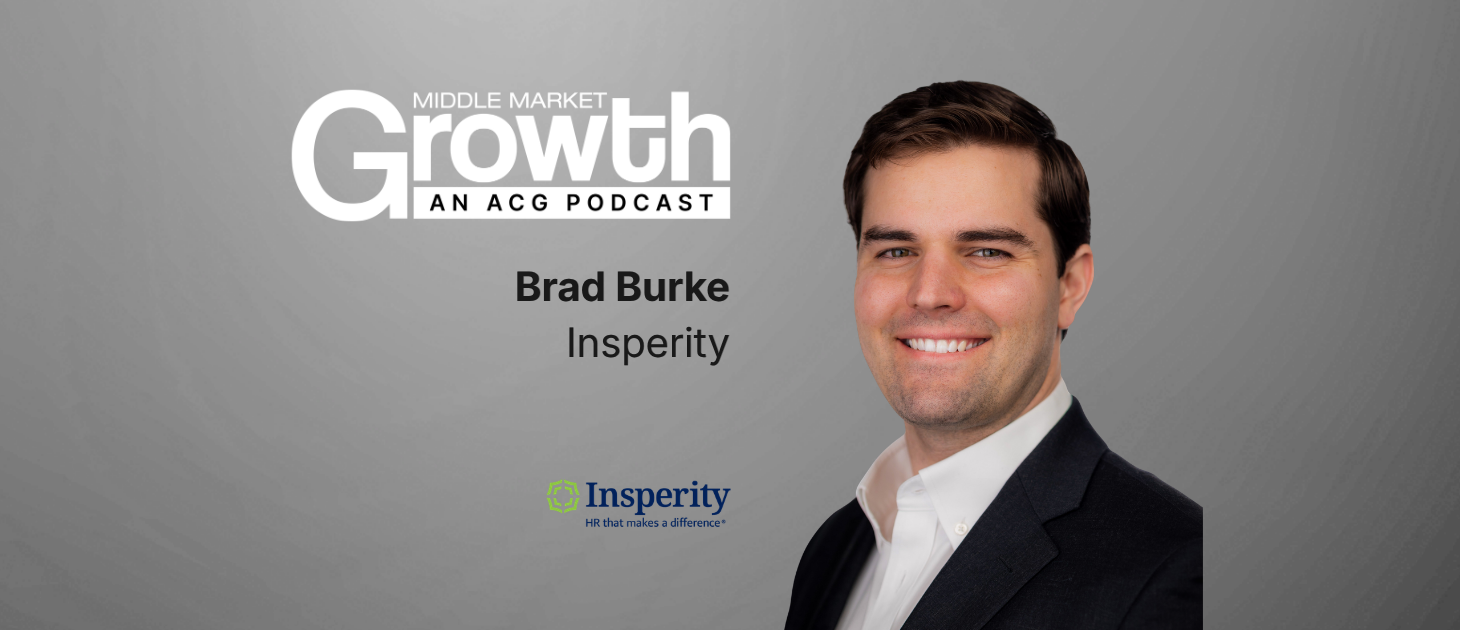
Firms that can respond swiftly to a complicated and rapidly shifting investment environment have a competitive advantage. Creating that agility requires the right human capital strategy, a component that is often overlooked, says Insperity Private Capital Consultant Brad Burke. He joins the podcast to offer tips on enhancing operational agility through people pre- and post-close, how AI plays into the equation, and more.
This episode is brought to you by Insperity. For more information, visit Insperity.com/ACG. Read a transcript of the podcast below.
MMG: Welcome to ACGs Middle Market Growth podcast, I’m Carolyn Vallejo. Responding quickly to a complicated and rapidly shifting environment requires the right human capital strategy. Here today to share strategies for how to execute with agility pre- and post-transaction is Brad Burke, private capital consultant with Insperity. Brad, welcome to the podcast.
Brad Burke: Yeah, I’m great. Great to be here and looking forward to chatting.
MMG: Let’s get to know you first a little bit better. So first, can you tell us about your role at Insperity and what your work focuses on?
BB: Yeah, so I’m a private capital consultant at Insperity, so I primarily work with our private capital or private equity backed companies, and then the private capital firms backing them on their human capital and HR strategies. So my role is mostly about bringing you know, experience and best practices to the table to kind of help their portfolio companies think through their people operations more so strategically so that they can scale effectively without any operational friction.
MMG: And as we ask all of our podcast guests, just for a bit of fun, if you could learn any new skill in 2026, what would it be?
BB: Yeah, not to you know, sound like everybody else, but I’d love to figure out a way to continue to get better about leveraging AI. But more so in my personal life, you know, trying to figure out, maybe figuring out a way to get AI to do my taxes next year, or other things, that’s definitely the goal for 2026.
MMG: You know what, it is a common response, but very fair. AI is definitely permeating all parts of our lives, personal and professional, and we will want to definitely talk about AI later on in the conversation. But today, let’s get started, we’re talking about operational agility and how the right approach to human resources plays into that. So, starting off kind of small, I want to know, how do you define agility when it comes to, say, a private equity firm or an investment bank, and how does that translate into having a competitive advantage in the deal making ecosystem?
BB: I’d say the biggest piece, if you try to really boil it down, is trying to make it so that growth at the portfolio level is never impeded by operational constraints. And I think, you know, a good example of this is. I was recently working with a firm that had made a platform acquisition and they proactively got ahead of their people operations strategy, so that when they just recently went ahead and acquired a couple add-ons, both in Q1, they were able to kind of seamlessly integrate those entities into the existing body rather than becoming a patchwork design of systems and procedures. And what we found is that the traditional model of that kind of patchwork design of what the group can look like after a variety of add-ons is it typically drives inefficiencies, a lack of financial clarity across the, the group as well as also then finally results in operational drag, which everyone’s ultimately trying to avoid as they continue to scale the businesses. So I’d say most firms are pretty much reactive and wait until pre-sale and then before they go to market to clean up that back office. But these guys were able to proactively get that done early so they could keep moving and keep scaling and maintain visibility across the group throughout the whole period.
MMG: So of course, a firm is only as agile and effective as the people it employs. So how can firms tweak their human capital strategy to enhance these qualities, and make sure that they can move quickly? As you just mentioned, it’s so important.
BB: I’d say it really starts with standardizing the people operations at the platform level. Even before closing little things like clearing up compensation structures or benefits frameworks or performance management processes, or even the cultural playbooks of the various groups when you have a foundation that any new team can come in and knows what to expect and able to kind of get up and running faster, that is ultimately a benefit for not only the investors, but also the operators within the group itself. I’d say firms also need human capital expertise in their advisory bench, whether it’s a fractional CHRO or another type of consultant, you need someone that really kind of specializes in this area, just like as if you’re doing any other form of advisory work, whether that’s on the legal or maybe on the revenue and the business development side. What I found is that larger middle-market firms often have this built out through their in-house operating teams, but as we’re seeing a lot of newer, lower middle-market firms or even funds start up, those smaller firms investing in the lower-middle market often skip this, whether it’s just because they have a smaller team and it’s a bandwidth constraint, or they simply run into cost constraints on upfront capital to get these advisors in pre-close. Maybe it’s their first investment out of their first fund, something I’ve just recently seen. But again, these firms will hire other advisory groups as a regular, traditional part of the process, but oftentimes the human capital aspect is overlooked. And I think that’s a mistake because it directly impacts your ability to integrate and scale, which is the ultimate grow of every investment.
MMG: Absolutely. What would you say are some of the most common barriers that you’ve seen when it comes to operational agility and effectiveness?
BB: Ooh. The biggest barrier, I’d say, is probably bandwidth prioritization. I Think smaller PE firms often are constrained. Again, teams (are) kind of wearing multiple hats, so inevitably the human capital hat kind of falls down the stack rank, especially as you’re seeing these teams trying to just get deals done, especially in today’s environment. I’d say the second barrier is a disconnect between the firm’s vision of the exit and the portfolio. You know, leadership’s willingness or ability to execute on these changing in a dynamic environment. I know that we’re all very familiar with the quintessential turnover rate of CFOs of these portfolio companies, but I often think that sometimes these other leadership positions within the leadership group don’t get as much of a spotlight, but have just as much of an impact on the operational efficiencies of these groups. So these firms can have the best investment thesis, but if you’re operating partners and the leadership team as a whole group, not just the CEO and CFO are not bought in or equipped to execute, it really doesn’t matter. You ultimately have some major hiccups or an ultimate failure.
MMG: Now, operational effectiveness of course has always been important, but we are in this era where financial engineering is no longer delivering the returns that it used to. So operational effectiveness is perhaps climbing up the priority list, if you will. How are you seeing that play out in your conversations with clients and, and them talking about some of the challenges that they’re facing?
BB: Yeah, I think, you know, all of us, if you go to any of these, you know, any conference or you go to any thought leadership panel or networking event, you hear that the market has shifted away from strictly financial engineering to more of genuine operational value creation. And I’ve seen that directly with my clients as well. You know, the deals that are performing well are not the ones where someone simply swapped out the management team for someone that they see as more fit and cut the costs in the near term. They’re the ones where the sponsor is coming in and looking for real opportunities to improve operations to help the company grow. These firms are shifting away. You’ll still see the replacement or the addition of new executive leadership, but I think the idea of replacing people at maybe the middle or lower levels is maybe kind of going by the wayside and maybe looking more so towards ways to upskill existing employee base. So you’re not having to deal with as much of the ramping up of new hires, getting to know the people, the strengths, the weaknesses of the organizations, and instead looking at how can you upskill the value and assets that you currently have as part of the business as well as they’re looking at more of a long term operational efficiency as holding periods continue to extend rather than trying to see if you can just finagle the financials over a two to three year period. You really have to look at this as more of a holistic building out of the operations in order to really hit your target when you exit.
MMG: Tell me about add-on integrations and how that can also be a challenge for a variety of reasons. Add-ons have become, you know, more popular. There’s been a higher volume of add-ons in recent years, but I want to know how that is impacting the ability to kind of capture the upside of operational efficiency and how firms can approach those challenges differently to achieve better results.
BB: Yeah, I think most firms focus on what’s easily quantifiable on the front office revenue integration piece and the go to market strategy. And oftentimes, I’m not saying every time, but oftentimes the people operations piece is thought of as an afterthought, which is interesting. Consider you need people to do both. I would say that the firms that try to do both are often the ones that win when you’re integrating an add-on. Most firms will look at, you know, from the people operations piece, benefits from a pure cost angle, but you need to look at it more holistically, are the benefits richer or less rich than the existing platform? How do the cultures of that add-on versus the existing group blend? Especially if you’re looking at owner operated acquisitions where you can no longer, or they can, those employees will no longer value the relationship that they might have had with the prior ownership, especially if it’s over a long tenure. How does the compensation match up against the market? Are you at risk for losing those human assets after closing because they feel like they just got bought up? All of those pieces, I’d say, play into how you make a successful integration post-close. And, I would argue, it’s better to get all of that clarity and evaluation done pre-close, so your OpEx model is more grounded in reality and less guesswork. The adage is, you’re going to find out a lot post-close to what’s actually going on in the business, but the idea is if we can get a little bit more clarity on the people operations side and the human capital side pre-close, it oftentimes allow for more accurate modeling and a cleaner transition post-closing throughout that whole period.
MMG: I want to talk more about this pre- and post, post-close experience because in the private equity world, we often think about them in that binary, pre- and post-close era. Can you break down what firms should perhaps be doing differently in each kind of moment? I want to talk pre-close first and talk about what firms maybe should be doing to set themselves up for operational agility.
BB: Pre-close, I’d say, bring in human capital expertise from the initial onset. You know, even when you’re making that initial data request, it makes it seamless so that you’re collecting all the data up front. And it also allows for your human capital expert or advisor consultant to have more time to truly provide quality feedback. That’s also comprehensive in scope. I’d say like the next piece is map the targets people operations. Again, kind of going back to it, is there a compensation strategy in line with the marketplace, or is that something that might have to be improved? Or is it overly rich compared to what your existing group might look like from the benefit structure? Is it overly rich? Is it scalable? Especially if you’re looking at a platform acquisition, oftentimes you’ll see where these owner operated groups had extremely rich benefit offerings, and that was just the nature of how they went about it, but that’s probably not scalable in the private equity world. So how are we able to create a scalable strategy when it comes to benefits that’s still attractive for new hires, but also not agitating to the existing employee base. And then same thing with like organizational design, so forth.
I’d say a critical piece that is almost like an umbrella is, which firms still focus on I’d say a little bit today, but could go a little bit deeper, is compliance. And it can be a critical red flag in certain especially owner operator situations where businesses that might have grown very quickly or steadily over decades may have swept things under the rug. “Well, if it’s not broken, don’t fix it.” They’ve relied on, again, employer-employee relationships to maybe avoid certain risk exposures, maybe to lawsuits and so forth. Now that that relationship’s been lost, how are we mitigating those downside risks on the maybe workers’ classifications on the 1099s versus W2s situation, which oftentimes comes up? Are there any undocumented policies that might come up? It’s really in situations where you’re inheriting possibly leg legacy liabilities, those issues can be very problematic post-close. And then I would say build your integration plan pre-close so that you’re executing on day one and not figuring it out as you go. I think, and I could talk about it here in a bit, but I think communication during that transition period is very much so undervalued in today’s current space.
MMG: Okay. So a lot of concepts there that touch on your earlier point of being proactive instead of reactive. Tell me about the post-close experience and maybe what firms could be doing differently post-close to set themselves up for operational agility.
BB: Yeah, I think there are two sides of the house on this. There’s the investor that comes in and says, “Let’s quote-unquote ‘rip the proverbial Band-Aid off and put these new systems and processes in place.’” And then there’s the other side of the house that says, “You know what, let’s let it sit for the first 12 months and then we’ll go from there.” I think that it doesn’t have to be one or the other. I think there is a middle ground because post-close, you still need, let’s say for example, you’re speaking about a platform acquisition, you still need those systems and operating procedures, the core infrastructure to be set up in the near term to not delay or impede, again, that growth versus operational capabilities. You need that platform to be able to seamlessly integrate add-ons probably within that first 12-month period in order to avoid that patchwork design. So the idea that you can kind of delay it for a full year before you start stirring up the dust I think is unrealistic and oftentimes inefficient. But at the same time, I think that you can still preserve a lot of the culture that those employees of the company prior to ownership transition will still love. So you can kind of find that blending of the middle ground to get the group or get the company in a position to integrate these add-on acquisitions in the near term while still preserving the culture and employee buy-in immediately after closing. Again, I think the biggest piece is that because you did all that work, ideally proactively before closing, that you’re now able to execute from a position of clarity because you did all that work upfront.
MMG: Absolutely. Going back to kind of the pre-close era, I know that an important focus of your work is on pre-close financials. Could you tell me a little bit about how concepts of operational agility and human capital strategy show up on the balance sheet?
BB: Yeah, I’d say your human capital strategy shows up on the P&L first through your OpEx savings. Typically, for example, just one that was, you know, just a couple weeks ago I worked with a 47-employee platform acquisition, and just by looking at the systems and the benefits, we were able to identify $80,000 or approximately $80,000 in recurring OpEx efficiencies that could be implemented on day one. And then when you scale that across the velocity of add-ons that they’re anticipating throughout that whole period, or you ex, you know, you kind of expand that out to a middle-market company, that figure and impact can multiply rapidly. But the bigger value is honestly financial predictability. Putting strategies in place that let you forecast and control people costs consistently across the hold period is more valuable than just a one-off cost savings, is what I would say on the balance sheet side, it’s more about downside risk mitigation. You know, you’re protecting against compliance liabilities, retention risks of your human capital, and then, you know, integration failures that would otherwise hit your numbers post-close. Again, (laughs) I hate to keep saying the same thing over and over again, but doing this work upfront oftentimes saves money on the upside, those recurring costs, but it allows you to, or gives you more of a predictable, thought-out way to prevent downside surprises in the years to come.
MMG: Now the topic, as we mentioned earlier, that is so important to everybody’s lives and, and professional lives, especially today: artificial intelligence. A lot of what we’re talking today is of course about human capital people first, but it’s inevitable that AI is going to further permeate the middle-market dealmaking ecosystem. So I want to hear your thoughts on how AI and tech more broadly kind of play into this conversation.
BB: I would say that AI in the human capital space specifically, because I do think that it’ll have broad spectrum, to your point, broad spectrum impacts across this space. But I think on the human capital side, AI will mostly help on offloading administrative and compliance. The burdensome small tasks, freeing up your HR, your human capital teams, your COO’s, your CFO’s teams to handling more strategic aspects of operations versus focusing on what county or state or federal legal landscape has changed underneath them that they now need to adjust for. It can be very time intensive. So I’d say I think AI will free up a lot of time for leadership or the existing team, especially if we’re talking about, let’s say going back to that platform example, you’ll have leadership become more efficient, but you’ll also have any existing teams be able to handle larger workloads in a more strategic sense. So you might not have to add as many people as you continue to maybe 2 or 3x the company overall just on the operation side. So I think you’ll be able to see a lot more smaller teams do a lot more, be able to handle much larger, more evolved employee groups for anything on the people operation side. So anything that’s mission critical, like payroll compliance, AI has to be 100% right or it’s 100% wrong. There is no room for error. And until your AI tools reach that point of reliability, I think the real value is pretty modest. We still see, again, kind of going back to using it in personal life, the hallucinations you hear about of making up on where they’re pulling data from. So until those types of refinements or evolutions to what’s actually given out to the, the business world, I think it’s a longer roadmap than people will think for it to be real actionable value creation strictly on the AI side.
MMG: So to close us out, if you could give a listener three actionable steps that they could take immediately today so that their firm could be more operationally agile, what would those steps be?
BB: Yeah, bring in someone on the human capital side, an expert or some advisor pre-close, whether that’s a fractional CHRO or another consultant or a firm like Insperity. You need that perspective from the initial onset of that deal and not just after closing when you’re trying to put together the pieces to get you where you’re going. I think the second piece would be implement those new systems and standard operating procedures in that first a hundred day period. I wouldn’t say do not let that integration drift kind of occur, which can easily happen in a rapid deal environment. So I’d say get ahead of it with a clear playbook that you again, put together pre-close so you’re not operating in chaos. It’s a lot easier. Again, we’re talking about some dental roll-ups that we’ve recently worked on. It’s a lot easier to build out an efficient ecosystem and infrastructure from the onset versus trying to put all the pieces together in an efficient manner once it’s gained in scale. And then third, I’d say build an ongoing communication infrastructure across the organization. This is something that I’ve routinely been working on with my clients over the last couple years from the PE firm. They’re communicating their vision to the leadership team, but oftentimes the leadership team may or may not get full buy-in or clear communications down to middle management, and then that only expands or gets worse as that middle management that might not fully understand the vision tries to communicate that down to their employees. So I’d say if that chain really breaks down that communication chain, everyone really stops moving in the same directions and you lose alignment that really drives that agility. So I’d say focusing on clear communication strategy, upskilling not only your executive suite, but your middle management or your team leaders on communication strategies so everyone is truly driving the same direction is a critical piece of the playbook.
MMG: All right, well, get ahead of it, be proactive, communicate effectively. That’s Insperity’s Brad Burke, thank you so much for being with us on the podcast today.
BB: Yeah, grateful to be here.
This transcript was prepared by a transcription service. This version may not be in its final form and may be updated.
The Middle Market Growth podcast is produced by the Association for Corporate Growth. To hear more interviews with middle-market influencers, subscribe on Apple Podcasts, Spotify or Soundcloud.