Why Manufacturing Execs Are Bullish on 2026
Bryan Wright of Forvis Mazars offers insights into manufacturing M&A
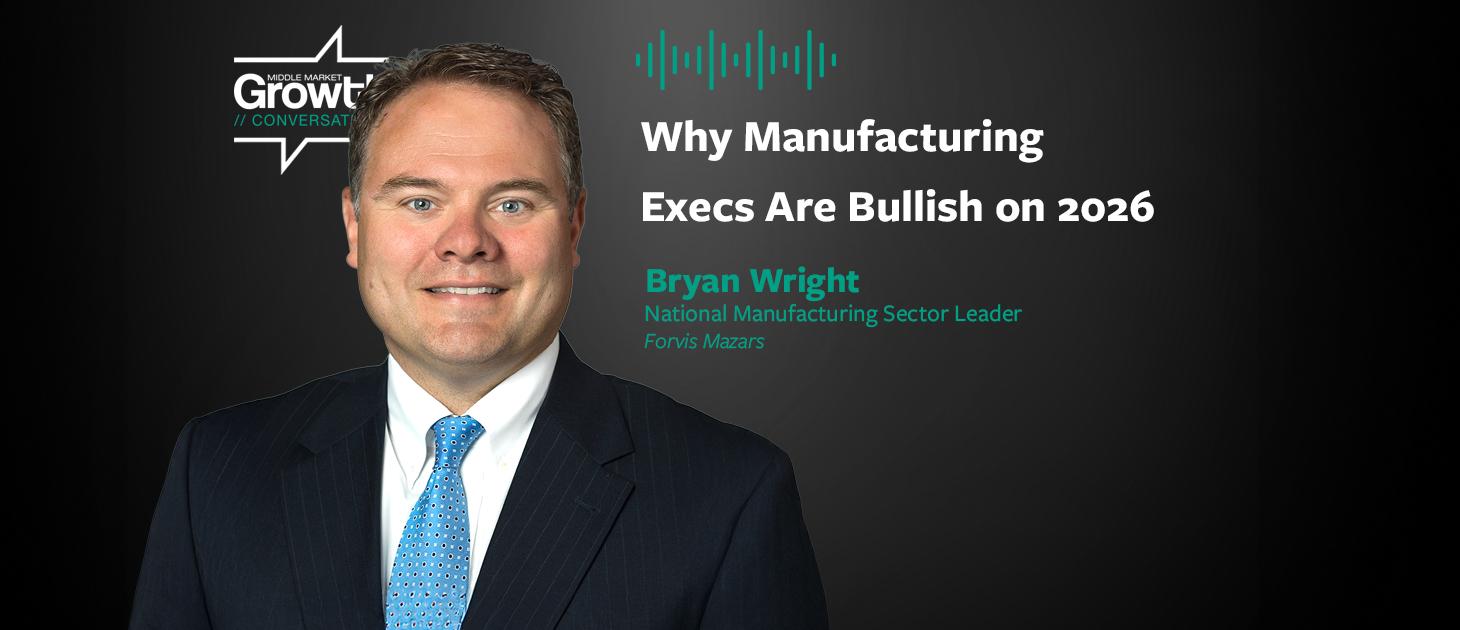
A recent survey of manufacturing executives conducted by Forvis Mazars found strong optimism for future growth, despite supplier price hikes, tariff shock waves, and other pressures. Bryan Wright, national manufacturing sector leader at Forvis Mazars, sits down with the podcast to share what’s driving this positive sentiment, how AI and automation are shaping the sector, and how he sees manufacturing M&A playing out in the year ahead.
This episode is brought to you by Forvis Mazars, a leading global professional services network.
Read a transcript of the podcast below.
Middle Market Growth: Welcome to Middle Market Growth Conversations, a podcast for dealmakers discussing the trends shaping the middle market. I’m your host, Carolyn Vallejo, and this is a production of the Association for Corporate Growth. In a tough M&A environment, manufacturing has remained a resilient target for investors, particularly as sponsors eye value creation opportunities with the integration of AI in the industry. Here to offer a deep dive into the space is Bryan Wright, national manufacturing sector leader at Forvis Mazars. Bryan, welcome to the podcast.
Bryan Wright: Well, thank you Carolyn. It’s nice to be with you today.
MMG: It’s so nice to have you here, and we want to get to know you a little bit better before we jump into our conversation. So, tell me, first, can you talk about yourself and your work at Forvis Mazars?
BW: Yeah, so a little bit about myself. I have been at the firm now and the predecessor firms that have created Forvis Mazars for just over 29 years. And you know, time really flies and during those 29 years, really my focus from a professional standpoint in serving clients has been around the audit practice. So, I’ve done a lot of financial statement audits and as you can imagine, serving now as our national manufacturing sector leader, most of those engagements have been centered around manufacturing companies and I call Indianapolis, Indiana home. So, I’m excited about, you know, our local economy, and I’m excited about really the concentration of manufacturing that we have here in the Great Lakes region. So yeah, it’s been a great experience for me to be at the firm over the vast number of years here.
MMG: And Bryan, what was your first job and a lifelong lesson that you took away from it?
BW: Well, that is really interesting. I thought of two jobs, Carolyn, that were interesting to me. I grew up in a family business and that family business was really home heating and agricultural propane fuel. So maybe people familiar with this part of the country in the Midwest have seen those cylinder kind of shaped propane tanks out in the countryside. And so, it’s really a business that kind of goes back to my grandfather. But so, my first job at really with, at the age of driving was to go around the countryside and make sure those tanks were maintained and paint them, make sure they’re looking nice for the customers. And that was really a great experience for me. It was a lot of, you know, entrepreneurial skills just from the standpoint I had to navigate and connect with the customer and explain kind of what I was doing. There was no cost to them. It was just really cool from that standpoint at that age to be able to lean into that and really see it from the customer’s vantage point of, hey, we’re trying to make your world just a little bit better and provide great customer service. And that was something I learned very early on in that job. The second job was when I was in college, I had the opportunity, probably more of a fun job, but I had the opportunity to go work at a dude ranch in Colorado. And so that was a guest ranch where people brought their families and maybe some of your listeners today have taken their families to dude ranches and there’s a dude ranchers association in the state of Colorado that helps promote that industry. But that was just really a neat experience being up in the mountain environment and really just being with families, helping them go on trail rides and prepare meals and there was an even a camping evening out with the families, which was really fun and pick them up at the airport, and this was the Denver airport, and we’d drive them up to the ranch, which was a few hours away, but that gave me the experience of really working with maybe a different type of client and these are people vacationing and really, they’re interested in this ultimate experience. And I just never will forget that, ended up doing it for three summers when I was in my college years.
MMG: Yeah, it sounds like both jobs were really about interpersonal skills and supporting the customer there.
BW: Yep. No question.
MMG: Well, let’s get into our main topic of conversation today, which is the manufacturing sector. And I can already tell that you’re passionate about this. Forvis Mazars recently published a survey that noted strong optimism among manufacturing executives, so can you tell me a little bit more about those survey findings and the overall outlook for the manufacturing sector that you have?
BW: Yeah, it was a good survey. We were really impressed with the respondent’s feedback. A lot of it was very overwhelming in certain categories and that level of optimism and really expectations. I think 98% reported back and this was over 150 C-suite executives that responded to the survey in U.S. manufacturing and 98% expected sales growth over the next 12 months, which is a pretty optimistic view and was encouraging to us because, you know, in the time period the survey was completed during 2025, there was just a lot of uncertainty with new legislation working through the legislative system here and at that time of the year we had a lot of tariff discussion and there was some real headwinds that manufacturing was faced with. But, you know, I reflect back on that and think about, well, what was maybe driving that optimism? And certainly, from the legislative seat and that new tax act that was signed over the fourth of July holiday that really put in expanded bonus depreciation, made it permanent. And that was a really big impact for manufacturers. Also, changes to allow for immediate expensing of research and development costs that were previously capitalized was a big change. Again, very beneficial to manufacturers. And then some of the changes for deductibility of interest that has a broader impact not just for manufacturers, but particularly for manufacturers that are owned by private equity groups and that tend to have more leverage and interest expense. That was a particularly important change along with many of our clients are structured as partnerships and flow through entities and making sure that pass-through entity deduction, that 20% deduction was made permanent, which was really passed originally in the TCJA era, in the first Trump administration, to better align those C-corp rates with what individuals would pay from income receipt from a passive entity. So, all those things were really, I think, beneficial in driving a lot of optimism here in our respondents and kind of where that was headed at the time the survey was completed. Also, I would note that most of the respondents had felt supplier price increases, whether due to some of the maybe lingering effects of the COVID era and some of the tightening and disruption to supply chains or just tariffs that had actually come through and started to impact material pricing. So nearly a hundred percent of the respondents did report back that they had felt that in the course of the last year. And nearly all of our manufacturing respondents reported that they had felt supply chain disruption in the last 12 months. So both of those kind of aligned. Now, the impact to tariffs itself was only 63%, so about two thirds of the respondents felt that there was a modest increase directly tied to tariffs that were being reflected in their material costs. So, that had not yet worked through the supply chain. And I think there’s still debate now that it’s not yet fully worked through the kind of U.S. economy and what’s being felt maybe by the end consumer. So, all those things were highlighted in the survey, yet we walked away with optimism. And I think one thing that I would point to is the manufacturers were really focused on things that they could control, which is supply chain, and what supplier alternatives that need to be considered and what is more economical and just focus on what they can control along with customer pricing. And certainly, in an environment where there is increase in cost and it’s across the board and your competitors are experiencing it at the same pace and rate, then that opens the door to be able to manage that to a certain degree with what can be passed on to customers. So, I think all those things really drove the level of optimism in the responses that we received from that survey.
MMG: Okay. So it sounds like the manufacturing sector is benefiting from certain tailwinds, most notably perhaps from the One Big Beautiful Bill Act as you mentioned, but it’s not necessarily that they’re immune to a lot of the market pressures, it’s that they’re strategic about how they navigate them and tend to focus, as you say, on what they can control. So, it does sound like they have kind of this strategic roadmap for growth. Can you talk about some of the value creation strategies that manufacturing leaders say they’re prioritizing right now and into the new year?
BW: Yeah, and the survey was really effective in pointing some of that information out, and certainly pricing was near the top of that list and raising prices over the next year, and again, controlling kind of what’s happening on the margin, compression of costs are going up. So that was one item that was highlighted, as well as new product and customer expansion. So, both of those new products and customer expansion and a focus on customer relationships from a standpoint of maintaining their current core business were all highlighted as key strategies that manufacturers had identified and were executing on as well as other areas that they can control around efficiency, reducing scrap, working smarter, not harder, better responsiveness to equipment downtime, and kind of eliminating that impact on their businesses. And then the last thing that I took away from the survey was, hey, M&A is really important as well. And manufacturers, particularly those that are private equity investors, those key add-on acquisitions can really be a strategic move to build in some more economies of scale and really have some smart add-on acquisitions. And that was highlighted as well.
MMG: We’re definitely going to talk about those M&A trends, as you mentioned. But first I want to talk about technology investment in this space, and one trend that we saw from the survey was that investments in ERP software have also emerged as key to this industry right now. Talk a little bit about what’s motivating manufacturing businesses to maybe reevaluate their administrative and financial technologies in the back office.
BW: You know, that’s a great topic, Carolyn, and, and it seems like we talk about it every day here at Forvis Mazars and this is an environment honestly we’ve not seen, and certainly in my 29 years where there is so much conversation, so much focus around good data, quality data, good information systems, and I think what we’re seeing in our client base, what we’re seeing through this survey, they are all aligned, is that we see a lot of middle-market companies, maybe particularly on the lower end of that middle market, that just do not have adequate ERP systems for where they’re at and where their growth trajectory is planned to be. And in order to effectively manage the business, the leaders have identified that as maybe a long overdue area to spend and invest to enhance the business. And we’ve seen that in our manufacturing practice, which is about a third connected with private equity through private equity sponsors. And ownership in our client base is probably more enhanced on the ERP side because what we see is when middle-market companies go through a private equity transaction, there is almost instantaneous board support it seems for enhancing the company driving additional investment. And now you’ve got capital behind the company and really smart business leaders, right, to really support the company and taking on something that can be a pretty big challenge, right? And implementing a new ERP system and selecting the correct ERP system. So, private equity certainly has a very strong hand in helping some of these lower-end middle-market manufacturing companies move forward in that area. So not a surprise to see that result in the survey. And certainly, just a tremendous amount of emphasis around technology and kind of where our U.S. and global economy is migrating towards, so exciting to see that and I’m sure it’ll drive further returns for a lot of these companies.
MMG: So, it makes sense that investments in effective ERP software are helping to boost efficiency in the back office, as you mentioned. You also touched on something I find very interesting, which these businesses are also focused on data and quality of data, which as it turns out, is critical for successful adoption of artificial intelligence, which is another topic of conversation I’d like to kind of go into now. So, tell me about the state of automation and manufacturing and how companies in this space are using AI right now?
BW: Yeah, that’s a really interesting topic and it seems to be the dominating topic of the day, right? You just can’t go a day without hearing and discussing AI and what is happening in your world with AI and what is the impact of automation. So, it is certainly a big theme in manufacturers, and I would tell you, Carolyn, the focus right now is around data. Let’s not jump ahead and get too far down the spectrum with what we’re doing with AI. There seems to be a lot of focus on, well, let’s make sure we’ve got good data that we can make good decisions with, and we can employ some AI tools around that once we’ve got confidence in our data. And so right now what we’re seeing is a very mixed environment. We’re seeing some very, very large manufacturers that are, honestly, pretty far along with AI technology. And really this goes beyond just the back office and the administrative functions, which I think are maybe a little bit more in the low-hanging fruit areas right now, kind of where we’re at from an AI development and rollout in our economy. But we’ve seen some manufacturers really lean in heavily in that operating technology and in the facilities and certainly robotics have been something that have been discussed for ever since I started in this sector 29 years ago. There were large automotive companies that were employing robotics and automation in the manufacturing process, but really just taking it down even a notch into just lower-level type of operating technology around machine downtime, machine functioning, and just things to control maintenance and better efficiency in the equipment. And we’re seeing a lot of just really niche-y areas where technology is driving better information, which can result in better management and better outcomes, right? And that’s really I think the big theme that we’re seeing with our manufacturing clients is a lot of mixed and we’re also seeing some early focus in that administrative function, but then larger companies that are more apt to be leaning in hard around some of the operating technology to really improve their businesses.
MMG: For the businesses in this space that are maybe not as successful in implementing AI yet, or perhaps are just kind of dipping their toes in for the first time, do you have any actionable insights or advice or guidance for these businesses, in terms of how to get started and achieve the goals that they want to achieve? For example, you emphasize the importance of data quality. If a business wants to improve the quality of data, where do they start?
BW: Yep, that’s a great point, Carolyn. And some of that may revolve around ERP implementation, and if you’re in the process of selecting a new ERP system, that better data would be something connected to a new ERP environment. So, for a lot of companies, that’s where they’re at to really harness the data and have better data that they can trust and use around some AI tools. I would say, you know, for companies that are early days and thinking about automation and AI to really have a strategy session around it, and maybe just not only what you want to accomplish, but a strategy session around things like governance. What are we going to allow to be uploaded from our company into maybe web-based AI tools? And there’s just a whole a cadre of tools that are out there. In our firm, in our practice, we utilize Copilot, and so you have to have some controls and security measures that are in place. And you certainly want to be thinking about cyber security as you’re utilizing more and more web-based AI tools and privacy. So, that kind of strategy and security and governance is really, I think, very important not to just jump over that and try to go right to utilization and getting returns because you don’t want to have a situation where you’ve got to backpedal, you certainly hope that you don’t have any sort of disaster recovery incident that’s happened because of perhaps a cyber-attack. So, I just encourage companies that are maybe in that stage to think about that first and set those strategic strategies and do some planning around that before maybe going too far. There’s certainly a lot of opportunity for our private equity investors that are investing in these lower middle market manufacturing companies. There’s just so many manual processes and so many things that are really ripe for automation and particularly in the administrative area. And you can just do a walkthrough of an order entry process, customer invoicing, customer application of payment, and you can find in many, many companies very manual processes. And so I think as companies begin to think about, well, where are we going to get some opportunity from this technology that’s a great place to focus, focus on those processes that are highly, highly manual and where that can be automated, using technology, using different tools that can maybe a lot of times sit right on top of an ERP environment. And I’ve been really impressed with some of the examples that we’ve seen from clients and from some of our team members that they’ve been able to help some of our clients implement some of that technology.
MMG: Let’s talk about human capital for a minute, because as these businesses invest in their technologies, you know, we’re not quite at the point where they’re entirely replacing the need for humans. So talk to me about talent. And I’m particularly interested in the ongoing talent shortage that we have been hearing a lot about from, frankly, all corners of the market in recent years. How is the talent shortage affecting manufacturing and how are successful businesses in this space and their sponsors responding to this talent shortage by improving their recruitment and their worker retention strategies?
BW: Yeah, Carolyn, it’s a great topic and it’s really been, it’s not a short-term problem that manufacturers and other industrial companies have faced in other sectors as well. You know, that was highlighted so clearly during COVID and we had supply chain disruption and there was really a resurgence and levels of demand for consumer products and just everything from housing, just through all the way through it seemed like the value chain and all the way through automotive and other types of equipment that there was just a shortage and products couldn’t be produced quick enough and there was just a lack of skilled labor, right? At the end of the day, firms just could not employ enough workers to produce the products. And a lot of focus during that time period and over the last five years in recruiting and what we’ve seen directly from some of our clients is making sure that manufacturing is represented as a career, as a long-term career. And the National Association of Manufacturers has done a brilliant job in supporting this initiative. And it’s just really, I think too often the default was, you graduate from high school, you go to college, and what we’re seeing a lot of successful firms do is get engaged. You get in those career fairs at the high school level when they’re juniors and they’re thinking about what’s next to be able to present what a career in manufacturing can look like, and maybe it’s a technical degree or some other associate’s degree that gives you the skills that you need to really have a successful career in manufacturing. And we’ve seen that a lot with our clients. And it’s certainly I think helped in addition to some supply chain and other disruptions that have eased coming out of that time period. But the survey did respond that two thirds of manufacturers felt they had adequate workforce currently but still concerned with the long-term kind of workforce development. So I think you raise a great point. It’s probably not an easy solution because ultimately, you’ve got a lot of things that may be driving that including some issues around immigration, right? And being able to just have the quantity and the volume of workers in certain industries that maybe are more labor-intensive and don’t rely on technology as heavily. So, it’s an interesting topic. It’s not easily solved, but I think the recruiting efforts have been effective.
MMG: So, we’ve touched on, in our conversation today, several factors influencing the manufacturing space. Let’s bring it home and talk about how those factors are influencing dealmaking. As I mentioned in the introduction, manufacturing has seen quite a resilient M&A market in recently years, even as other industries maybe aren’t seeing the dealmaking volume they hope to see this year. You mentioned earlier about add-on acquisitions and the popularity of add-ons in this space. Tell me more about M&A trends and manufacturing and what you saw this year and how maybe that’s going to feed into deal making in the industry next year.
BW: Yeah, add-ons are definitely the theme and probably the most prevalent transaction theme that we have seen in our manufacturing client base. Certainly, some platform deals have been completed, but a lot of activity around add-on acquisitions for existing platforms. And I’m kind of leaning back into that private equity space and the manufacturers that we serve there. And you know, one area that also that we’re starting to see some activity around is larger corporations, multinational corporations, F1000 type corporations that are doing carve-outs. And so maybe it’s not a strategic product line for that company. And we’ve had a number of clients that have engaged and really pursued targeted carve-outs that really bring a whole level of different complexity with the information and completing some of those transactions. But they can be really accretive to the value of companies as you bring in and maybe a key product line that is such an enhancement to the existing operations. So just a couple of industries I would highlight that are particularly high in demand right now is anything kind of connected from a manufacturing standpoint to infrastructure and the type of infrastructure that I am seeing with a lot of tremendous upward mobility here is the power transmission side. And a lot of that’s being fueled by data centers. And we could tie back to AI and just other things in our economy, but we have seen a number of examples of companies that are really performing quite well and driving into either maybe planned transactions or planning for further expansion with M&A that are impacted by that infrastructure around power transmission. And it could just be the smallest component that goes into a circuit breaker or an electrical panel all the way through the actual transmission equipment itself. But we’re seeing tremendous growth in demand for products and frankly, we’re seeing that result in higher earnings and cash flow for those companies. And then on the flip side, some industries that maybe have struggled a little bit are those that were so hot during that COVID time period, maybe around some of those consumer durables, I think of kind of some marine products and recreational vehicles. And just those types of examples have definitely felt a pullback. And there’s just a lot of examples of those types of products even in the furniture industry that has seen a pretty significant pullback. And you can point to tariffs, we can point to higher costs, we can point to uncertainty, but I think we can also point to, well, this market was incredibly hot during, you know, post COVID and early to mid-COVID time period. And so there’s just probably been a lack of demand because spending has already occurred. So those are maybe some highlights that I would point out from an industry standpoint as we look into the manufacturing sector a little deeper and see some of those M&A trends and where companies are really focusing maybe some deal market activity.
MMG: It’s an interesting point because manufacturing really is such a diverse market and, you know, one niche might be performing differently than another of course, but it does sound like from what you’re saying and from what the survey revealed, that there is a lot of optimism for the manufacturing sector, both for dealmakers and for the performance of the sector overall next year. So, tell me about your outlook for manufacturing, both for M&A and for the strength of the industry moving forward.
BW: Well, I’d be happy to give you my personal opinion and just take it as that, okay. It’s my personal opinion, but from what I’m reading and what we’re hearing from clients and the survey results and just a lot of different data points, my view of, and I come back to also the legislative environment with the new tax legislation and the focus on making product in the U.S., certainly strategic product that has a ripple effect that can expand out to a lot of different levels of manufacturers as we think of all the components that go into maybe a bigger product that’s being produced or a facility or infrastructure and those type of things. So, I have a very solid growth outlook for the manufacturing sector as a whole in the United States for the next 12 months. Very solid growth outlook. I think, you know, just again, a lot of tailwinds that are helping, and I think we’ve got some clarity, more clarity today around tariffs and some of the trade deals that have been struck with some of the key trading partners, including Europe, that will help maybe calm the waters a bit around trade uncertainty and tariff costs. So, feel pretty bullish, pretty solid on the growth outlook. And I would really translate that down into the M&A environment as well. I think it’s going to be certainly stronger in 2026 from an M&A deal activity then we saw in 2025, and I just point out to the listeners that, you know, the first half of 2025, there was a tremendous amount of uncertainty around tariffs and cost structure. And we didn’t have the tax legislation pass as we got further into the second quarter, we began to get a lot more certainty. So, we’ve certainly seen an uptick in the second half of the year in deal activity and expect 2026 to be much stronger from that standpoint within manufacturing for M&A activity. And I point also to the central bank being less restrictive on its interest rate posture, I think that’ll also drive a more favorable environment with the lower cost of debt and will help fuel some increase in M&A activity. So, a lot of things in the mix, and of course with, you know, middle market companies in manufacturing, succession doesn’t pause for administrations, succession doesn’t pause for the economic outlook, right? So, we know that’s inevitable for businesses that are maybe founder-led right now, founder-owned, and they’ve come to a point from a succession for a need for capital, for an opportunity to grow to the next level that those businesses are very likely to be in the market. So, those are just some items I would highlight, Carolyn, and kind of my views on M&A activity within the manufacturing sector as well as the overall sector outlook.
MMG: All right. An outlook of solid growth. We love to hear it. Bryan Wright of Forvis Mazars, thank you so much for joining the podcast. It was great to speak with you.
BW: Great to be with you, and thank you for the time.
This transcript was prepared by a transcription service. This version may not be in its final form and may be updated.
The Middle Market Growth Conversations podcast is produced by the Association for Corporate Growth. To hear more interviews with middle-market influencers, subscribe to the Middle Market Growth Conversations podcast on Apple Podcasts, Spotify and Soundcloud.